

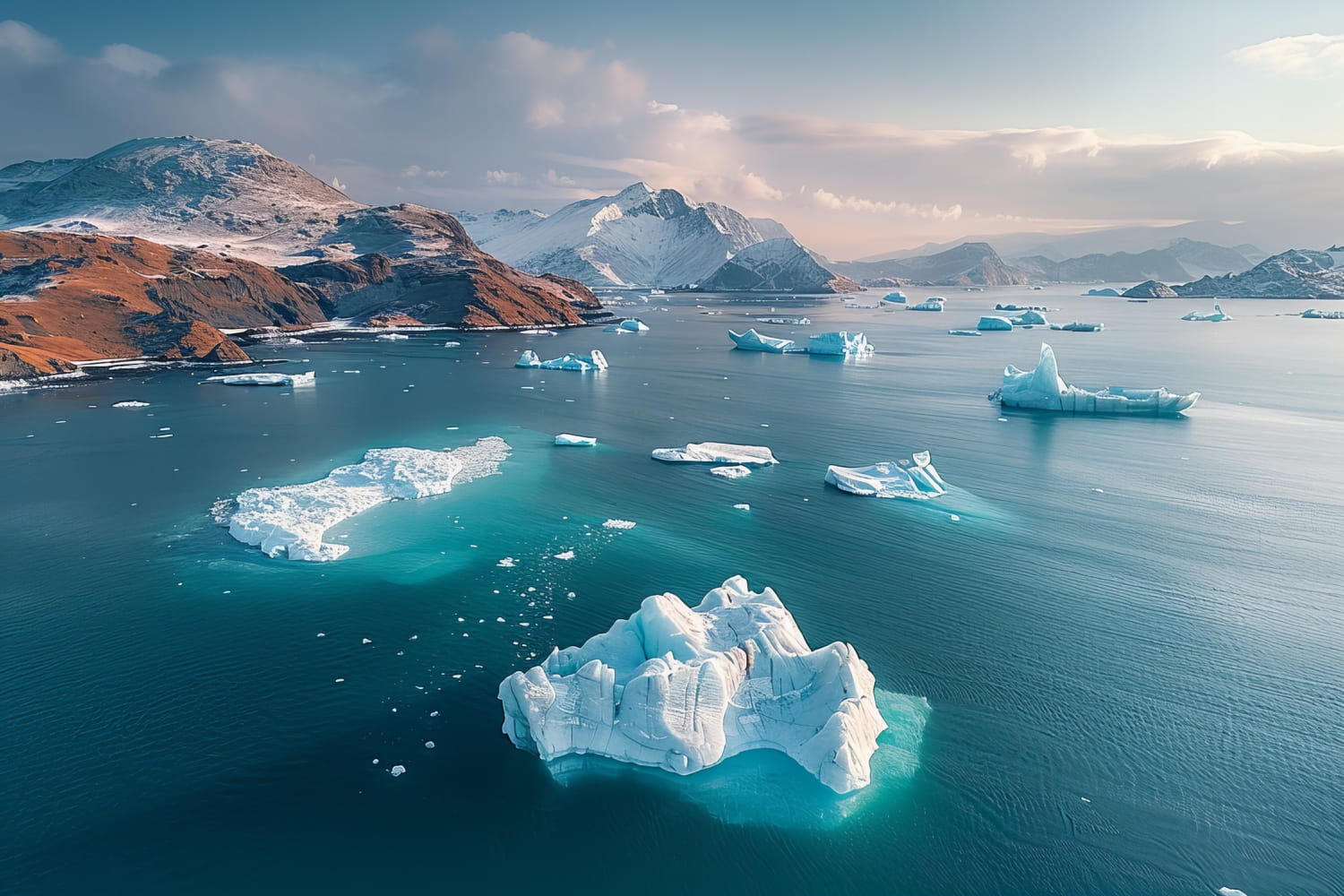



We imagine Greenland as a rigid and immobile block of ice. However, a recent study has revealed a much stranger and changing reality. Miles below the surface, the ice behaves in ways no glaciologist predicted.
We imagine Greenland as an immense white, silent and frozen expanse. Below, at abyssal depths, solid rock and compact ice are expected to be found. But the latest radar images relayed in a recent study tell a completely different story: the deep ice actually seems to be rolling up into giant and complex whirlpools and this would have direct consequences on our cities. Professor Andreas Born, a glaciologist at the University of Bergen, uses a striking image to describe the phenomenon: “it’s almost like a pot of pasta boiling“, he describes in his study published in the journal The Cryosphere. But how can ice, by definition solid and cold, “boil”?
In the bowels of the Earth, heat rises from the Earth’s crust and heats the base of the ice cap. This process, called “thermal convection”, is the same as that which drives the magma in the Earth’s mantle: the ice in contact with the hot rock heats up slightly. Having become less dense, it begins to rise very slowly towards the surface. The colder ice, located above, descends to take its place. This cycle creates spiral-shaped structures (plumes) that take thousands of years to form. It’s a fascinating spectacle, but one that reveals a real fragility.
While these swirls are not new (they date from the last ice age, more than 10,000 years ago), what they tell us about the nature of ice is alarming. Until now, climate models considered Greenland’s ice to be a fairly resilient structure. However, these movements prove that the ice is much more “soft” and sensitive to stress than we thought.
The consequences are colossal. If the ice is softer and more fluid, it may flow toward the ocean faster than expected due to global warming. Greenland contains enough frozen water to raise global sea levels by 7.4 meters over the long term. It’s not just numbers: a sea level rise of this magnitude would redraw the map of the world, threatening to engulf entire coastal cities like New York, Tokyo, Bombay or our French cities like Le Havre or Bordeaux and forcing 40% of the world’s population to leave their homes to take refuge inland. We would be talking about hundreds of millions of “climate refugees”. Obviously, this rise in water levels would not happen overnight: it would take centuries or even millennia.
For Dr. Robert Law, glaciologist and co-author of the study, these ice plumes are like “ancient artifacts” that help to better understand the physics of solid water. These movements do not mean immediate catastrophe, but they are a reminder that our understanding of the ice sheet is still incomplete. At a time when Greenland is already losing its ice at an unprecedented rate (six times faster than in 1990), each new discovery beneath the surface brings us closer to a crucial truth: the “white giant” is much more fragile and unstable than it seems.