






No one saw it coming… but fashion knows how to create a surprise.
Fashion houses often extend their influence beyond clothing alone. Some go into music like Saint Laurentothers in sports accessories like Louis Vuittonthe last, finally, explore an area that we believe – wrongly – reserved for children: games. Remember, not so long ago, Miu Miu had happily reinvented the scoubidou, Jean Paul Gaultier had teamed up with the Bratz doll. Today, it’s the turn of another Italian house to take part in the game.
The luxury label Bottega Veneta thus delivered its own version of a board game that we all played as children. Born in 1983 and published under the license Hasbrohe brightened the daily lives of many generations – from ours to that of our parents. The principle is simple: in a tower built with 54 pieces of wood, the participants must, each in turn, remove a piece and then replace it at the top of the “infernal tower”. The goal? May it not collapse and may we be the last to keep it intact. This game is called Jenga.
When the original is worth around twenty euros on the market, the luxury version signed Bottega Veneta sells for 5,200 euros – or 260 times more expensive. Obviously, this is debated. Some people don’t understand why the price is so high for a game that we all had at home. But let’s look at the materials used, the design of the object and the finishes to understand the price charged.
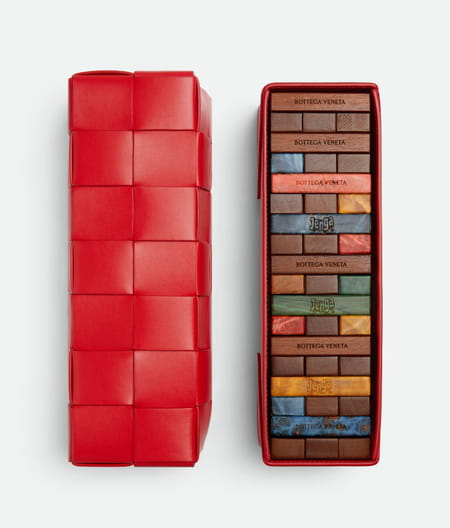
The case that protects the game is made from calfskin. It also uses the iconic braided leather Bottega Veneta – known as“intrecciato” – know-how specific to the house that can be found on all its bags and pouches. The small pieces are made of Italian walnut and wood colored red, blue and green. The detail that kills? The pieces of wood are delicately engraved sometimes with the name of the brand, sometimes with the board game.
As in all universes, the desirability of the label obviously catalyzes the price of the piece. Under the claw Bottega VenetaTHE Jenga thus ends up going beyond a simple board game to become a “beautiful collectible object” intended for aesthetes. The debate is open.