

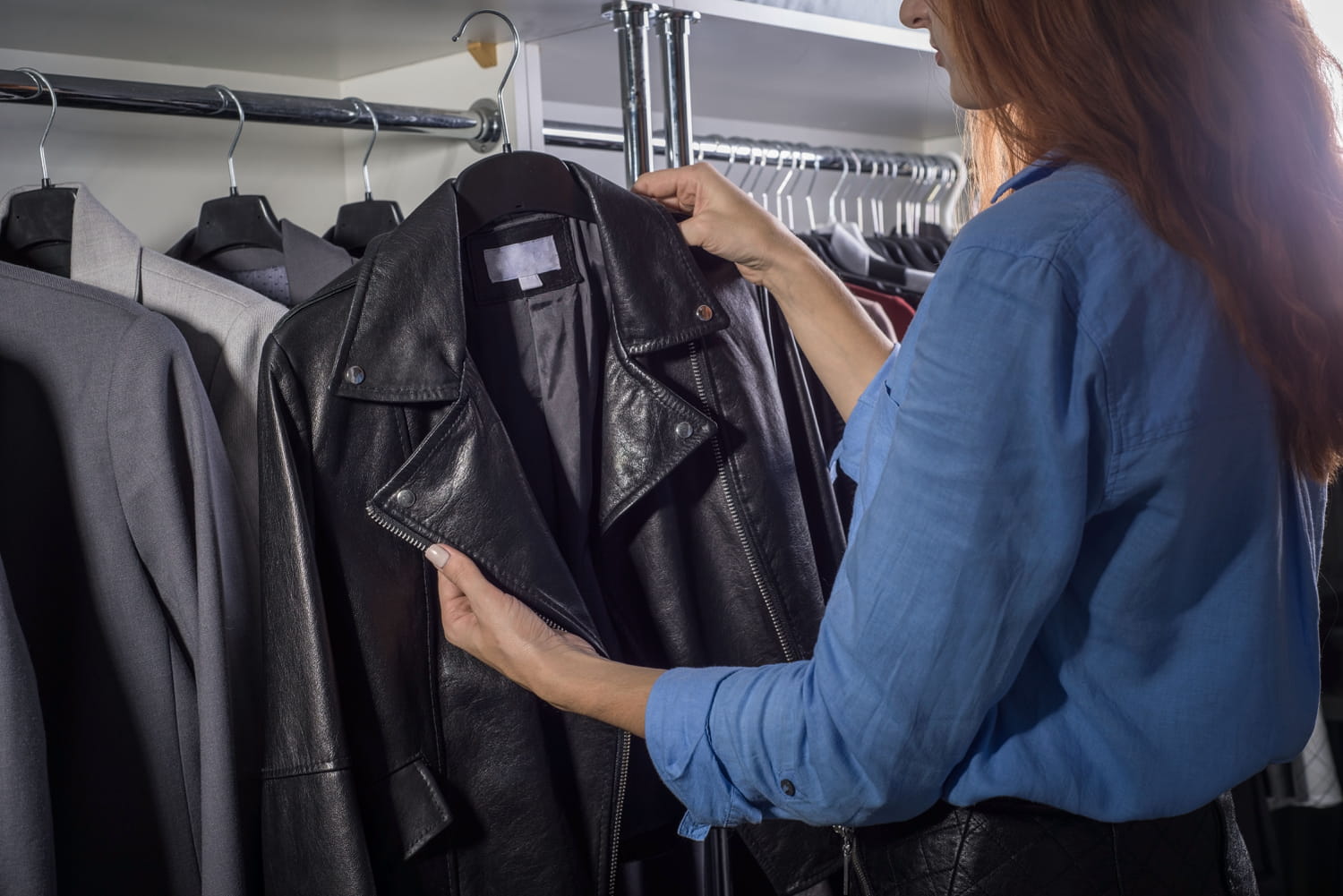



This mention appears on jackets, bags, shoes. It reassures, it gives the impression of a safe purchase and yet, it says almost nothing about the quality of the product.
When you buy a leather jacket or bag, a material adored by stars this season, like Michèle Laroque, you are looking for a piece made to last. We imagine a resistant material, capable of developing a patina over the years. However, not all leather pieces are created equal. And the “genuine leather” label, often perceived as a reliable benchmark, actually fuels confusion.
Professionals in the sector regularly point out that this mention does not give any information on the origin of the hides, the tanning conditions or the level of finishing. It also does not specify which part of the skin was used, even though it is a central point. The top layer, called full grain, retains the skin’s natural surface with its original pores and texture. It is stronger and more breathable. Conversely, other leathers are sanded, corrected, covered with a coating or a pigmented layer to standardize their appearance.
The consumer is generally accustomed to seeing perfectly smooth leather, without marks or variations in color. This search for uniformity encourages manufacturers to heavily rework the surface. Once coated or embossed, it becomes difficult to judge what is really underneath. Two products can then display the same statement on their label while presenting very different durability.
Certain expressions further add to the confusion. An indication such as “made in Italy” describes the place of assembly or processing, but it does not guarantee the quality of the skins or compliance with specific environmental or social standards. For its part, the name “vegan leather” fuels another misunderstanding. By definition, leather comes from tanned animal skin. So-called vegan alternatives are generally made of synthetic materials, often plastic, even if their marketing presentation may suggest a direct equivalent.
Concretely, “genuine leather” only means that the product is made from animal skin and not from a synthetic material. It does not correspond to any recognized quality category and is not subject to any precise specifications. Both high-end leather and more basic leather can therefore carry exactly the same label.
Knowing how to read clothing labels is essential to assess the quality of what you buy, and leather is no exception. Good leather is not perfectly uniform. Slight irregularities in grain or color are normal. To the touch, the material must be flexible, neither rigid nor cardboard. Over time, well-crafted leather develops a patina and softens, instead of cracking or flaking. The smell can also give a signal: natural leather does not give off a strong chemical scent.