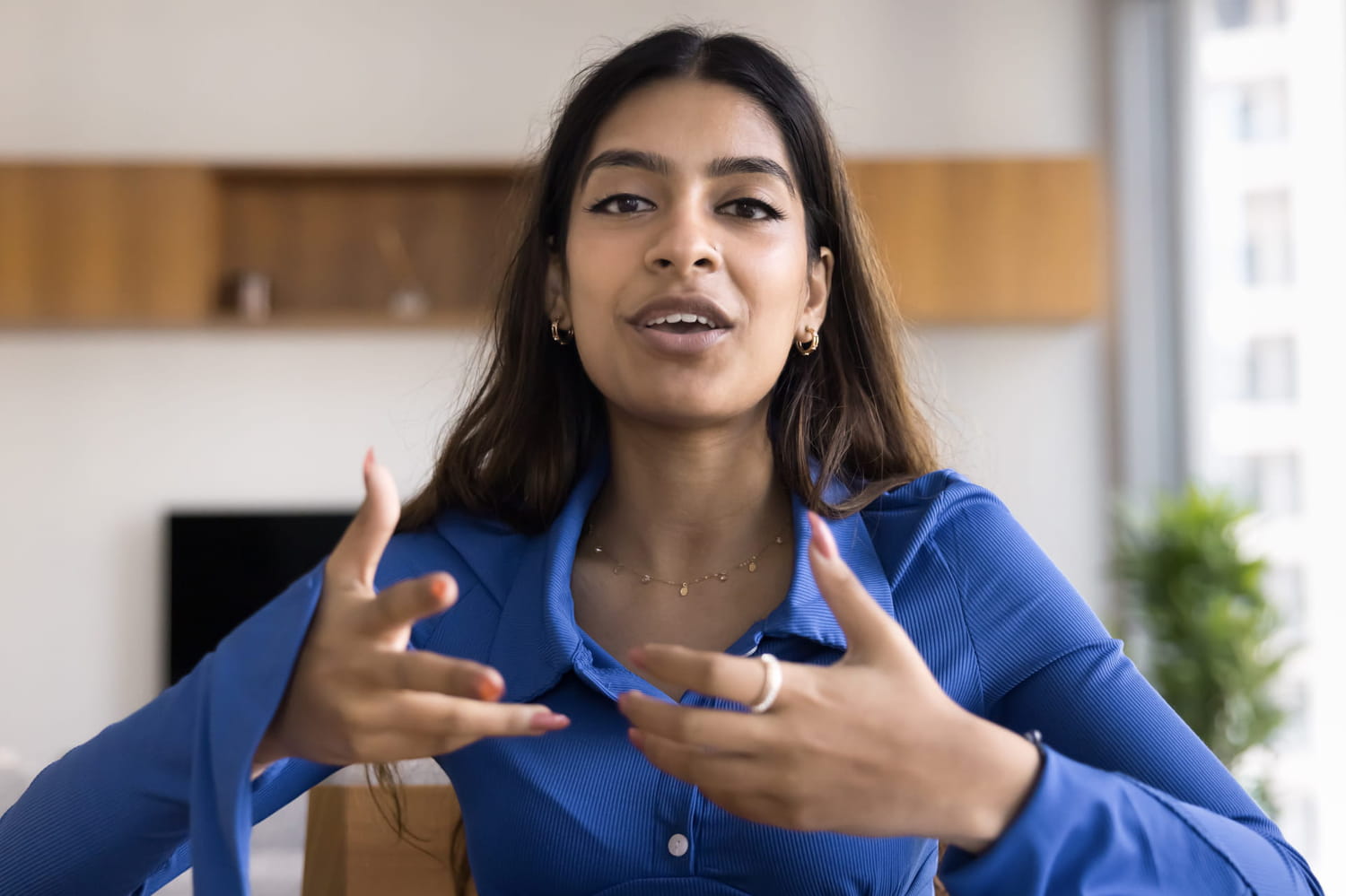




“People who are confident in themselves, their thoughts or their beliefs often use a gesture to punctuate their words,” according to a famous psychologist and former FBI agent.
In psychology, we often give more importance to words than to gestures. However, gestures are a direct mirror of personality. Unlike spoken language, which is filtered by the neocortex (the reflective part of the brain), gestures are controlled by the limbic system, the seat of emotions. This is why she is more spontaneous and more “honest”. For example, tilting your head slightly while listening to your interlocutor is the sign of an empathetic and curious personality, touching your face reflects an anxious or cautious personality…
“Charismatic individuals use their hands to “draw” their ideas. And the more the gestures are synchronized with the rate of speech, the more the person is perceived as honest and intelligent. When there is a lag (the hands move after the words), the listener’s brain detects dissonance, which instantly destroys charisma“, explain Professor Marvin Karlins, psychologist and Joe Navarro, former FBI agent specializing in counter-espionage and behavioral analysis in their book “These gestures that speak for you” (Ixelles Editions). A scientific study confirms this: after having analyzed thousands of hours of speeches and conferences, a team of researchers discovered that the speakers considered the most charismatic used on average 465 hand gestures in 18 minutes, compared to only 272 for the least charismatic (so twice as much).
Among these gestures, there is one typical of charismatic people. “People who are sure of themselves, their thoughts or their beliefs often use a gesture to punctuate their words”continues the psychologist. It’s about “Lhe pyramid (joining the fingertips together in the shape of a steeple) (which) is perhaps the most powerful gesture of trust we know. It is almost universal. According to the FBI agent, it’s a gesture that requires no effort and instantly communicates: “I know what I’m talking about.” This simple gesture, used by the greatest leaders, instantly projects an image of competence and serenity. But be careful, if it is used too rigidly or too high (for example in front of the face), it can become a sign of arrogance. “Charisma lies in the low pyramid, performed at the waist or chest level.“
To increase their overall charisma, the greatest speakers use three other psychological levers. First of all, the look: don’t break eye contact when you finish your sentence. Many people reflexively look down as soon as they stop talking, which betrays micro-insecurity. Then, the smile. When you greet someone, don’t immediately smile. Look at the person for half a second, then let the smile gradually take over your face. This slight shift makes your smile seem like a specific, authentic reaction to that specific person. The instant smile can seem automatic, even false (“polite” smile). Finally, language.
Charismatic people talk less about themselves and more about others. Instead of saying “I think this idea is good”, say “You are right to emphasize this point, it allows us to…”. The most charismatic word for your interlocutor remains their own first name. Integrating it naturally into the conversation (without overdoing it) instantly activates the pleasure zones in his brain.