






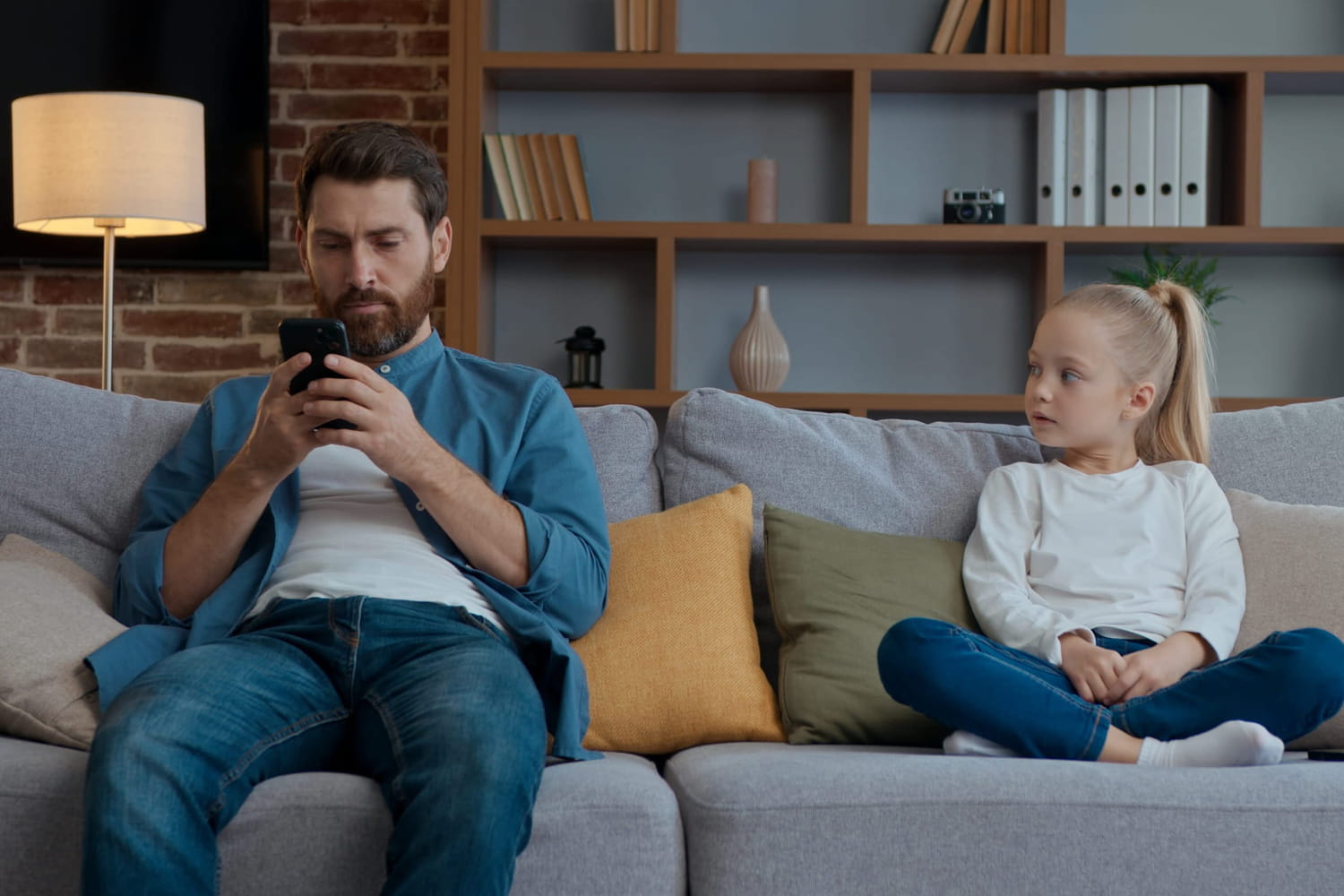
Every day, we look away from our children and offer it to a screen. This gesture, which has become a reflex, nevertheless hides a painful reality for their development, explains a psychotherapist.
We all know this scene: a professional email that appears, a video that scrolls on a social network, or a discussion started that absolutely must continue. Whether it’s a real emergency or a simple mechanical habit, our smartphone has become an extension of our hand. We have a hard time doing without it, to the point that this gesture turns into an automatism, including during these precious moments when we should be fully present as a family, with our children.
Examples of this fragmented daily life are everywhere. It’s that father or mother, sitting on a park bench, who doesn’t take their eyes off the screen while their little one is playing, even if it means forgetting the basic safety rules. It’s that family dinner, at the table, where the phone placed near the plate vibrates and captures all the attention. Worse still, it’s that moment when the child asks a question, seeks validation or reassurance, and hits a wall: the parent, totally absorbed, doesn’t even hear him. English speakers have given a very precise name to this phenomenon: “phubbing“, a contraction of phone and snobbing to speak of the act of royally ignoring a natural person for the benefit of their screen.
Interviewed by the media HuffPost UK, psychotherapist Anna Mathur sounded the alarm on the impact of this bad habit on young people. Beyond setting a bad example when it comes to excessive screen consumption, we are sending a terrible signal to our children: we are showing them, unconsciously, that they are less important than a simple TikTok video or a news feed. The psychological consequences are, however, profound. “Children learn their own worth through their parents’ attention. When the phone consistently wins the competition to capture our gaze, children can begin to absorb the message that they are less important, less interesting, less worthy of attention than whatever is on that screen“, explains the therapist. Ultimately, this lack of visual attention directly affects the child’s self-esteem, his ability to regulate his emotions and alters the quality of his relationships with others… After-effects which can continue until adulthood.
To break this vicious circle and relearn how to let go of our screens, Anna Mathur offers concrete and easy-to-implement advice. In particular, she suggests the use of blocking applications to make access to the phone physically impossible during the time slots when children come home from school. If you absolutely have to use your phone for a specific task, such as shopping online, the therapist advises verbalizing our action out loud: “I’m just adding something to the shopping list.” This creates a form of accountability and avoids drifting towards social networks. Finally, she recommends recreating physical distance with the device by leaving it in another room or on the kitchen counter rather than in your pocket.
Also, it is not a question of blindly blaming parents, who are often overwhelmed by the mental load of modern life. As the therapist kindly reminds us, “Phubbing is rarely a sign that a parent doesn’t care about their child. It’s a sign that we are all navigating a technological landscape that our brains and bodies were not designed for”. However, awareness must lead to action. The therapist invites us to make a simple but infinitely powerful commitment: when your child enters the room or begins to speak to you, look up, fix their gaze and manifest your presence. “It takes three seconds and it tells them absolutely everything about their place in your world.”