





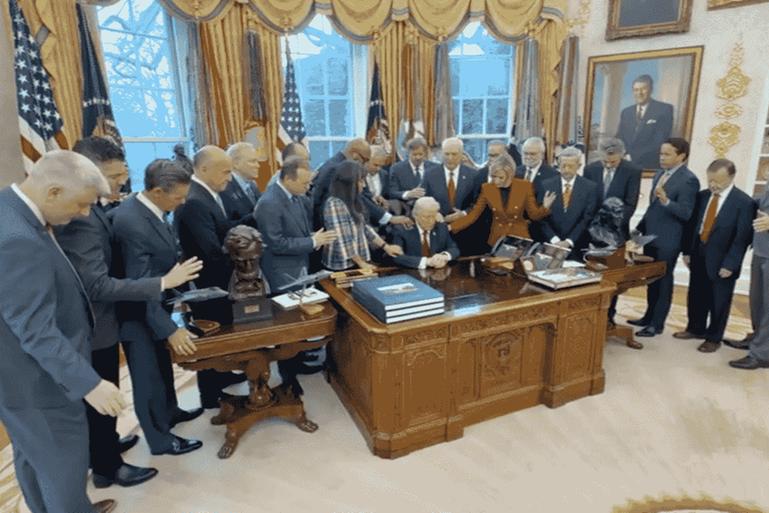
The image is not new. Change the color of some clothes and the position of some of the evangelical preachers who bless the president Trump who, absorbed in prayer, occupies the center of the scene. From the side, very visible but this time in a showy red dress, is the shepherdess Paula Withe Cainanimator of the Faith Office established in the White House at the beginning of Donald Trump’s second term.
Same choreography as almost two years ago, but the context and content are different. Then it was a question of reassuring the evangelical people who with great conviction had supported the President in his return to White House. The commitment was to keep the promises made during the election campaign: making America great again (MAGA), but also making America Christian again (MACA).
Against woke and gender ideology, against the fumes of political correctnessthe President wanted to give public testimony to his adherence to a national, conservative, moralizing and patriotic public religion. The one that for decades, at least since the times of Ronald Reagan, it was claimed by the Religious Right.
On this occasion, however, the court of preachers gathers around the President to invoke blessing on the Supreme Commander, at the head of an army engaged in a war.
Prayer is political and asks for God’s help for victory against evil forces. The theological genre is that of Christian nationalism, of a religious patriotism that celebrates the destiny of a nation that he places himself before God in the awareness of his election and his particular role in the community of nations. It is the theological version of an exceptionalism that has its roots in American history but which, over time, has been balanced by other principles and other norms. For example, the separatist ones between the State and religious communities, divided – according to the famous statement of Thomas Jefferson – by a wall of separation that protects the freedom of believers on the one hand, and the secularity of institutions on the other.
This vision is under attack today, threatened by a fundamentalist vision which ignores the religious and confessional pluralism of America today.
The image of the President at the center of an altar on whose head the hands of those who blesses it rise it is the icon of a religious nationalism which excites patriotic feelings which, in times of war, they have nothing to do with the Christian message of peace.