



More than four years after the start of large-scale war, Ukraine is now one of the countries most contaminated in the world by mines and unexploded ordnance. It is estimated that a third of all national territory is potentially contaminated, since February 2022, when the invasion by Russia began, more than 1,300 people have been injured, including at least 135 children.
Mines and unexploded ordnance represent one of the most lasting legacies of conflict. Even after a war is over, their impact continues for years, limiting freedom of movement, access to education and the ability to live in safety.
Mines are sneaky, insidious, extremely dangerous traps: they are placed in the ground very easily, they are often hidden and not very visible, and removing them requires long work, complex and also very expensive. In Ukraine they have devastated the agricultural sector, rendering much of the country’s fertile arable land unusable. The vast majority of mine victims are civilians.
Children are the most vulnerable subjects, those who risk the most: they return to live in areas damaged or previously occupied by the Russians, where they attend potentially contaminated schools and open spaces, they are curious, they do not realize the traps, they play in contexts where they have no possibility of recognizing and avoiding the risks.

A woman in the Mykolaiv region uses a metal detector to find landmines in a plot near her house.
(REUTERS)
Mines and unexploded ordnance are «a widespread and often invisible threat that continues to strike even far from the front line», he observes Piero Medacountry director in Ukraine of WeWorldan Italian organization that works to guarantee the rights of women, girls and boys in over 20 countries. «It is essential to work with children: will grow up in a country where these risks will be part of daily life, and they must have the tools to recognize them and protect themselves.”
On the occasion of International Mine Awareness Day, which occurs on April 4, WeWorld reminds us that it is necessary to strengthen the commitment to interventions that put the protection of civilians and, in particular, children at the centre.
In the southern regions of Mykolaiv and Kherson, together with the local partner PHK, WeWorld carries out educational activities that today reach over 10,800 people, including children and adults. For the little ones, methodologies suitable for their age are used: games, stories, songs and interactive materials help to recognize dangers and adopt safe behaviors, without generating fear. At the same time, teachers, parents and communities are involved to strengthen the dissemination of correct information and safety practices.
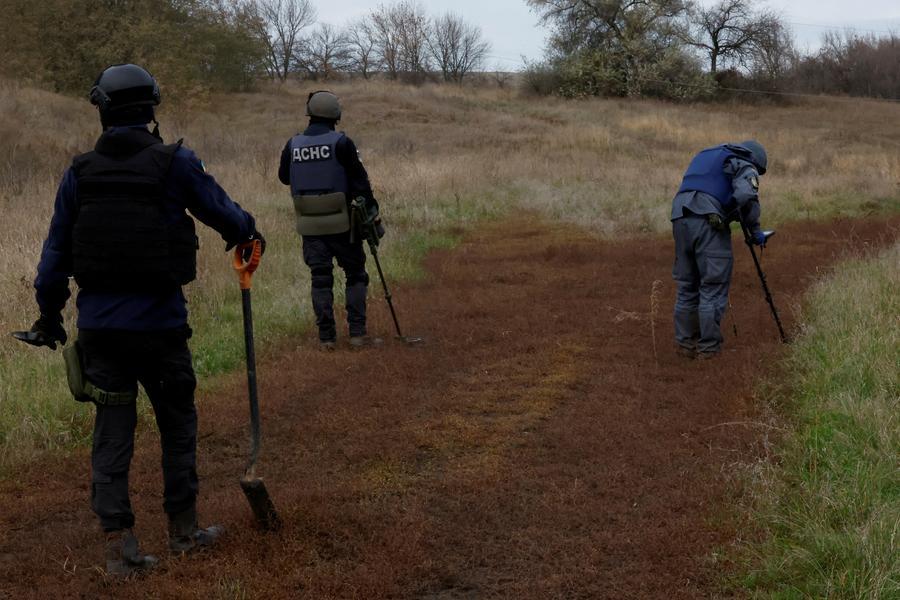
Alongside educational work, humanitarian demining operations continue. In Ukraine today, women increasingly perform the work of deminers (three times more than in 2021), engaged daily in the reclamation of agricultural land, roads and residential areas, because most of the men are engaged as soldiers at the front, and many have died. Thus women find themselves taking the place of men in many tasks and jobs that were previously traditionally male (for information on WeWorld visit the website).
Also Cesvi Foundation – active in Ukraine with various reception, protection, psychosocial support and reconstruction interventions in the eastern regions of Kharkiv and Sumy – is engaged in activities against mines and unexploded ordnance. As he explains Stefano Pizialigeneral director of Cesvi, «with the project Safe Stepsthanks to the support of the Italian Cooperation, we guarantee a safe return to the liberated areas, promoting awareness and psychosocial support, essential to address the challenge of mine contamination. One of the objectives is to inform communities at risk about the dangers of explosive devices and correct behaviour” (for information on Cesvi visit the website).
The international mine ban treaty (Ottawa Convention), signed in 197 and entered into force in 1999, has been ratified by more than 160 countries (including Italy). The Russian Federation, China and the United States did not join. In 2025, with the ongoing war in Ukraine, some Eastern European countries and Ukraine itself announced their intention to leave the treaty.