
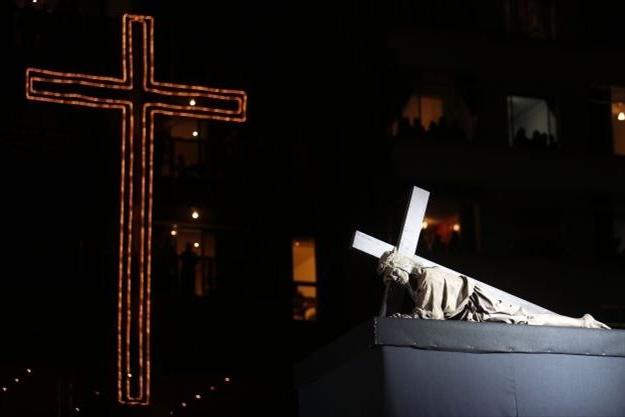



It has deep roots. And it crosses time. The Via Crucis is a rite very dear to popular devotion that intertwines the Word of God, history and prayer. It recalls the last stretch of the journey traveled by Jesus during his earthly life: from when he and his disciples, “after singing the hymn, went out towards the Mount of Olives” (Mk 14, 26), until the Lord was led to the “place of Golgotha” (Mk 15, 26), he was crucified and buried in a new tomb, dug into the rock of a nearby garden.
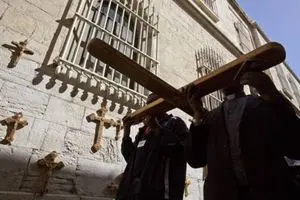
The Church of Jerusalem very early showed its attention for the “holy places”. Archaeological finds attest to the existence of expressions of Christian worship as early as the second century AD, in the cemetery area where the tomb of Jesus had been excavated. At the end of the 4th century, the pilgrim Eteria gives us news of three sacred buildings erected on the top of Golgotha. And he informs us of the procession that on certain days took place between two of them, more precisely from the Anastasis to the Martyrium. In truth, it was not a Via Crucis or a Via Dolorosa. Nor was that sort of journey through the sanctuaries of Jerusalem, which can be deduced from the various “travel chronicles” of the pilgrims of the fifth and sixth centuries. But that procession, with its songs and its close link with the places of the passion, is considered by some scholars to be an embryonic form of the future Via Crucis.
Jerusalem is the city of the historical Via Crucis. It alone has this great tragic privilege. Throughout the Middle Ages, the fascination of holy places aroused the desire to reproduce them in one’s own land: some pilgrims, upon returning from Jerusalem, “rebuilt” them in their cities. The complex of the seven churches of Santo Stefano in Bologna is considered the most notable example of such “reproductions”. But there is also Kalwaria Zebrzydowska, in Poland, about 40 kilometers from Krakow and 15 kilometers from Wadowice, birthplace of John Paul II.
The Via Crucis, in the current sense of the term, dates back to the late Middle Ages. Saint Bernard of Clairvaux (1090-1153), Saint Francis of Assisi (1182-1226) and Saint Bonaventure of Bagnoregio (1221-1274) prepared the ground on which the pious exercise will arise. To the climate of compassionate piety towards the mystery of the Passion we must add the enthusiasm raised by the Crusades which proposed to recover the Holy Sepulchre, the resurgence of pilgrimages starting from the 12th century and the stable presence, since 1233, of the Franciscan Friars Minor in the holy places.
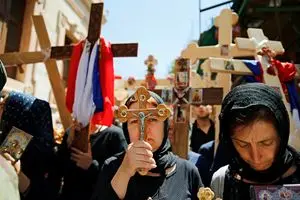
The Way of the Cross of the Orthodox faithful on Good Friday 2023 in Jerusalem
(Reuters)
From the Holy Land to “European devotions”
Towards the end of the thirteenth century, he reminds us of the specific site of the Holy See in which Monsignor Piero Marini, Master of the pontifical liturgical celebrations, reconstructs its history with scientific rigor, the Via Crucis is already mentioned, not yet as a pious exercise, but as a path followed by Jesus in the ascent to Calvary and marked by a succession of “stations”. Around 1294 a Dominican friar, Rinaldo di Monte Crucis, in his Free peregrinationis he states that he ascended to the Holy Sepulcher «per viam, per quam ascendit Christus, baiulans sibi crucem», and describes the various stations: Herod’s palace, Lithostratus, where Jesus was condemned to death, the place where He met the women of Jerusalem, the point where Simon of Cyrene took upon himself the cross of the Lord. And so on. Against the background of devotion to the passion of Christ and with reference to the path taken by Jesus in the climb to Mount Calvary, the Via Crucis, as a pious exercise, was born directly from a sort of fusion of three devotions that spread, starting from the fifteenth century, especially in Germany and the Netherlands: devotion to Christ’s falls under the Cross; up to seven are enumerated; the devotion to the painful paths of Christ, which consists in the processional march from one church to another in memory of the paths of pain – seven, nine and even more -, completed by Christ during his passion: from Gethsemane to the house of Annas (cf. Jn 18, 13), from this to the house of Caiaphas (cf. Jn 18, 24; Mt 26, 56), then to Pilate’s praetorium (cf. Jn 18, 28; Mt 27, 2), at the palace of King Herod (cf. Luke 23, 7); and devotion to the stations of Christ, to the moments in which Jesus stops along the way to Calvary either because he is forced by the executioners, or because he is exhausted by fatigue, or because, moved by love, he still tries to establish a dialogue with the men and women who often participate in his passion.
In the long process of formation of the Via Crucis, two elements should be noted: the fluctuation of the first station of the Via Crucis and the variety of the stations themselves.
As regards the beginning of the Via Crucis, historians point out at least four different episodes, chosen as the “first station”: 1) Jesus’ farewell to his Mother; it is a “first station” which does not seem to have had a wide diffusion, probably due to the problematic biblical foundation; 2) the washing of the feet; this “first station”, which takes place in the context of the Last Supper and the institution of the Eucharist, is attested in some Via Crucis from the second half of the 17th century, which enjoyed widespread success; 3) the agony of Gethsemane; the garden of olive trees, where Jesus, in extreme and loving obedience to the Father, decided to drink the chalice of passion to the last drop, constitutes the beginning of a Via Crucis of the 17th century, short – it includes only seven stations -, notable for its biblical rigor, spread above all by the religious of the Society of Jesus; 4) the condemnation of Jesus in Pilate’s praetorium, a very ancient “first station”, which effectively marks the beginning of the last stretch of Jesus’ journey of pain: from the praetorium to Calvary.
The subject matter of the stations was also varied. In the fifteenth century the greatest diversity still reigned in the choice of their number and order. In the various schemes of the Via Crucis there are stations such as the capture of Jesus, the denial of Peter, the flagellation, the defamatory accusations in the house of Caiaphas, the mockery of the white robe in Herod’s palace, which do not figure in what will become the definitive trace. The Via Crucis, in its current form, with the same fourteen stations arranged in the same order, is attested in Spain in the first half of the seventeenth century, especially in Franciscan environments. From the Iberian peninsula it passed first to Sardinia, then under the dominion of the Spanish crown, and then to the Italian peninsula. Here he met a convinced and effective propagator in San Leonardo da Porto Maurizio (+ 1751), friar minor, tireless missionary; he personally erected over 572 Via Crucis, of which the one erected in the Colosseum, at the request of Benedict XIV, on 27 December 1750, in memory of that Holy Year, remains famous.
The current ritual
The 14 stations of the Via Crucis, in the definitive form that has come down to us, are the following: 1) Jesus is condemned to death 2) Jesus is loaded with the cross 3) Jesus falls for the first time 4) Jesus meets his Mother 5) Simon of Cyrene helps Jesus to carry the cross 6) Veronica wipes the face of Jesus 7) Jesus falls for the second time 8) Jesus warns the women of Jerusalem 9) Jesus falls for the third time 10) Jesus is stripped of his clothes 11) Jesus is nailed to the cross 12) Jesus dies on the cross 13) Jesus is taken down from the cross 14) The body of Jesus is placed in the tomb.