






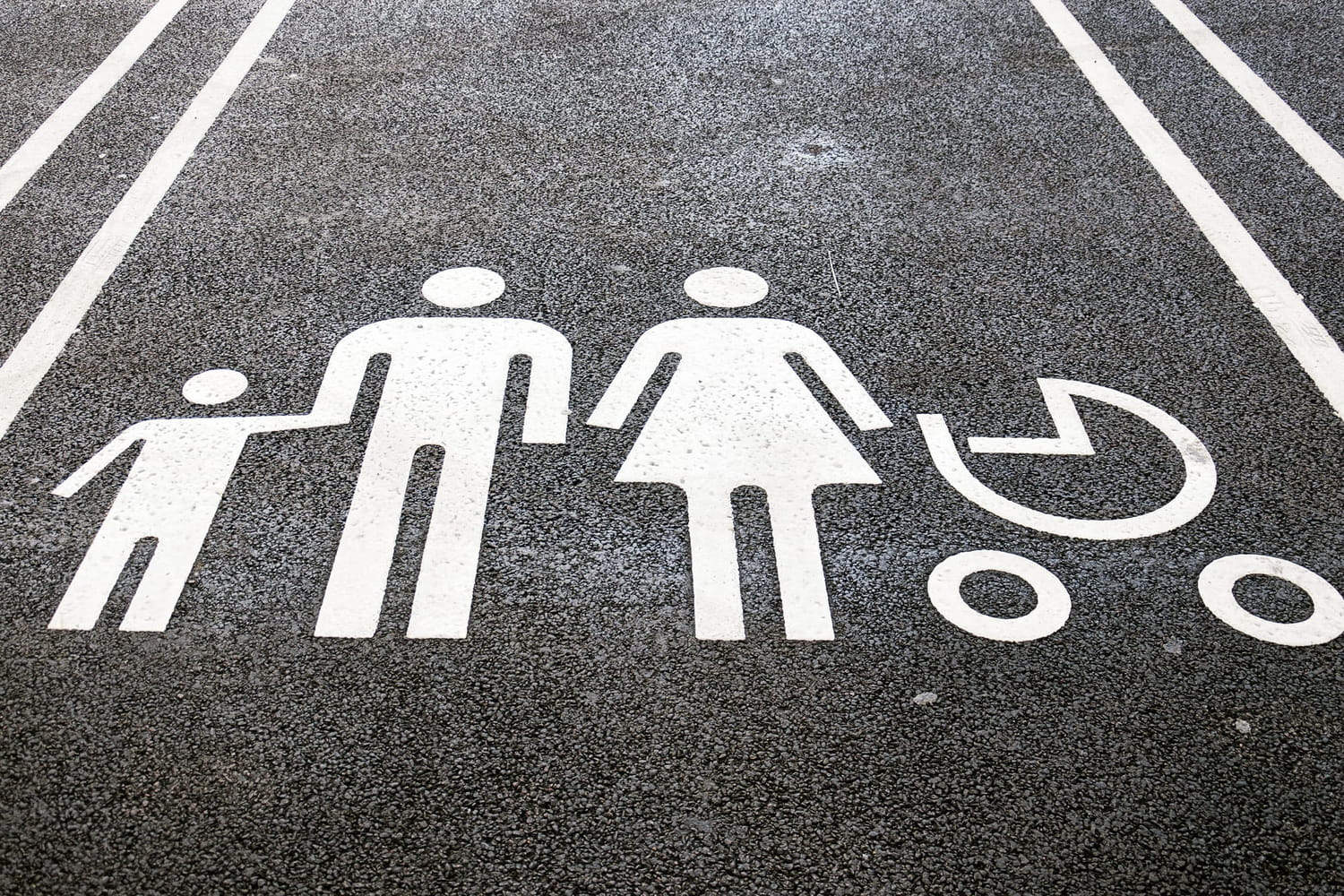
Wider, closer to the entrances… “Family” spaces have been flourishing for several years in the parking lots of supermarkets and shopping centers. But are they really reserved for parents with children? Between the vague legal framework and the growing anger of families, the reality is much more surprising than it seems.
Widely democratized in the early 2000s, so-called “family” parking spaces have become a standard in the parking lots of large stores and shopping centers. Recognizable by their marking on the ground, their pictogram representing a stroller or the silhouette of a child, and their strategic location near the entrance to stores, they meet a very concrete need. Wider than traditional slots, they allow parents to open the doors wide to place baby in their car seat, remove a stroller from the trunk without hitting the neighboring car, or even help a young child to climb into the passenger compartment in complete safety. “It’s not easy to take out the baby carrier when you only have a few centimeters to open the door“, confirms Léa, young mother. For pregnant women, these few extra centimeters are also essential to enter and exit the vehicle without difficulty.
Except that these places, although explicitly marked, are regularly occupied by single motorists, without children on board. A situation which exasperates many parents looking for a suitable parking space, as evidenced by the numerous exchanges on social networks. On the Reddit forum, a young mother shares her annoyance: “I hate it when people park in these spaces without children. This is so selfish and inconsiderate. Before I had my son, I never parked there“, she writes. Some Internet users denounce the lack of civility among motorists without children, while others question, more pragmatically, the real legality of these locations.
So, what does the law say? Unlike places reserved for people with disabilities, which are strictly regulated by the Highway Code and improper occupation of which is punishable by a fixed fine of 135 euros, “family” places do not have any official legal framework. In fact, these locations are set up voluntarily by the brands themselves, in private parking lots that belong to them. Concretely, this means that a motorist who parks in a family space without children risks, in the eyes of the law, neither fine, nor fine, nor impoundment. The marking on the ground, however explicit it may be, has no more legal value than a simple recommendation. At most, the supermarket can display internal regulations or ask a security agent to intervene, but the sanction remains, in practice, non-existent.
Beyond the strict legal framework, the use of these locations is above all a matter of good citizenship and common sense. Although French law does not provide for any sanctions, certain private car parks can nevertheless set up their own deterrent systems, such as video surveillance or spot checks by agents. Also note: as these places are not legally protected, they are also not guaranteed for families who really need them.
It is therefore better, when you are a parent, to anticipate by arriving a little earlier or heading directly to a traditional place in case of crowds. And for motorists without children? A simple reflex is enough: remember that a free family place can make all the difference for a mother, a pregnant woman, a single father with his children, or a parent in a hurry on a Sunday morning. A small gesture of courtesy that costs nothing… and which avoids a lot of dark looks when returning from shopping.