





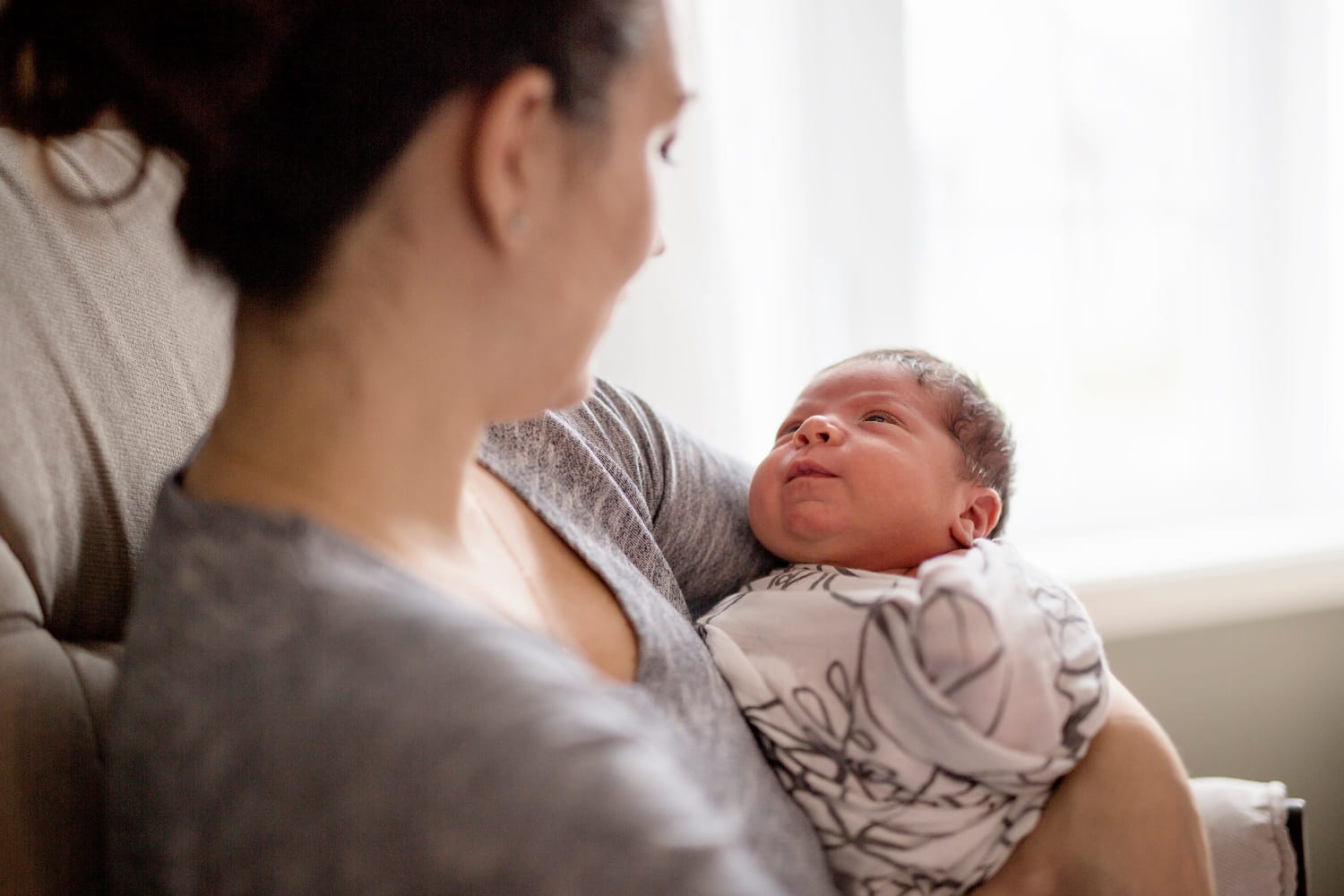
While loved ones immediately spot “the father’s nose” or “the mother’s look”, many young mothers struggle to say who their baby looks like. A discrepancy that psychologists explain very simply.
When Romy was born, Alexia, 30, didn’t try to find out who she looked like. “You already have a hard time processing the fact that it’s your own child, so the resemblance… too hard!”this young mother tells us. Several months after giving birth, she still hesitates when asked from whom her daughter inherited her features. Some relatives assure that Romy is “his spitting image”others see “a real mix” between his two parents. She continues to navigate between several impressions. “They change so quickly that I find it depends on the day and the baby’s expressions”she emphasizes.
In maternity wards, debates about similarities sometimes start before the baby has even opened his eyes. Everyone has their own comparison. However, many mothers fail to see what seems so obvious to those around them. Stéphanie Maquet, psychologist specializing in attachment bonds, tells us that this is nothing to worry about. “It seems normal to me that a mother has difficulty seeing a resemblance of her baby to herself, given that we see more – and often know better – the faces of those close to us than our own.” Result: some mothers spot traits of the father, a grandparent or a brother more easily than their own. The specialist also recalls that, for a mother, the question of resemblance is not necessarily central at the start. “The mother knows that this child is hers and therefore does not need to be reassured by her physical resemblance to him.” Conversely, those around them often seek to place the baby in a family history, almost as a collective reflex.
The postpartum context also plays an important role. The first days with a newborn are not like a session of careful observation in front of a family mirror. Between fatigue, interrupted nights, hormones and emotional upheaval, many women go through a period where everything seems a little blurry. “Profound fatigue produces a form of mild dissociation: we are there without really being there, we look without really recording”explains psychologist Capucine Canal-Chastel. Some mothers even report having the impression of discovering their baby gradually, as if the bond took time to become concrete. This doesn’t mean they love their child any less. On the contrary. “The bond does not fall from the sky at birth. It is built, sometimes slowly”recalls the specialist. Stéphanie Maquet adds that this period weakens many mothers: “70% to 80% of women feel depressed a few days after giving birth.” In this state of fatigue, some may have difficulty being fully emotionally available, which also influences their perception of the baby.
Remarks from those around you can also muddy the waters. When everyone claims to see an obvious resemblance, the mother may end up wondering why she doesn’t see it herself. Alexia recognizes it: she especially feels “a little pride” when someone tells her that her daughter looks like her, but the conflicting opinions amuse her as much as they lose her. Especially since babies change very quickly during the first months. An expression, a smile or a look can remind you of a person one day, then disappear the next week.
But photos sometimes put things into perspective. “Today I see some similarities with the photos of me when I was little, but it’s not obvious to me, even though it’s obvious to everyone”she said. For Capucine Canal-Chastel, comments from those around her are never completely neutral: “When the mother does not yet feel what everyone else clearly seems to see, these remarks can deepen a painful feeling of exclusion.” For psychologists, this difficulty in recognizing oneself in one’s baby above all reveals something very concrete: a mother does not look at her child the way others look at him.
Where relatives look for physical clues and family resemblances, she is immersed in a much more intimate, sensory and everyday relationship. “The bond is first built in the body, not in the eyes”summarizes Capucine Canal-Chastel. Also, in the baby’s smell, his way of sleeping, his cries, the rhythm of the days shared. The physical resemblance generally becomes more visible over time, when everyday life calms down and the mother can finally take a step back from what she sees. This is exactly what Alexia describes: “We’re together every day so it’s hard for us to step back and look at the similarities, like when we don’t see them growing up.” In reality, if others sometimes notice the resemblance more quickly, it may simply be because they observe the baby from afar, with a more detached look.