




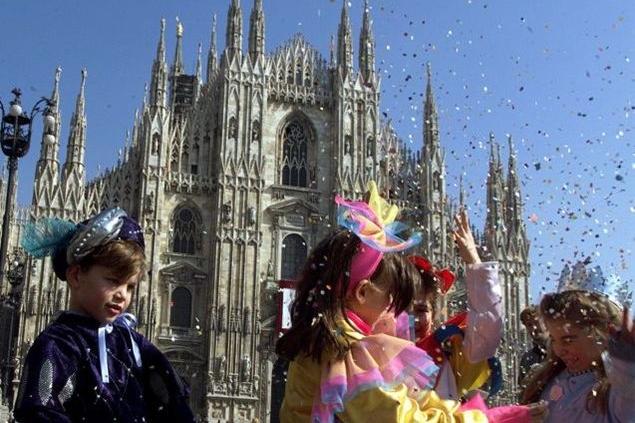
TO Milan Carnival is celebrated on the Saturday after Ash Wednesday, when in the rest of Italy, where the Roman rite is in force, it has already been Lent for three days. Why? At the base there is a historical fact: the Ambrosian ritedifferent on a liturgical level from the Roman rite, but there are quite a few legends that have been grafted onto it and which are still handed down.
In ancient times, as we reconstruct based on the notes of Marco Navoni, Prefect of the Ambrosiana Librarythe Ambrosian rite, which dates back to a tradition older than the Roman one which Milan has never conformed to, has never had “Ash Wednesday”: the start of Lent is calculated starting from the following Sunday, the sixth before Easterthe one in which the Gospel of Jesus’ fasting in the desert is read. In fact, the Ambrosian rite preserves, in the liturgy of the intermediate Sundays of Lent, precise traces of the ancient connotation of Lent in the baptismal sense: it was in fact the period in which the catechumens prepared for the sacraments of Christian initiation, administered during the Easter vigil (as still happens today).
The beginning and end of Lent (Ashes and Easter Sunday in the Roman rite, the sixth Sunday before Easter and the Easter triduum excluded in the Ambrosiano) are different becausewrites Marco Navoni: «If we take the calendar and, starting backwards from Holy Thursday, count forty days, we arrive exactly at the first Sunday of Lent: therefore, the forty days of penance begin on the sixth Sunday before Easter and extend up to, excluding the Easter Triduumwhich begins at vespers on Holy Thursday. This is the original calculation of Lent, preserved in the Ambrosian rite. From this perspective, Lent is understood as a period of forty days of penance, but not of strict fastinggiven that, according to an ancient tradition, one was not supposed to fast on Sunday. In the Middle Ages the idea of actual forty days of fasting took over; Furthermore, Lent was understood more as a period of preparation for Easter Sunday, rather than for the Easter Triduum. Hence the need for a new calculation: if in fact we start from Holy Saturday and count backwards forty days, but skipping the Sundays in which there was no fasting, we arrive precisely at the previous Wednesday the first Sunday of Lent. The calculation was accepted by the Roman Church and spread throughout the West, except in Milan.”
To the history of the Ambrosian rite and in particular that of the carnival, the so-called “carnival” which in Milan is celebrated on the Saturday following Shrove Thursday, add up the popular legends all linked to the popular hagiography of Sant’Ambrogio. It is said that in the 4th century, during the time of Saint Ambrose, the Milanese carnival was renowned and considering how much the Venetian one and that the Milanese waited to celebrate their bishop who returned late for a pilgrimage. This story is circulating two variants: the first according to which it was the Milanese who took advantage of the absence to prolong the celebration, the second which claims that it was the future Saint Ambrose who asked to wait for him.
Another, similar version instead replaces the pilgrimage with a more institutional diplomatic commitment at the imperial court and interprets the wait as a form of respect on the part of the city and the delay like a dispensation granted by a bishop on his return, or, according to others, obtained by ambassadors on the way back.
Yet another story, a little different, instead, he believes that one year the end of Lent coincided with the end of a plague that had prevented the celebrations and forced the population to starve due to isolation and rationed food and that the dispensation to prolong the celebrations was asked of the Pope by Ambrose to cheer up the Milanese.
What historically it is certain that the Ambrosian carnival had attracted the attention of Carlo Borromeo who, as bishop of Milan, did not look favorably on the prolongation of the festival, but not even the greater severity of the post-Ridentine Church was able to modify the exclusive tradition of the city which still preserves the unique tradition of its carnival outside the maximum time.