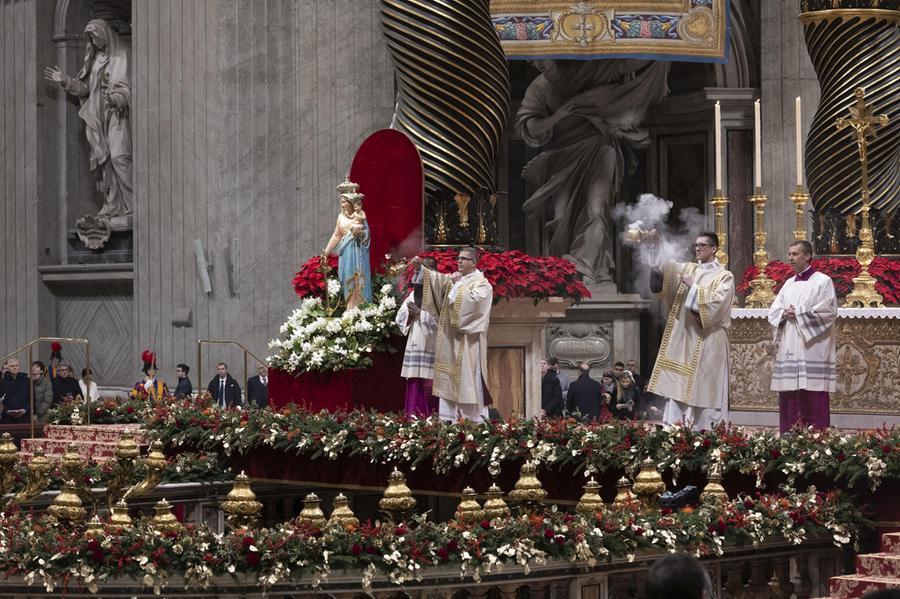



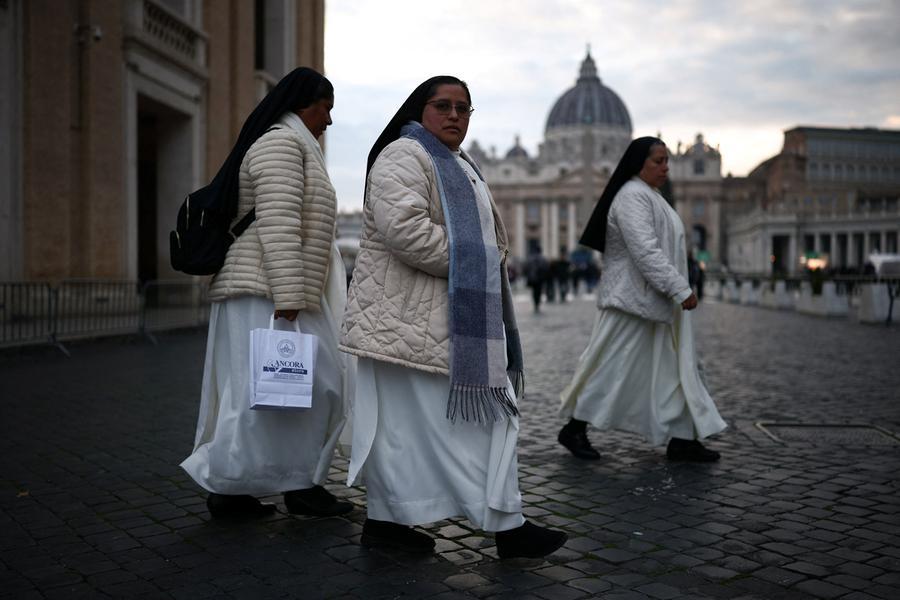
The Holy See slows down, but does not close. The Vatican commission responsible for examining the possibility of the female diaconate expressed a negative vote, confirming that to date there are no conditions to open access to Holy Orders to women.
An expected and at the same time delicate decision, destined to fuel the debate inside and outside the Church. But alongside the “no”, the document allows us to glimpse a possible “yes”: that of a broader, recognized and more structured female ministerial role.
It is the result of the work of the commission led by Cardinal Giuseppe Petrocchiarchbishop emeritus of L’Aquila, established on the mandate of Pope Francis, which concluded its work last February. We read it in the seven-page report that the cardinal sent to Leo XIV last September 18th and which is now being made public at the behest of the Pope.
The discussion isn’t starting now. For years theologians and experts have studied the role that some women played in the first Christian communities. The Commission calls for reasoned prudence: there is no shared theological basis that allows the female diaconate to be assimilated to Holy Orders. Therefore, no definitive closure, but not even an immediate possible opening.
Between tradition and renewal
The line of the document brings together two needs: safeguard the sacramental tradition and, at the same time, open up to new forms of lay ministeriality, even stable ones, entrusted to women.
The basic idea is clear: ministeriality does not coincide with ordained ministries. Christian communities already live today thanks to the essential contribution of women, protagonists in catechesis, education, charity, liturgical animation and in the leadership of ecclesial groups.
The real issue, therefore, is how to recognize and enhance this role in a more official and authoritative way.
The text does not modify the sacramental discipline, but indicates three points of work: to further investigate historical and theological aspects that are still controversial; establish or strengthen stable lay ministries, in which women can exercise effective responsibilities and involve communities in broader discernment, overcoming rigidity and clerical visions.
The phases of the works
The Commission, in the first session of work (2021), established that “the Church has recognized at different times, in different places and in various forms the title of deacon/deaconess referring to women, however attributing to it a non-univocal meaning”. In 2021, the theological discussion unanimously led to the statement that “the systematic study of the diaconate, within the framework of the theology of the sacrament of orders, raises questions about the compatibility of the diaconal ordination of women with the Catholic doctrine of the ordained ministry”. Again unanimously, the commission expressed itself in favor of the establishment of new ministries which “could contribute to the synergy between men and women”.
In the second work session (July 2022), the commission approved (with 7 votes in favor and one against) the formulation which excludes the possibility of proceeding towards the admission of women to the diaconate as a degree of the sacrament of orders but without formulating today “a final judgment”.
Finally, in the last session of work (February 2025), after, following the indications of the Synod, anyone who wanted to do so was allowed to send their contribution, the commission examined all the material received. «Even though there were numerous interventions, the people or groups who sent their papers were only twenty-two and they represented a few countries. Consequently, although the material is abundant and in some cases skillfully argued, it cannot be considered as the voice of the Synod, much less of the people of God as a whole.”
The reasons for the “yes”: dignity, Scripture and signs of the times
The pros and cons are summarized in the Report. Those who support the opening to the female diaconate first of all recall the equal dignity between men and women, rooted in creation (“image of God”) and in the evangelical message. In their opinion, the tradition that reserves all degrees of Holy Orders to men risks contradicting this principle and not taking into account the dynamism of the history of salvation. The famous passage from Saint Paul’s Letter to the Galatians is also quoted: “There is no longer male and female, because you are all one in Christ Jesus”. A text which, according to those in favor, opens up a more inclusive reading of ministeriality. Added to this is the reference to contemporary social development, which recognizes the full accessibility of men and women to institutional roles and public responsibility.
The reasons for the “no”: sacramental identity and spousal meaning
Other members of the commission instead maintain that Christ’s masculinity is not a marginal detail, but an essential part of sacramental symbolism. According to this theological line, introducing the female diaconate would break the nuptial bond that unites Christ and the Church, expressed in the three degrees of Holy Orders. This paragraph was put to the vote: five members voted to keep it, five to delete it. A clear split that photographs the complexity of discernment.
One shared point: expanding the ministries established for women
However, there is one passage that has garnered almost unanimity: with 9 votes in favor and one against, the commission hopes for an expansion of women’s access to the ministries established and officially recognized by the Church.
According to the report, offering stronger recognition to women’s ecclesial service would be a “prophetic sign”, especially where gender discrimination is still a reality.
The “intense dialectic” indicated by Cardinal Petrocchi
In the conclusions, Cardinal Giuseppe Petrocchi noted the existence of one «intense dialectic» between two theological approaches: one sees the ordination of the deacon as a ministry, not as a priesthood, thus opening up to a possible ordination of women; the other underlines the unity of the sacrament of Orders, whereby admitting women to the diaconate would make their subsequent exclusion from the presbyterate and episcopate illogical.
For this reason the cardinal called for a broader and more rigorous study, above all to clarify the sacramental identity of the diaconate and its ecclesial mission. In many parts of the world, in fact, the diaconal ministry is almost non-existent; in others it actually coincides with roles already occupied by lay people.