



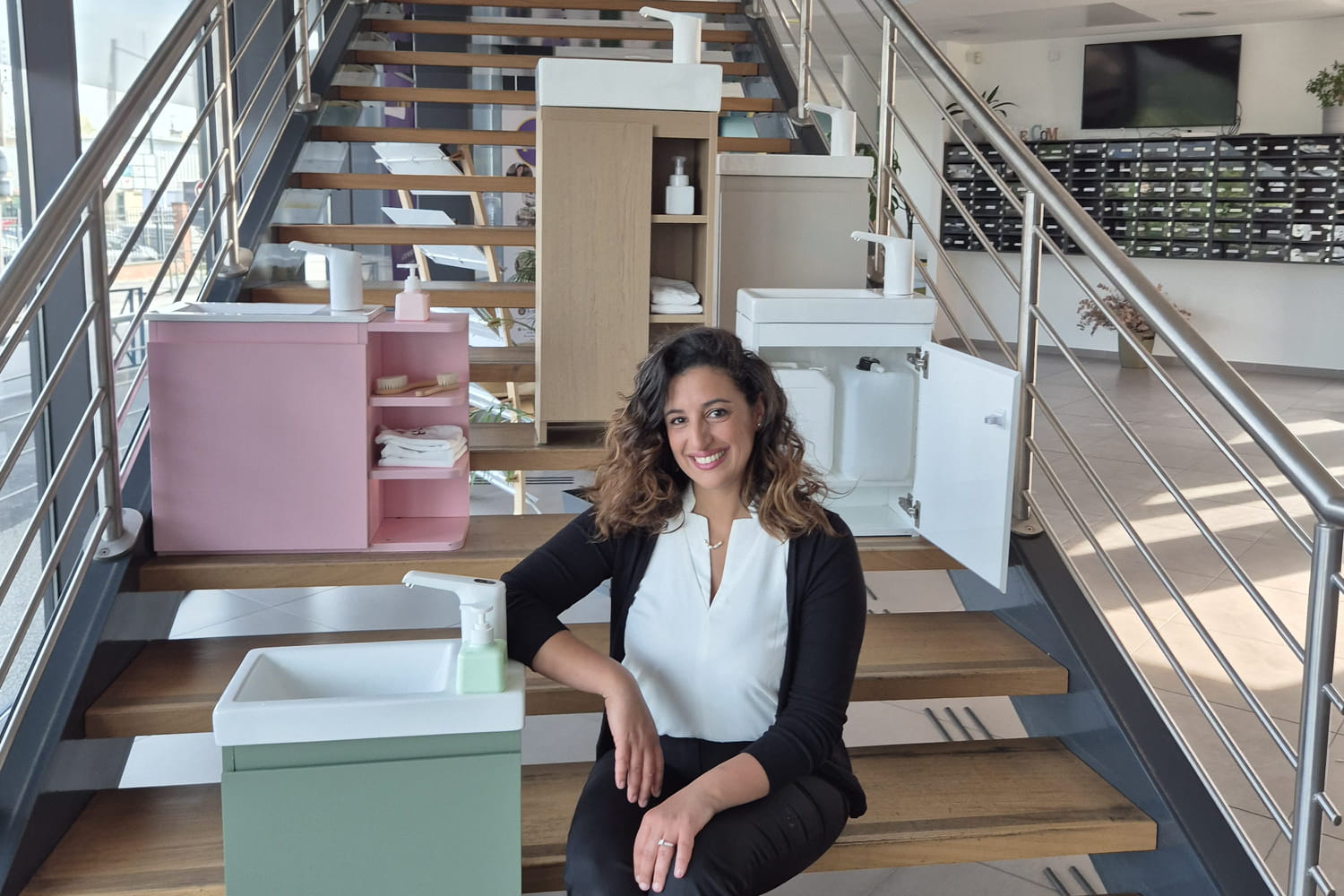
A former energy engineer and mother of three children, Yassmina is the founder of Feny, the very first sink adapted to the size of children, which can be installed anywhere and without any tools. A simple idea, but above all practical, and not just for parents!
Getting children to adopt good hygiene habits is often a daily challenge: asking them to wash their hands before eating, reminding them to do it again after going to play, insisting that they brush their teeth after each meal… all essential actions, but which often come up against a very simple obstacle: equipment designed for adults, not for children. The parents then opt for a step, while ensuring that the child does not slip. Besides, at the hotel, “some use the trash can to make the little ones climb up when brushing their teeth“, notes Yassmina. Mother of three children (Sarah, 9 years old; Samy, 4 and a half years old and Dina, 2 and a half years old), she founded Feny, THE practical solution to make children independent, by designing the very first sinks adapted to their size.
This former energy engineer, converted to data in IT, did not hesitate to leave everything to devote herself to her family life, to the great happiness of her children. “As soon as I saw that they were missing something, I created what they needed.” she tells us. It was then that she decided to found Feny, THE practical solution to make children independent. And the effects are immediate: “Since then, I don’t even have to ask them to wash their hands”she tells us.
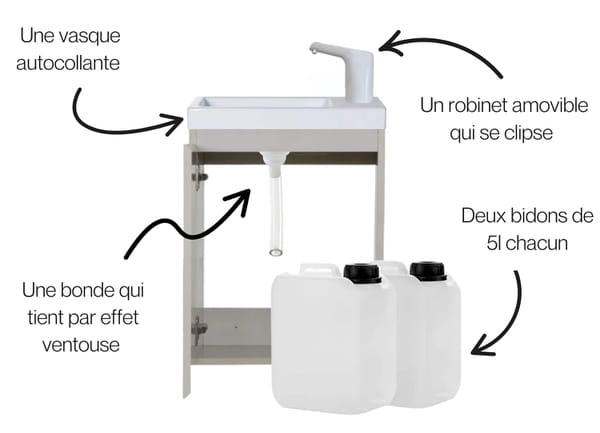
Better than Montessori sinks which require filling basins, going back and forth and which are intended for children aged 2 to 4 years, these autonomous and mobile sinks operate with an economical tap, without work or water supply and are designed to grow with the child up to 6-7 years old, or even older.
How does it work? Simply connect a container of clean water and used water and the child just has to press a button which releases just enough. No more waste: “the water stops flowing after 20 seconds” and a 5 liter container allows you to do around 10 washes. Another positive point: this lightweight sink finds its place in the bathroom, in a kitchen, a bedroom, but also in the garden, for washing hands or watering plants. An invention which had the merit of being rewarded at the Lépine Competition 2025!

“It all started with an accident“
But the origin of Feny goes back to the fall of her eldest daughter Sarah. At the time, the little girl was only 2 and a half years old when she fell hard on her knees after trying to grab a small perfume from the bathroom shelf. Yassmina takes him to the hospital where the pediatric team reveals to him that “most children who consult fall either on the stairs or in the bathroom, in 75% of cases“. There, she was made to understand that there was no real alternative, so she decided to create one. Very quickly, the idea aroused interest around her. Her first client arrived almost naturally, during a birthday party organized at home. A mother, impressed by seeing her son Victor washing his hands by himself, asked her to “tweak him the same thing”. This request acts as a trigger. Then others follow. Yassmina understands that her invention goes far beyond the family context.
Furthermore, if parents remain primarily concerned, Feny is also of interest to many other audiences. Orders now come from childminders, daycare directors, but also from hoteliers or owners of Airbnb, food trucks, campervans… Everyone sees it as a concrete solution to hand washing, wherever you are. Thus, this portable sink priced at 250 to 300 euros, initially designed for children, ultimately becomes useful equipment for everyone. Yassmina also plans to develop this idea.of water accessible everywhere without constraints or tools” with “l’Eautonome”, by creating sinks intended for these professionals from different sectors, which it will present at the Paris Fair from April 30 to May 11, 2026.
As an extension of this universe, she also imagines “a children’s kitchen, with a real mini fridge“or again”a gardening area for children, to teach them how to sow and wash fruit”always with the desire to make everyday actions more accessible and rewarding. But behind the innovation, there is also a deeply social ambition: through feedback from Martinique, where certain families live with water cuts and cans, Yassmina measures the extent to which her system could have “a social impact beyond economic aspects”by bringing “a human side” to those for whom access to water still remains difficult, uncomfortable or uncertain.
A report is dedicated to him in the Show Envoyé Spécial presented by Elise Lucet broadcast this Thursday April 16 at 9:10 p.m. on France 2 and on france.tv