





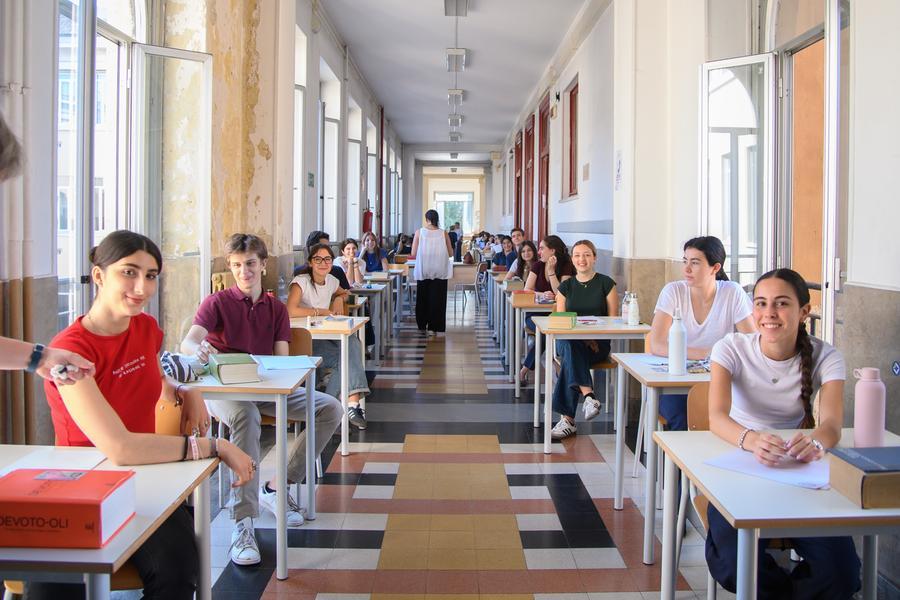


These days, over half a million young people are struggling with a sort of initiation rite: the transition from high school to university or the world of work. Among the innovations in this year’s exam, the greater relevance of behavior, the overall training path and the name change: after 36 years, it will return to being called “of maturity”, as desired by the Gentile reform of 1923. But is it really a test to verify the human path of people or is it just a numerical judgement? We talked about it with Marco Erbateacher and writer.
According to the new ministerial ordinance, “personal maturation” and the curricular and human path enter the evaluation of the 2026 state exam: is it a step forward?
«A final evaluation that takes these elements into account is, certainly, positive news. However, these parameters must be experienced by students and teachers as part of the journey, and not as a duty to be carried out or a part of the bureaucracy to be formalised. These are ideas to be used to make school increasingly an area where one trains for life. School is not only made up of numbers and performance, but also – and above all – of openness to the world: a teacher is someone who uses his or her subject to touch the lives of children and, in this logic, these evaluation criteria can also be important. Then, obviously, everything that is part of the human is difficult to rigidly classify.”
Does the fact that oral exams have become compulsory encourage greater personal responsibility?
«The oral exam – like all the tests to be faced, especially in this increasingly frenetic society and with the myth of performance at all costs – can generate anxiety, but it can also be an opportunity to give the best of oneself. Compulsory nature is a ministerial choice, but as a teacher I ask myself if I see the kids as numbers, or as people on a journey to be accompanied, if I am an inflexible referee or a life coach. This is the question that remains in this logic and that must always ask us, every time something new is introduced.”
After 36 years, the licensing exam is no longer defined as “state”, but goes back to being called maturity, as in the Gentile reform of 1923. Is it just a matter of terms, or also of substance?
«The words are important, but I think the substance does not change: the high school exam is one of the great first tests of life that a person faces, a sort of initiation rite to become adults. Maturity is the transition from the boy who begins high school with a series of limits and rules, to the adult who holds the helm of his life in his hands.”
In an exam that tries to enhance the person but remains highly standardized, is it possible to reconcile evaluation and human growth?
«The school – and therefore the exam – is based on norms, rigid rules that are the same for everyone, but every human being is unique and unrepeatable in the history of humanity. Paradoxically, however, school itself – with its rules – can become the place where one can express one’s uniqueness, where one can find one’s vocation, coming into contact with oneself and with others and delving into the complexity of reality. Here, critical sense and empathy are the antidotes to standardization. Obviously, it’s a job that needs to be done for five years and requires you to get involved over a long period of time.”
How should the state exam be reformed, so that it is truly “maturity” and not just a passage now emptied of meaning?
«I don’t think that the final exam is now devoid of meaning. In recent years, different formulas have been tested to reform it, each of them has pros and cons. What makes the difference is youthful protagonism: young people must experience that achieving a grade is not just effort as an end in itself, but a foothold to climb a mountain and this mountain is called the meaning of life and the contribution one wants to give to the world. Every reform must favor the possibility of self-expression by students, without obviously neglecting the component of disciplinary knowledge of the subjects, which remains fundamental. We need to work so that the kids understand that the exam is an opportunity, not a monster to be afraid of. Even if, between adrenaline and anxiety, emotion and desire for the future, the night before the exams will always remain a magical moment…”.