





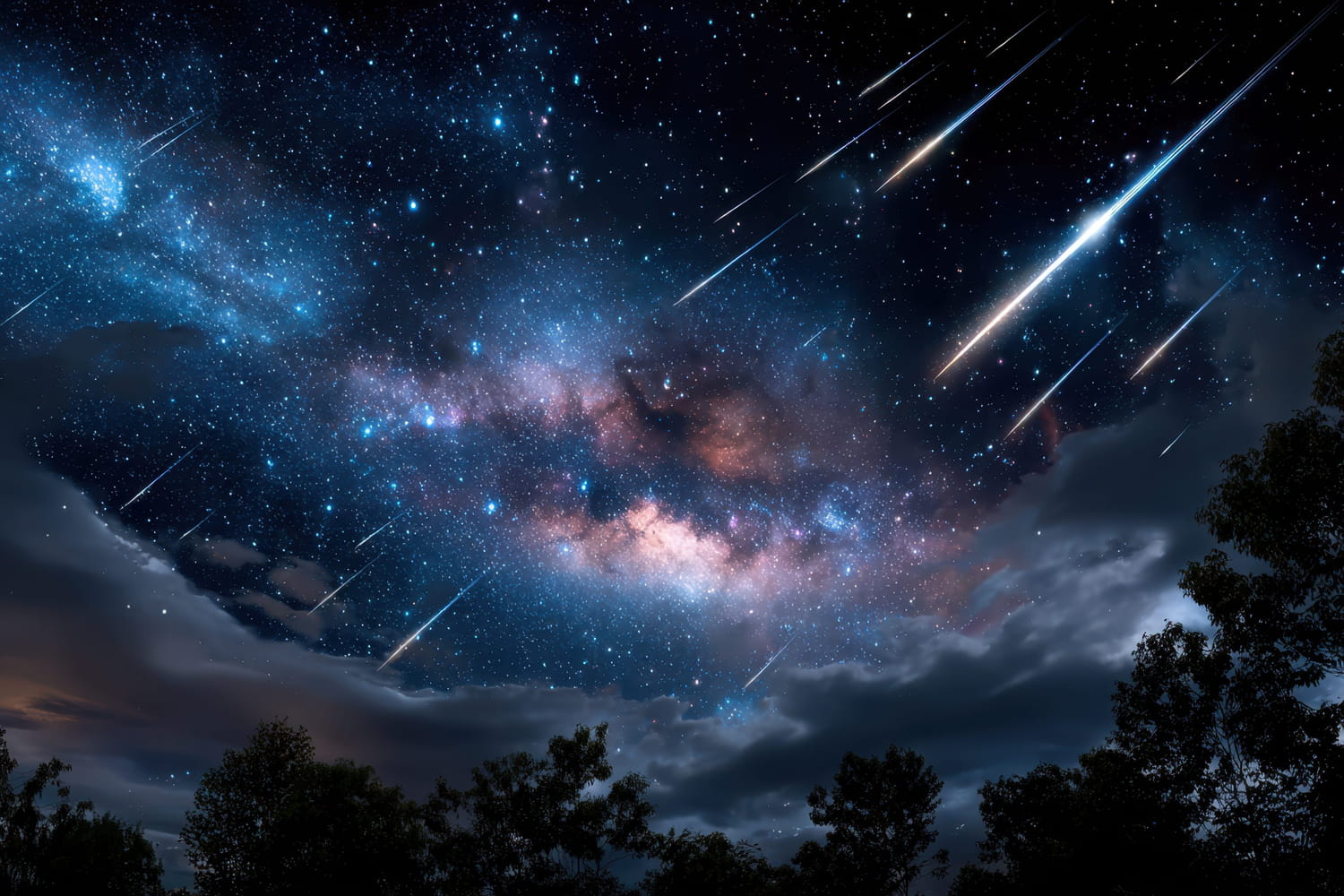
Starry sky lovers, prepare your wishes! A historic meteor shower is approaching and promises pretty streaks of light in the night sky.
Contrary to what their name suggests, shooting stars are not falling stars. These are tiny pieces of dust left behind by a comet as it passes near the Sun. After the cloud of 1000 stars in February, every year at the same time, Earth passes through this cloud of debris, resulting in showers of stunning shooting stars in the sky. They are called “Lyrids” because they seem to come from the constellation Lyra.
As they hit the atmosphere at full speed, these dust grains ignite and create fine white streaks that tear through the darkness for a fraction of a second. Sometimes the larger dust from the comet creates what are called bolides: brighter, more colorful meteors that leave behind a trail of ionized gas visible for a few seconds. Astronomers expect around 15 to 20 shooting stars per hour under optimal conditions. It’s not a permanent fireworks display, but it’s enough to see several if you’re patient.
The phenomenon is active until April 30, but if you only have to choose one night, it is better to bet on the night from Wednesday 22 to Thursday April 23, 2026, ebetween midnight and dawn. This is when the constellation Lyra is highest in the sky. To spot it, you have to look towards the North-East horizon. There is normally a very bright star that stands out clearly from the others due to its white-blue color. It’s Vega. Once you have Vega, look at the area just to the left of it. This is where you are most likely to see shooting stars.
That night, the Moon will only be about 30% illuminated (a thin crescent) and will set quite early in the night, leaving a very dark sky, which is crucial for spotting the most discreet meteors. If the weather remains mild and the clouds part, the spectacle will be perfectly visible. According to current weather forecasts, 50 million French people will benefit from favorable conditions to observe them.
To see shooting stars well, you don’t need a telescope or binoculars, your eyes are enough. Flee light pollution and stay away from city streetlights. A country garden or dark park is the ideal place. Let your eyes adjust: It takes about 15 to 20 minutes for your vision to adjust to complete darkness. Put away your smartphone: the blue light from the screen “dazzles” your retina and breaks your night vision.
Comet Thatcher, responsible for this shower of stars, takes approximately 415 years to circle the Sun. The last time she visited “our place” was in 1861… and she won’t return until the year 2276! What we see in the sky this April are the crumbs of its last passage.