





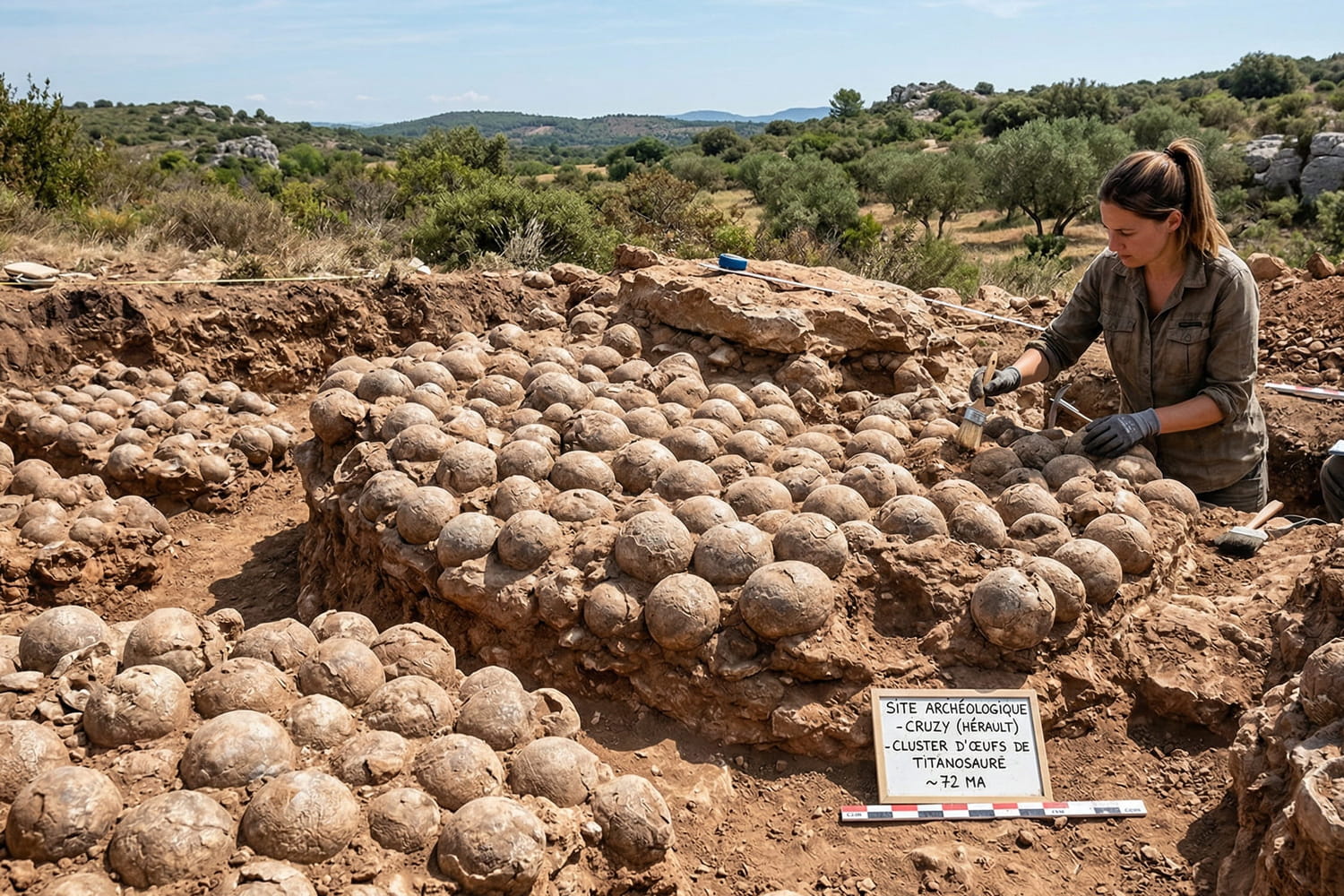
A major paleontological discovery has revealed a dinosaur nesting site containing hundreds of fossilized eggs.
It’s a discovery worthy of Jurassic Park! What appeared to be simple rock formations turned out to be one of the largest dinosaur egg deposits ever discovered in Europe. More than 500 fossilized eggs were exhumed, providing a unique look at the life of species that roamed French soil 72 million years ago.
It all started with a conservation mission in the “Dinosaur Plain”. This site, already known to paleontologists around the world, is based on red clays from the Upper Cretaceous, the golden age of dinosaurs. Every year, natural erosion and runoff bring new fragments of fossils to the surface: predator teeth, bone debris or shell shards. While this sector had never revealed a secret of this magnitude, researchers have uncovered a phenomenal concentration of nests.
While digging, the team realized that they were not facing a few isolated specimens, but a real prehistoric open-air nest. Ultimately, 552 dinosaur eggs, attributed to Titanosaurs (giant herbivores with long necks), were identified at the foot of the famous Sainte-Victoire mountain, in Bouches-du-Rhône. For the excavation team at the Natural History Museum of Aix-en-Provence, it is a real time capsule. “We didn’t expect to find so many at once. What is incredible is the state of conservation: we can still see the structure of the shell, it is as if time had stopped 70 million years ago“, explain the Museum’s experts, amazed by the density of the deposit.
For decades, scientists wondered about the breeding habits of large sauropods in Western Europe. This colossal deposit confirms two important points: dinosaurs returned year after year to the same place in Provence to lay eggs, like current sea turtles. The density of nests also suggests collective egg-laying, a group strategy to protect their offspring against predators. If the discovery of Sainte-Victoire fascinates us, it is also because it represents the “final chapter” of a story that began more than 230 million years ago. On the other side of the world, in Zimbabwe, researchers recently exhumed the Mbiresaurus raathione of the oldest dinosaurs ever discovered.
The Sainte-Victoire site is unique because the eggs were frozen by deposits of mud and sand from ancient tropical rivers. Some specimens are so well preserved that they make it possible to study the porosity of the shell, revealing valuable details about the humid and hot climate that reigned in the south of France at the end of the Cretaceous.