



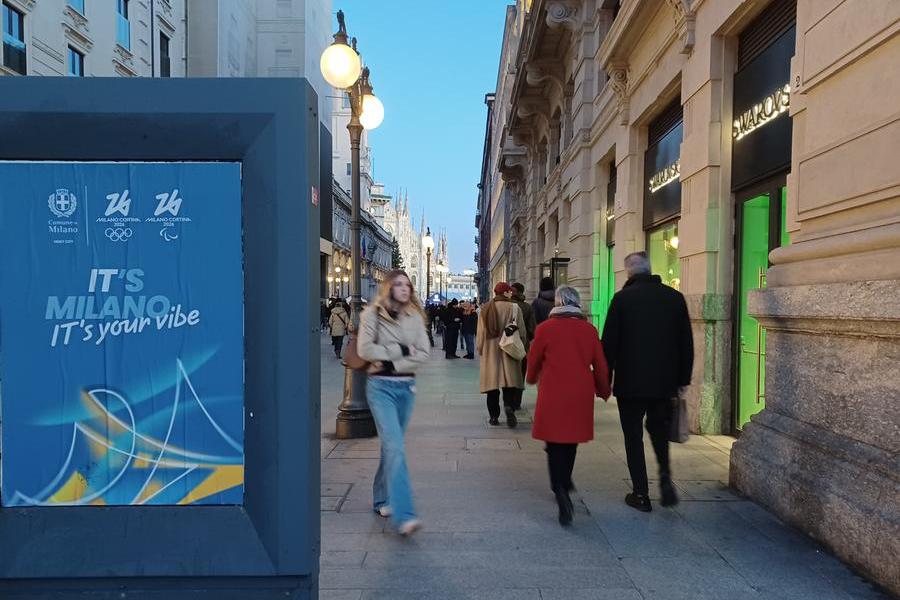
An untranslatable motto for an indescribable sensation. We could summarize the busillis of «It’s Milan, its your vibe» (pr. go): literally «it’s Milan, it’s yours vibe”which we find intermittently, since well before the start of the Milan Cortina 2026 Olympic Games, on every bright advertising board in the Lombardy capital.
Abbreviation from English vibration, vibe indicates the atmosphere, the sensation that a place, a person, an image communicate, something that cannot be described, but which is felt and shared. It is not a standard English word, but American slang, which youth language, through social media, has spread and made popular especially in relation to content, an image, a place. It has something to do with aesthetics, but it doesn’t end there, something to do with the spirit of a time or place, but it doesn’t end there either. In English it is mostly used in the plural. It can also be negative if accompanied by an adjective, for example “bad vibes”, but generally expresses a positive thing. There is a harmony between people. Vibe it does not have a direct translation into Italian, it requires a rather complex periphrasis. In English by necessity, given that the Olympic motto must be as international as possible, was born, explained Raffalla Paniè, responsible for the Image and Look of the Milan Cortina Games from the medals, to the mascots, to the livery, to «give a positive sensation of the Italian spirit and at the same time identify the Games with a contemporary concept, because the past of Milan and Italy is already known». To then comment: «everyone knows what one is vibe».
Maybe not all of them, unless they were born after 1995.
What does it have to do with vibration? It established itself in the musical field after the invention of the vibraphone, of which vibe was also used as an abbreviation at the beginning of the twentieth century.. In an article dedicated to her in 2022 the Guardian defined vibe as the most abused word of our era, thus reconstructing the transition from musical jargon to common language, albeit slang: «The most important characters in the history of the word “vibes” are the Beach Boys. Before the release of Good Vibrationsin 1966, if you heard someone say “vibration,” they were probably referring to a vibraphone, the xylophone-like percussion instrument with rattling metal bars, invented in 1916. The idea that a person could emit “vibes” was a niche, mostly hippie concept.”
As for the most recent evolution, roughly the 1920s, the word became widespread in marketing and consultancy jargon especially in the branch that deals with the optimization of web content on search engines, and then, driven by image-based social media such as Instagram or Tik Tok to describe fashions, atmospheres, lifestyles, it has become commonly used among young people who practice these tools.
In advertising it indicates content constructed to arouse emotions or sensations. In political discourse, however, the ability to capture consensus on the basis of the emotions of those who have to vote. Then when you think about it, Dante had already thought or felt something equally exciting, indescribable, but shareable only through common experience.seeing the angelic woman of his dreams approaching: It shows itself so pleasing to those who look at it / which gives a sweetness to the heart through the eyes / who cannot understand it who doesn’t try it (sonnet So kind, so honest it seems, Vita Nova). If he had been of the same age as Generation Z he would have defined vibe that feeling?
Jokes aside, the risk is that, in everyday life, vibe becomes a parsley word, which is thrown everywhere due to laziness and genericity. He explains it well in his Facebook pills of 21st century Pop Vocabulary, in which he explains the sayings with irony and insight, Giuseppe Sant’Elia: «You enter a bar and say “nice vibe” because it’s welcoming. You meet a person and you say “strange vibe” because they don’t convince you. You get a message and think “bad vibe” because you don’t like how it’s written. It is an immediate, rapid word. It saves you from explaining the real, precise reasons, which you often don’t even know. You just need to feel. But be careful: by dint of saying “vibe“we risk not explaining anything anymore. Because behind a “vibe strange” sometimes there is something concrete: an unpleasant person, a wrong phrase, an annoying memory. Maybe every now and then we should stop and ask ourselves: “What am I really feeling? And why?”
Significant is the fact that in the compound “vibe coding” vibe also makes up the word of the year 2025 for the Collins Dictionarywho explains it like this: «Coined by artificial intelligence pioneer Andrej Karpathy, vibe coding refers to the use of artificial intelligence, stimulated by natural language, to write computer code. Basically, it’s about telling a machine what you want, rather than meticulously programming it yourself. It’s programming based on vibrations, not variables. While tech experts debate whether it’s revolutionary or reckless, the term has resonated far beyond Silicon Valley, reflecting a broader cultural shift toward artificial intelligence in everyday life.”
In any case, it is a reflection of the times.