





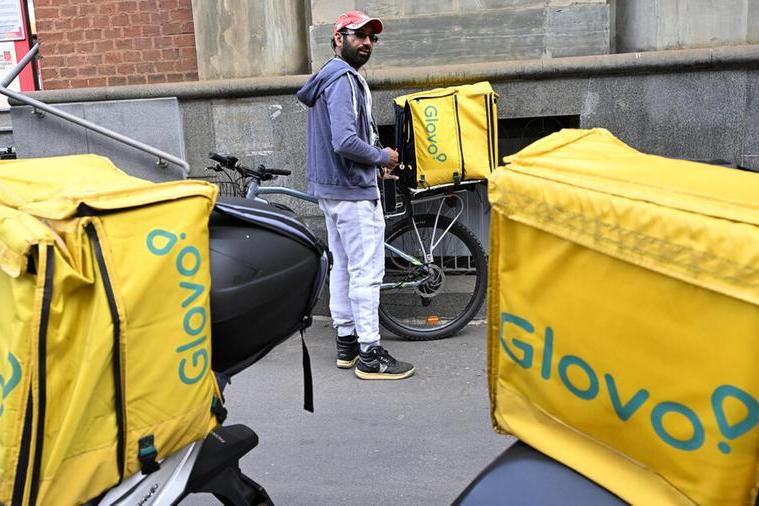
The Milan Prosecutor’s Office has ordered judicial control for gangmastering against Foodinho srl, the Italian company that manages the Glovo delivery platform. The emergency measure, signed by the public prosecutor Paolo Storari and awaiting validation by the judge for preliminary investigations, represents the last chapter of a judicial battle involving the entire gig economy sector and which comes a few months after the entry into force of the European directive on digital platform workers. The investigations conducted by the Carabinieri of the Labor Inspectorate Unit have brought to light an alarming picture: approximately 40,000 riders employed throughout Italy – of which 2,000 in Milan alone – receive wages that the public prosecutor Storari defines as “below the poverty line”with wages up to 76.95% lower than the poverty threshold itself and up to 81.62% lower than the national collective bargaining agreement.
In the decree of over 50 pages, Storari writes that the wages paid “are certainly not proportionate to either the quality or quantity of the work performed in order to guarantee a free and dignified existence”, in violation of Article 36 of the Italian Constitution.
Rider testimonials
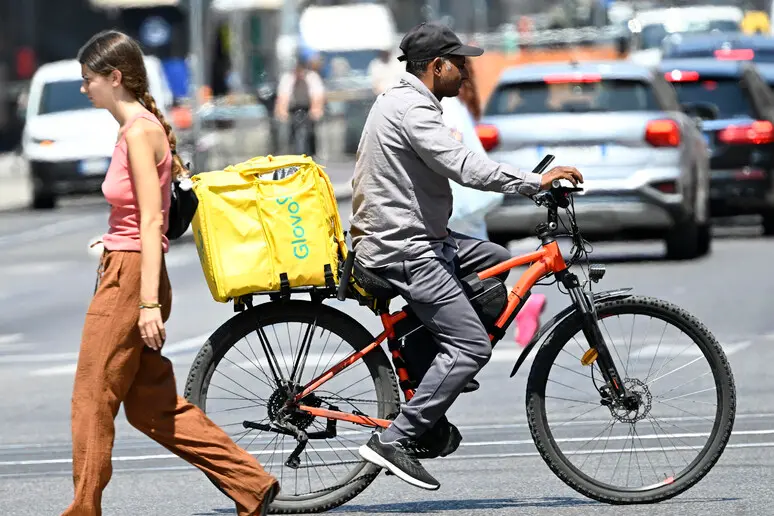
The investigation documents collected direct testimonies from cyclists who paint a reality of extreme precariousness. Solomon Saturday, a rider who operates in the Milan Central Station and Garibaldi areas, told investigators: «I work for Glovo with a VAT number every day from 12 to 22, carrying out between ten and twenty deliveries a day. The fee is approximately 2.50 euros per delivery and the monthly earnings vary between 700 and 1,200 euros. I have a dependent family, my income is insufficient and I find myself in a state of need.” This testimony reflects the condition of thousands of workers who, although formally classified as self-employed with a VAT number, find themselves in a situation of de facto subordination with respect to the platform, without however enjoying any protection typical of employed work: no holidays, sickness, maternity leave or protection in the event of dismissal.
The provision of the Prosecutor’s Office highlights how the algorithmic management system of the Glovo platform constitutes a form of “algorithmic hetero-organization of work performance compatible with the application of the discipline of subordinate work”. In other words, although the riders are formally self-employed, the platform’s algorithm exercises detailed control over every aspect of their work: timetables, compensation, assignment of deliveries, performance evaluation. The sole director of Foodinho, the Spaniard Pierre Miquel Oscar, has been formally investigated for gangmastering together with the company itself. The accusation is of having “employed labor in exploitative conditions, taking advantage of the workers’ state of need”, creating a system that the prosecutor defines as «toxic situations that have created the favorable humus for a working environment to be transformed into the occasion of offenses relating to criminal labor law».
The work of prosecutor Storari: 50,000 regularized workers
Paolo Storari is one of the most active magistrates in Italy in the fight against gangmastering and labor exploitation. In recent years, his investigations have involved logistics multinationals such as Ceva Logistics and Uber Eats, large luxury brands such as Dior, Armani and Loro Piana, and security and surveillance companies. Storari himself recently declared that the investigations by the Milan Prosecutor’s Office led to “fifty thousand internalisations and earned workers six hundred million euros”. A result that the magistrate proudly claims: “The state must be proud of these results“. Storari’s method involves a collaborative approach with companies: the objective is not to sanction, but to ensure that companies spontaneously regularize employment relationships. “We carry out trials against companies of a non-sanctioning nature – he explained in a recent conference -. The moment the company hires, pays taxes and changes its organisation, we stop”.
This is not the first time that Glovo has ended up in the crosshairs of Italian justice. In 2021, the company had received a maxi-fine exceeding 65 million euros from the INPS and the Labor Inspectorate for failure to pay social security contributions to riders. In a subsequent ruling by the Court of Milan in April 2025, Judge Giorgio Mariani confirmed that Glovo delivery drivers are “to all intents and purposes employees” and must be covered by a collective agreement with related social security contributions. While partially reducing the amount of the fine, the court had reiterated the existence of a relationship of dependence on the platforms. The Glovo-Foodinho case is part of a profoundly evolving regulatory context. After two years of tortuous negotiations, in October 2024 the European Union finally approved Directive 2024/2831 on improving working conditions in work via digital platforms, which member states will have to transpose by November 2026.
Finally, on March 11, 2024, Paris and Berlin relented, allowing the Council to confirm the agreement. On 24 April 2024, the European Parliament approved the directive with 554 votes in favour, 56 against and 24 abstentions. Final approval from the Council came on 14 October 2024, with all countries in favor except Germany which abstained.

The business model of the platforms under attack
The Glovo case highlights the profound contradictions of the economic model of digital platforms, which Paolo Storari defined as the expression of a “gentle mass society”, taking up an expression coined by the sociologist Luca Ricolfi. «Once upon a time – explains the magistrate – who could afford to have lunch or dinner brought home? People with a lot of money at their disposal. Today we all more or less do it, at extremely low costs.”
Delivery platforms have built their success on a system that completely outsources the costs and risks of work, offloading them onto thousands of formally autonomous but essentially subordinate people. Riders don’t have company vehicles, they don’t have insurance, they don’t have protection against accidents, they don’t have social safety nets in case of illness or economic crisis. As emerges from the investigations, this model has allowed large digital platforms to have “low costs” while maintaining high margins, thanks to the exploitation of a workforce paid “on call” and without any bargaining power.
The legal action on Foodinho is part of a broader context of combating digital gangmastering and irregular work. As the provision of the Prosecutor’s Office underlines, «over 52,000 workers have so far been affected by similar interventions, resulting in the insourcing of staff and regularization of employment relationships». At the same time, the companies involved have repaid tax debts of over one billion euros, “a sign of an increasingly incisive fight against irregular work in the home delivery sector”. A fact that highlights the systemic dimension of the phenomenon of exploitation in gig economy.
As article 36 of the Italian Constitution states: “The worker has the right to remuneration proportionate to the quantity and quality of his work and in any case sufficient to ensure a free and dignified existence for himself and his family.“. A principle that also applies to those who cycle by delivering food for 2.50 euros per ride.