





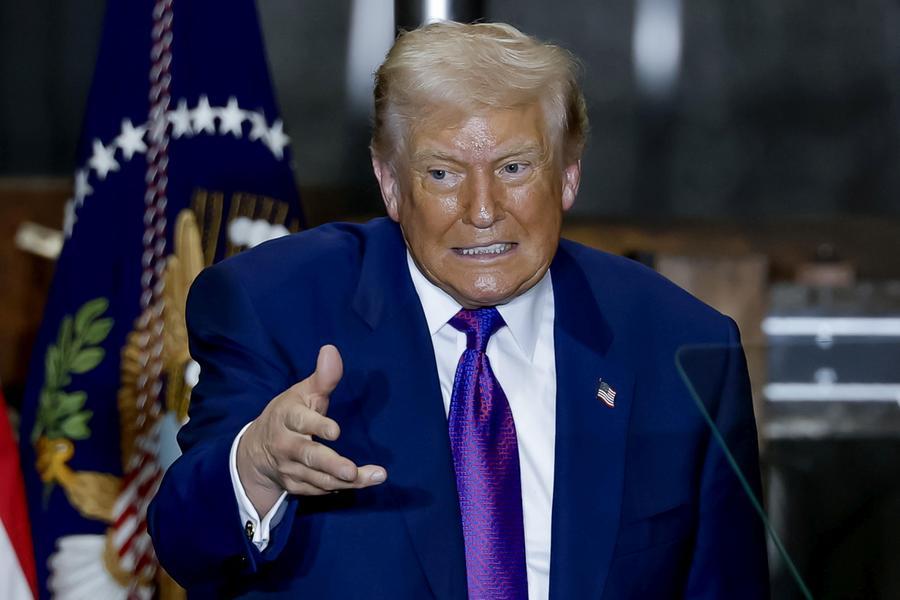
There United States Supreme Court dealt a severe blow to Donald Trump, ruling that the president exceeded his powers by imposing across-the-board tariffs – up to 30 percent – on imports without congressional approval. With a majority of six justices to three, the Court clarified that the 1977 emergency law invoked by the White House does not authorize the chief executive to introduce tariffs on a global scale and for an indefinite period. The President of the Court signed the decision, John Roberts, who spoke of “an extraordinary power” claimed by the Administration: the power to impose tariffs “of unlimited amount, duration and scope” without a clear legislative basis. A statement that goes far beyond the commercial theme and touches the heart of the American institutional structure.
The constitutional issue: who decides on taxes
The United States Constitution gives Congress the power to regulate foreign commerce and to impose taxes and duties. Over the decades, Parliament has delegated part of these powers to the president, especially in limited situations and for reasons of national security. But the Court found that Trump’s use of emergency legislation exceeded those limits.
The message is clear: the president cannot invoke an “emergency” in a generic way to redefine the entire American trade policy. At stake is not just a dispute over tariffs, but the principle of separation of powers. In a liberal democracy, even the strongest chief executive must abide by the boundaries established by law.
The economic and financial consequences
The decision opens up complex scenarios. From April 2, 2025, the date Trump renamed “Liberation Day”, the Treasury Department had collected approximately $240 billion in tariff revenue. Now thousands of companies could ask for refunds for the sums paid based on measures declared illegitimate. THEand estimates speak of a potential impact of between 120 and 400 billion dollars, with effects on the federal budget and the cost of public debt. It is likely that the Administration will try to react by introducing new duties based on different legal bases, perhaps more limited by sector or limited in time. But the symbolic significance of the sentence remains: the White House will no longer be able to use the tariff instrument as a permanent lever of geopolitical pressure, brandishing it against allies and commercial partners every time a political dispute arises.
A sentence that speaks to democracy
Beyond the immediate effects, the pronouncement takes on a historical value. In a phase in which many observers denounce the risk of an excess of executive power, the Court reaffirmed that America is a republic founded on the balance between institutions. There is no such thing as “unconditional” authority, not even in the name of national interest or economic security.
The decision therefore represents a reminder of the principle of responsibility and legality. Even when the declared objective is to defend domestic industry or reduce the trade deficit, the means must remain within the boundaries established by law. It is an essential point not only for the economy, but for the very stability of democratic coexistence.
The battle over American protectionism will continue, and will likely move back to the halls of Congress and the courts. But with this ruling the Supreme Court reminded us that the strength of a nation does not lie only in its ability to impose tariffs or negotiate agreements, but in fidelity to one’s own rules. A principle that applies to the United States and which speaks, more generally, to all Western democracies.