






The color of our four-legged friends’ collar has an essential meaning that every passerby should know. Pink, green, red, orange, blue, purple, yellow or white… Here are the 8 color codes in dogs and what you need to understand.
When we come across a dog, we don’t always know whether to be wary of it or whether we can approach it without fear. In the street, in a park while jogging or while strolling in a stroller, vigilance is nevertheless essential. You never know what reaction the animal may have, whether or not it agrees to be petted (with the permission of its master). Of course, when you have children, you should teach them, from a very young age, never to touch a dog they don’t know. And for good reason: the reaction of canines can sometimes be unexpected: it shows its fangs, starts to step back or growl…? Maybe he just wasn’t in the mood and didn’t want a stranger to touch him?
Thus, to avoid misunderstandings and the risk of accidents, owners now use a coded message: the canicode. These are labels that are attached to the dog’s collar, leash or harness with a particular color, sometimes a pictogram or a short message. It might be a few words like “leave me alone,” “don’t pet me,” or “don’t come near me.” But for most owners, the color of the collar is enough to convey a crucial message.
According to the SPA, “canicodes” are based on a system of eight colors, each corresponding to a specific situation. The objective is simple: to identify a dog’s profile at a glance and to adapt its behavior accordingly. For example, the yellow collar indicates a nervous, fearful or unpredictable dog who needs distance. He must not be approached. This very visible color allows passers-by to be alerted from afar and to avoid any inappropriate contact. The orange color indicates that the dog does not tolerate its peers. This code is primarily aimed at other owners: it invites them to keep their animal at a distance to prevent any incidents. Red concerns dogs who cannot tolerate other dogs or humans. He calls for extreme caution and no contact.
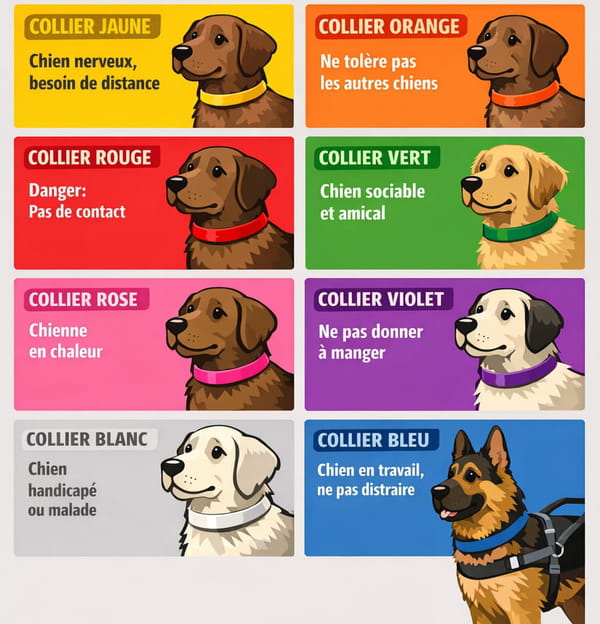
Conversely, green designates a sociable dog, which can be approached and petted without any particular risk. Pink is used to signal that a female dog is in heat. This code mainly targets uncastrated males in order to avoid tensions or fights linked to this period. Purple means do not give food to the dog. This may be linked to allergies, a weight problem or a specific job in progress. White is reserved for dogs with a disability or health problem, such as blindness, deafness or epilepsy. It invites attention and adaptation. Finally, blue indicates that a dog is in professional activity, for example a guide dog. In this case, he must not be distracted so as not to disrupt his mission.
Beyond the colors on a collar or a simple ribbon, these signals are there to protect both the animal and the people who encounter it. Knowing and respecting canicodes contributes to more peaceful walks for everyone, by reducing the dog’s stress and the risk of incidents. Everyone can participate in this better cohabitation: owners by clearly displaying the needs of their companion, and passers-by by simply observing these signals and adapting their behavior accordingly. Asking permission before approaching, keeping your distance when a dog needs space, or simply explaining these codes to your children are all small gestures that make the street, park or sidewalk safer for everyone.