




Let’s say it right away, without beating around the bush: Charles III with his terribly British accent (which Americans like so much) gave Donald Trump a lesson in politics and history. But not the pedantic lesson from a civic education textbook. No: a lesson of those that go unnoticed, with a smile on the lips and the knife well hidden in the napkin. Pure English humor, that is, the most elegant form of superiority ever invented.
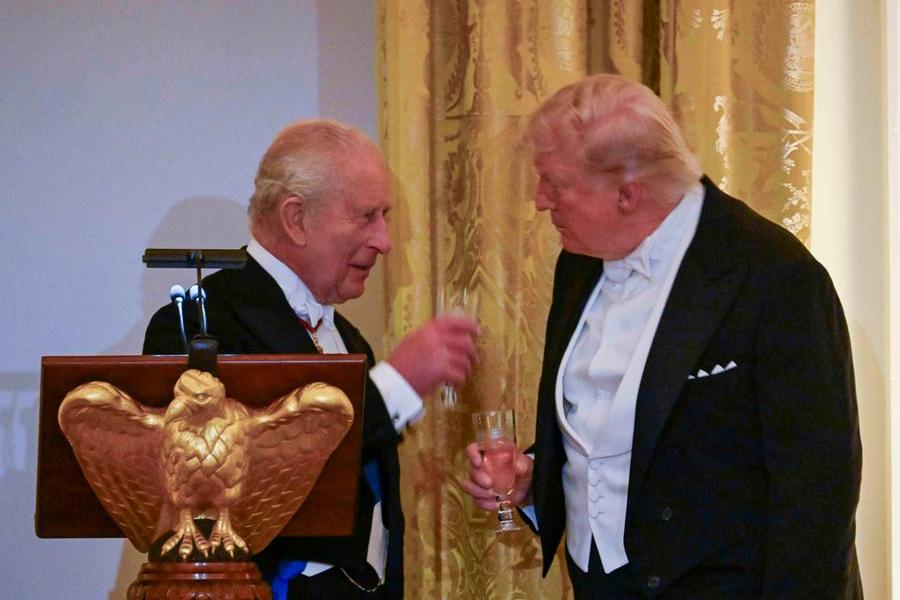
The scene was almost didactic. Trump who elbows his way, gets agitated, tries to take center stage as he always does – between slightly embarrassed family anecdotes, cheap social media gimmicks (“Two Kings”, really?) and that reality show gestures that confuse power with choreography. And on the other side Carlo, motionless, elegant, like an ancient column, which doesn’t need to do anything to be there. Indeed: the less it does, the more it weighs.
The masterpiece, however, lies in the nuances. When Carlo recalled that the United States is just over 250 years old, he added – with that lightness that is typical only of those who know exactly where to strike – that for an Englishman it is “like saying the day before yesterday”. A tiny, almost invisible sentence. Yet there is everything inside: history, irony, and a hierarchy of time that puts everyone back in their place. What royal class!
Then along comes Oscar Wilde, nonchalantly evoked in front of a Congress that suddenly finds itself capable of laughing. And again the jab at the language – English or French doesn’t matter, as long as it’s a lesson – which forces even Emmanuel Macron to recognize the style with a “very chic” that sounds like a handshake between gentlemen.
Trump cashes in. He smiles through gritted teeth. And maybe, for a moment, he also understands. But it’s just a moment. Because his problem is structural: he wants to be king without having the bearing. Trade authority for volume, leadership for visibility. Carlo, on the other hand, demonstrates the opposite: the less you impose yourself, the more you count.
And be careful: under the velvet there is steel, missiles. Ukraine, NATO, environment. Carlo lines up the themes one after the other, without raising his voice, without ever turning the speech into a rally. A political surgery that leaves no visible signs but works in depth.
The passage on the Magna Carta is almost treacherous in its composure: remembering that power has limits, even while speaking to those who consider limits optional. And mentioning John F. Kennedy as if he were a distant relative, one of the family, while today it already seems like an archaeological find. Let us remember that, if it is true that without the Americans who defeated Hitler the English would speak German, it is also true that without the English they would speak French, referring to the war of the English motherland against eighteenth-century France which owned half the American continent.
In the end this image remains: a man who would like to be king and one who is without having to prove it. Trump tweets “Two Kings.” Carlo, without tweeting anything, reminds him that kings do not proclaim themselves. They recognize each other.
And, above all, they don’t need to say that two hundred and fifty years is a long time. Because they know – with a half smile – that, in their story, they are just the day before yesterday.