






Every time we pray we risk doing so without thinking about what we are saying. These meditations serve to enjoy prayer, so that it can make us reach much deeper when we turn to God through Mary. The prayers addressed to Her are prayers to a Mother. It is therefore a question of understanding how some words, some formulas, some prayer patterns help us to remember the motherhood of this Woman and the formidable help that she can bring into our lives.. They are meditations that should humanize our prayer more and lead us to savor it to the full.” This is how Don Luigi Maria Epicoco explains the common thread he followed in developing the meditations that accompany the prayers to the Virgin collected in the series In dialogue with Mary: 6 handy volumes that you can find with the magazine starting from the next issue (see box on page 23).
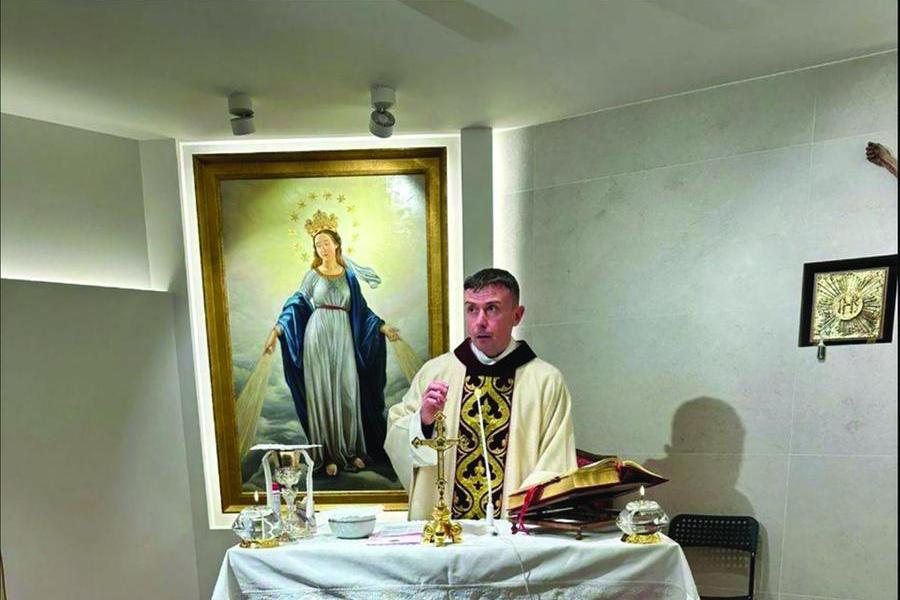
Don Luigi, parish priest of San Francesco da Paola in L’Aquila, combines his activity as a presbyter with that of an evangelizer, holding spiritual exercises and also speaking, with a huge following, on the web, with comments and reflections related to the Holy Scriptures. One of the few “social” priests who does not give in to the virus of vanity: it is even a problem, despite the old friendship and consolidated collaboration with the writer, to convince him to let himself be photographed to illustrate this interview. But if you ask him to talk about Mary he becomes a raging river.
Referring to your words, we also understand the meaning of the title of the series, In dialogue with Mary, because ultimately the dialogue with Her leads to intimacy with the Lord…
«Yes, above all because Mary is not an alternative to God, but is the medium that we use to be able to get closer to Him. Just as a mother teaches a child to speak, the Virgin teaches us to turn to the Lord in a more conscious way».
What place does prayer to Mary have in your daily life?
«I was born in Mesagne, in the Brindisi area, a town with a strong Marian devotion, therefore the Madonna has always occupied a privileged place in my personal life and in my spirituality. I experienced the motherhood of this Woman and then, only later, I discovered the fatherhood of God. And this bond was what benefited me most in understanding the Gospel and living my spiritual experience more intensely.”
What are your earliest memories associated with Maria, including childhood memories?
«The Patron Saint of Mesagne is the Madonna del Carmine, but the place that I always remember with affection is the small country church dedicated to the Virgin of Graces, which accompanied my vocational journey. When I decided to become a priest, I went there to his feet and every time I return to my city I always make a stop in that temple, where I recognize the root of my entire history.”
Does Maria still accompany you today? Do you feel its presence?
«Our Lady is the one who “humanises” the Gospel, a Christianity without her would leave us with only a great radical nature of the Scriptures, which could even discourage us. But the love of this Mother transforms the radicality of the Gospel into something possible, something livable. Mother’s love, after all, does this: it encourages, making possible what does not seem possible. There is almost a “power” of maternal love. Behold, the Lord gave us his Mother precisely so that we would not be discouraged by the radical nature of the Gospel.”
A concept that Pope Francis also wanted to reiterate at the WYD in Panama in 2019, speaking of Mary as “God’s influencer”…
«Exactly, you have positively influenced the life of the Church from the beginning. It did not “seduce” the Church, trying to bring it to itself, it did not put itself at the centre. Thanks to you, the Church has recovered freedom at a time when it could have been oppressed by discouragement and a lack of hope.”
Since the origins of Christianity, Mary has always been invoked in the hardest trials, even in the persecutions referred to in Sub tuum praesidium, the most ancient Marian prayer. Even the latest Pontiffs continually encourage us to turn to Her in dark contexts. Why do you think?
«It’s not just for an emotional issue, because you go to a mother above all when you experience the need to be put back into the world, you just need to read the Bible to realize that there is precisely a call from this Woman to crush the head of the serpent. Where evil manifests itself, his humility is the effective tool that God uses to make his grace win. Mary’s freedom has a great power over all the manifestations of evil in history: wars, pain, suffering, trials. This is why she functions a bit like a sort of “sacramental”: through her maternal love we realize that the Lord not only encourages us, but protects us through the hands of the Virgin.”
Is there another Marian place, apart from the little church in Mesagne, where you felt the inner dialogue with the Heavenly Mother more strongly? Maybe in the Holy Land?
«Certainly Nazareth has a charm of its own, knowing that the story began in that lost village in the Holy Land, but above all there is Ein Karem, Elizabeth’s house. There I felt a profound union with Mary, knowing that the call she had received had immediately become charity in her life. This thing has always moved me very much. The home of the Madonna’s elderly cousin truly seemed to me to be the place of friendship, of filial love that brings joy.”
One last question. Meditating on the Rosary, with which the series opens, but also on the other prayers, by meditating on it, means consistently pronouncing our “Here I am” to God in everyday life as Mary did, but also following the prayer with charity, because She is the teacher of love towards the Lord and towards others. How can this mix be achieved in concrete terms?
«We have three dimensions: that of our body, that of our mind and, finally, of our heart. Praying well means uniting all three. Sometimes we pray only with the mind, while with the body we are doing something else and perhaps the heart is distant. Other times we pray only with our heart, but we are distracted with our mind and body. The hope for all the readers of Mary with you is that these aids can help to rediscover a prayer that unifies these dimensions of ours: mind, heart and body”.
A great initiative to better enjoy the month of May dedicated to the Heavenly Mother, but also to continue our journey of faith in everyday life in intimacy with Her for the rest of the year. From the issue of Maria Con Te coming out on May 7th you will find the first of the 6 volumes that make up the series In dialogue with Mary, edited by our co-director, Luciano Regolo: a collection of Marian prayers each meditated by Don Luigi Maria Epicoco. The selected texts are among the most beautiful and intense dedicated to the Madonna over the centuries, some even composed by Popes and saints. We begin with the Rosary, the “queen” prayer of Marian prayers which allows us to live the Gospel through the eyes of Mary. The second volume is, however, dedicated to prayers to ask for the Virgin’s help not only for personal needs, but also in the face of serious emergencies in the world. Then follows the “trilogy” of daily prayers: those in the morning, those during the day and those in the evening. The volume on prayers for Marian solemnities concludes the series. An opportunity to experience the relationship with the Celestial Mother more intensely and let herself be carried by Her to her Son. The volumes are combined with Maria con te and Credere at 5.90 euros plus the price of the magazines. They can also be purchased by calling 02.48027575 or by connecting to the website www.edicolasanpaolo.it