




I was working in Haiti in the weeks after the January 2010 earthquake, doing what humanitarian workers do: distributing water, coordinating shelter, running logistics. I thought I knew what the women I was meeting needed. Then one of them looked at me in the eye and said something that stopped me cold.
“I don’t want water. I need a job.”
I’ve told that story many times since, but I want to be careful not to let it calcify into a neat origin myth. The truth is messier. That moment didn’t instantly clarify everything, it broke something open in me that took years to understand. What it cracked open was a question I hadn’t known how to ask: what does real, lasting support for women in a crisis zone actually look like?
The answer, it turns out, has almost nothing to do with emergency aid.
Why Women-led Recovery Outlasts the Relief Itself
Research on post-disaster reconstruction has consistently shown something development economists have known for decades: when women hold decision-making authority during rebuilding efforts, communities recover faster and more durably. A joint report by the World Bank and the Global Facility for Disaster Reduction and Recovery, produced in partnership with UN Women, documents this across multiple countries, female-led households reinvest a higher proportion of income into children’s health and education, and women’s involvement in recovery has been shown to produce deeper, longer-lasting results.
Field evidence compiled by UNDP adds another layer to this picture. Organizations led by women in fragile economies tend to build horizontally rather than hierarchically, creating networks of mutual accountability that hold up long after external funding dries up and international attention moves on.
When I built our fashion business, Deux Mains, I wasn’t drawing on a strategic framework. I was following what I’d actually seen work after the earthquake: give women real work, fair pay, and ownership over their craft, and they’ll build something that outlasts any single donor cycle.
The Ripple That Starts with a Paycheck
There’s a concept in development economics called the “multiplier effect” of women’s wages. Research from the Harvard Kennedy School’s Center for International Development has found that women typically reinvest up to 90 percent of their earnings back into their families and communities, compared to 30 to 40 percent among men. That’s not a value judgment, it’s what happens when you change who controls household income.
Women-led manufacturing, specifically, creates a particular kind of ripple. When the factory itself is women-owned and women-managed, wage equity tends to be enforced from the inside rather than imposed from the outside. Training becomes an investment rather than a cost. And the downstream effects, school enrollment, healthcare access, housing stability, compound over time in ways that a one-time aid distribution simply cannot replicate.
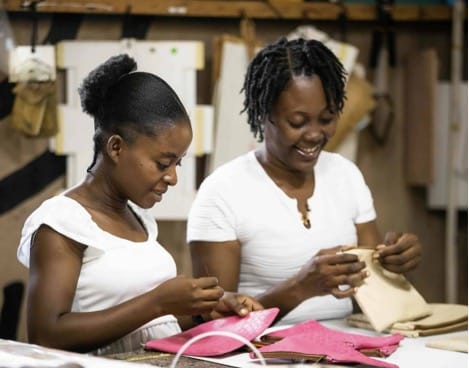
At our factory in Haiti, a women-owned, solar-powered leather goods facility, every artisan earns Fair Trade Verified wages, meaning our compensation standards are audited against real benchmarks rather than aspirational marketing language. What I’ve watched happen, one woman at a time over more than a decade, is that economic stability changes how women inhabit their communities. Her children stay in school. She builds credit. She gains standing. She leads. That trajectory doesn’t start with inspiration. It starts with a consistent paycheck attached to a skill she owns.
The Part Nobody Talks About: Choosing Mission Over Margin
Across the social enterprise world, there’s a tension that founders rarely discuss publicly because it can be read as a complaint: staying mission-driven is financially expensive. When you’ve built something around a moral commitment, every moment where market logic pushes against that commitment becomes a test of identity. Do you compromise on wages to hit a price point a retailer needs? Do you shift production to a cheaper country to survive a slow quarter? Each decision carries weight that a purely commercial business simply doesn’t carry.
I won’t pretend those moments are easy. There are months where keeping our production in Haiti instead of shifting to faster, cheaper manufacturing has cost us competitively. There are conversations with retailers where the ethical story resonates but the price point creates friction. The emotional cost of holding a mission under financial pressure is real, and anyone who tells you otherwise is selling something. What I’ve found is that the mission isn’t separate from the strategy, it IS the strategy.
The women we employ, their craftsmanship, their stake in what we’re doing: that’s what gives our work durability. But getting there required letting go of the idea that staying mission-driven was supposed to feel effortless.
From Relief Worker to Ethical Fashion Founder
People who pivot careers from humanitarian work to business often describe a clean narrative: I saw a problem, I built a solution. My actual path looked nothing like that. When I started Deux Mains, I was still processing what I’d seen in Haiti, still carrying the grievance of the earthquake and what came after it. Building a company was partly an act of grievance, partly stubbornness, and partly the conviction that the woman who told me she needed a job was right about something most of the aid world had gotten wrong. The early years were mostly improvising, learning leather craft, navigating Fair Trade certification, figuring out how to build a supply chain in a country with unreliable infrastructure.
Over time, a factory that has become a quiet proof of concept for what women-led manufacturing can look like in a post-disaster economy, and a brand that found its way into conversations about ethical fashion I wasn’t sure we’d ever be part of. The fashion industry’s conversation about ethics has caught up, somewhat, to what we were building from the beginning.
Writing my memoir, From Loss to Legacyrequired sitting with the parts of this journey I’d rather move past. The grievance, the self-doubt, the times I nearly walked away. What I found was that the losses weren’t obstacles to the mission. They were the reason I could understand it. You can’t build something for women recovering from catastrophic disruption if you’ve never had to figure out what solid ground feels like after your own foundation cracks.
The women of Deux Mains are not beneficiaries of my vision. They are the vision. My job has been to build the structure around them so their work can reach people who care about what they’ve done. Everything else follows from that.
About The Author
Julie Colombino-Billingham is a first-generation Italian American, Founder and CEO of Deux Mains, a Fair Trade Verified brand operating Haiti’s only women-owned, solar-powered leather goods factory, a different kind of fashion business focused on sustainable luxury goods that are better for both people and the planet. She’s also the author of From Loss to Legacy (2025).