



Grand bac oral exam, French baccalaureate, Brevet oral exam… The students are not sufficiently prepared for the oral exams and arrive on D-day stressed in front of the jury. Léo, an engineering school student, launched a new site so that everyone can train effectively. Interview.
As the baccalaureate approaches, the pressure increases a notch for high school students, especially for oral exams, sources of intense stress. And for good reason: students feel more anxious when it comes to speaking in front of a jury… Indeed, the opportunities to practice in real conditions remain minimal during schooling. To hope to progress, some parents call on a private teacher, a financially inaccessible option for many families (count on average between 80 euros and 100 euros per hour). “What most students do is revise by making flashcards. But on the big day, they risk discovering this pressure that they will not have had in their room because this time, they will be facing a jury who can quickly destabilize them with questions that they will not have prepared because they will have just learned a text by heart” notes Léo, aged 21.
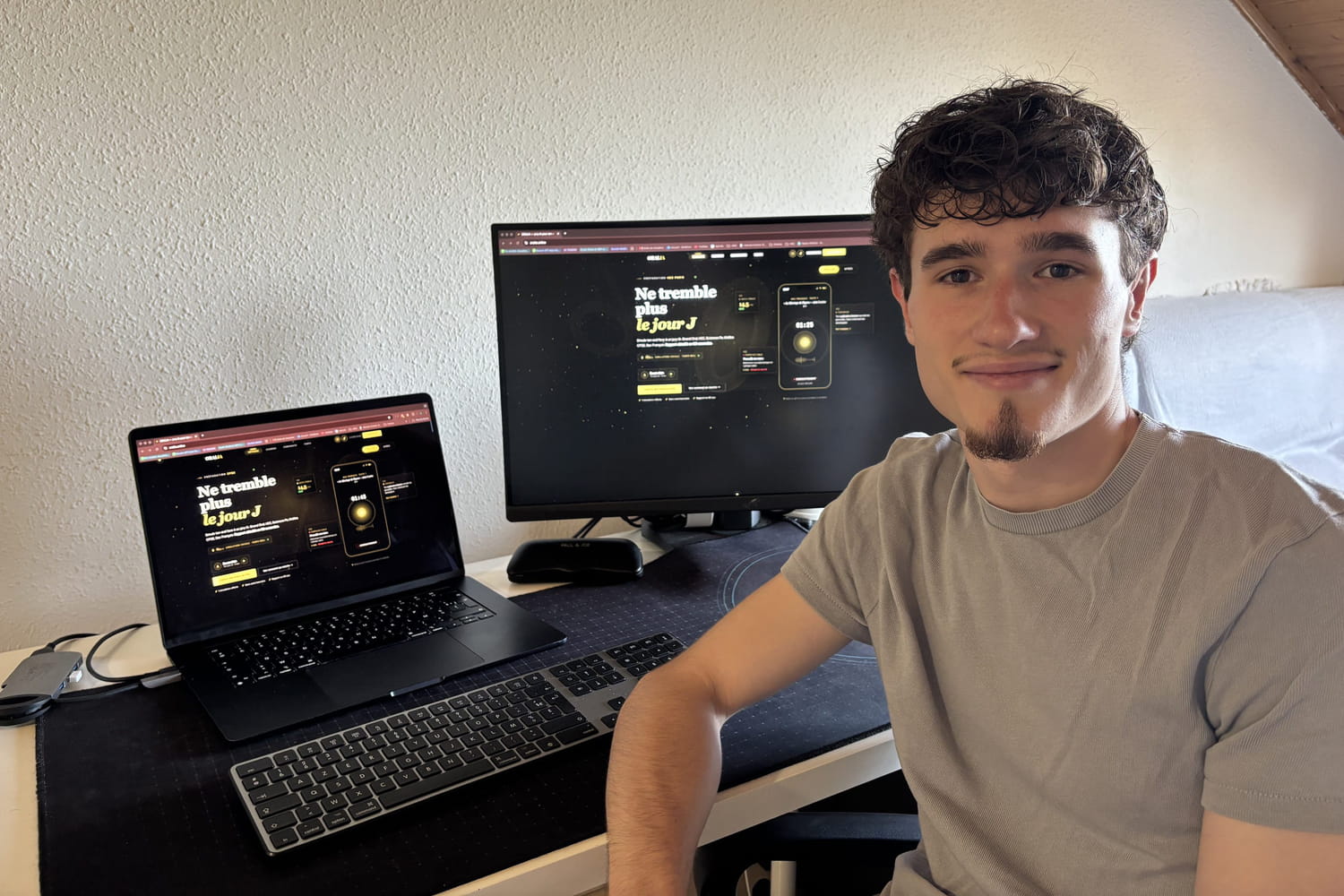
It is precisely this lack of preparation that pushed this engineering school student to imagine a unique solution. In six months of hard work, he designed and made operational the Oralia site which was launched on May 1, 2026. His goal? Allow each student to train effectively in front of a jury powered by artificial intelligence. “I wanted to provide a solution to students, because it does not exist“, he testifies to the Journal des Femmes. The young man did not do things by halves: the tool integrates a fluid vocal AI designed to come as close as possible to human interaction and above all, it is entirely calibrated according to the official evaluation grids of National Education.
So how does it work? “For the Grand Oral, for example, the student selects the two specialties chosen at the baccalaureate, then proposes their two questions to the jury who will choose one of the two. There is then 10 minutes of preparation where the student will have to speak in front of the screen” Léo explains to us. After listening to and analyzing the candidate’s comments, the jury makes “relaunches” to follow up on the student’s presentation, so as to train them in real conditions. “At the end, the student receives a detailed report with a score out of 20, always based on the evaluation criteria of National Education. The report also highlights the opinion of the jury, in particular on the structure of the presentation, the development of the student’s point of view, whether or not the conclusion was relevant, but also the rate of speech, which will make it possible to determine whether the student is stressed or not“, adds Léo. Regarding the oral French baccalaureate, “we need to cite a lot of references“, and for this review, the report will also note the culture and substance, quality of research and analysis. “Generally speaking, the candidate has a better understanding of their strengths, weaknesses and areas for improvement“, explains the founder of Oralia.
Finally, unlike the artificial intelligences that we could use to prepare for our exams, Oralia is very different from a traditional chatbot: “I implemented an AI that resembles a human voice as closely as possible“, specifies Léo. And above all, it is almost impossible to reproduce the ultra-precise prompts allowing you to speak to the juries as in the exam. On the site, it is also possible to practice facing Alain, “the caring”; Mathieu, the “demanding” jury; Hélène, the “curious” or even Etienne, “the intimidating”. The note and the report also provide real detailed feedback for the student… In terms of price, count on 3.90 euros for three simulations and up to 34.90 euros for the 25 simulations to no longer stress before the oral exam on the day. Note that this jury system was developed by Léo for numerous other oral exams (brevet oral exams, but also admission oral exams for major business schools like HEC Paris or Sciences Po exams)… And he doesn’t intend to stop there!
After a scientific, mathematics and physics baccalaureate, Léo joined the European University of Madrid for an aeronautical engineering course, where he is currently in his second year. At the same time, the young entrepreneur is already imagining diversifying his tools to reach other professional and academic sectors. “My plan is always to continue to develop Oralia, because I want to integrate all the different processes that we can have as an individual when faced with an oral presentation, for example job interviews in a company. There are also oral medicine exams where we could simulate a consultation with a patient.” he tells us. A brilliant and promising initiative which could well permanently transform the way we approach public speaking.