


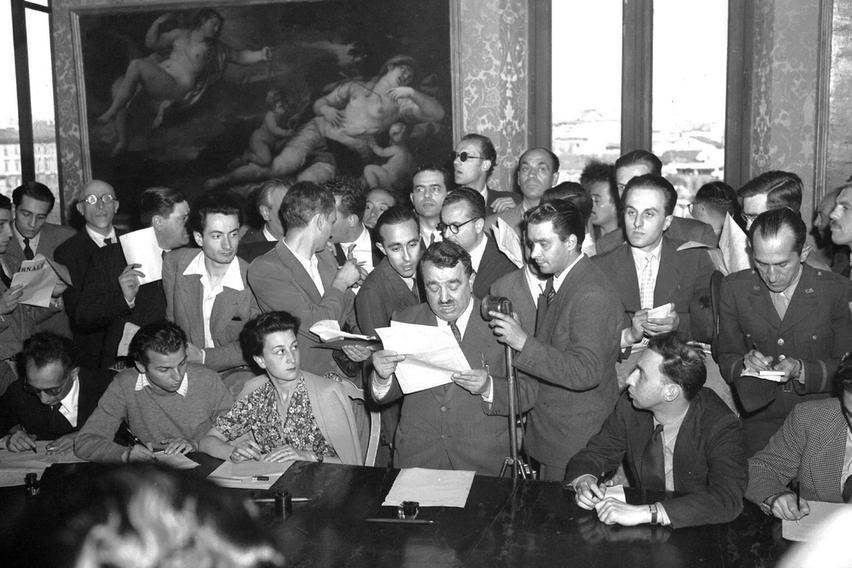
From the polls on June 2, 1946, came the portrait of a composite Italy, in which all cultures and positions were expressed. With a very strong representation entrusted to Catholics. Voters handed over 207 seats to the Christian Democrats, 115 to the PSIUP (Socialist Party of Proletarian Unity), 104 to the Communist Party, 41 to the National Democratic Union, 30 to the Everyman Front, and so on.
Then, in the Commission of 75, the one chaired by Meuccio Ruini with the task of physically drafting the text, all the components, even the most minority ones, were taken into consideration. But there is no doubt that the framework of the text of the Constitution was the result, to a large extent, of the contribution of Catholics. Among the 207 elected in the ranks of the Christian Democrats, many came from Catholic Action and Fuci, from commitment in the parish and from a faith that sought equality and social justice. Some of them, the so-called “professorini”, found themselves discussing together with Jacques Maritain and the positions of the future Pope Montini. In the house of the Portuguese sisters, a surname that is still found on the intercom of the building next to the Chiesa Nuova in Rome, Laura Bianchini and Giuseppe Dossetti, Amintore Fanfani, Angela Gotelli, Giuseppe Lazzati and Giorgio La Pira debated with Aldo Moro and De Gasperi. Together, the so-called “piggy community”, born also thanks to the then parish priest Father Paolo Caresana, elaborated, for Italy, a future of common good, freedom, work, health, justice, peace.
Practicing a “sanctity of everyday life”, they thought of a secular state, but strongly based on those ethical principles that exalted common humanity.
«They give us the idea of a Catholic community capable of tuning into great history», explains Luigi Accattolifresh author, together with Emilia Flocchini, of Eight at the Constituent Assembly. The men of God who founded the Republic (San Paolo publisher). «It came from the long situation of the fascist period in which the Catholic laity, the Catholic party and all the Catholic structures had been put aside, covered with a cloth, they had no public voice. With the Constituent Assembly, a sort of miracle occurs because the community of faithful manages to quickly express an ability to intervene that is perfectly up to the task that was asked of italmost as if she were natively prepared for this role.” Of all the Catholics who participated in that phase, Accattoli cites eight for whom the cause of canonization was opened or there was talk of opening. «That eight saints worked in unity of place, time and intent is an extraordinary fact», he specifies.
From the eldest, De Gasperi, to the youngest, Aldo Moro, passing through Igino Giordani, Giorgio La Pira, Giuseppe Lazzati, Enrico Medi, Benigno Zaccagnini and Giuseppe Dossetti, Accattoli and Flocchini’s text underlines «the historical preparation for a public role of the Christian faith. A heritage that is still alive, just think of figures like Sergio Mattarella or Romano Prodito name two.”