Above 30°C, intense sport exposes you to dehydration, cramps and heatstroke. In the event of red alert, all physical activity should be avoided. Which sports should you absolutely avoid and what essential precautions allow you to train without risk?
As soon as the thermometer exceeds 30°C, caution is required during intense physical exertion outdoors. At the slightest warning signal, you must immediately stop exercising, move to the shade in a ventilated area, splash yourself with water and hydrate. What are the real dangers of sport in high heat? What activities should you prioritize for safe maintenance and what essential precautions should you adopt? Update on health recommendations.
What are the dangers of doing sports during a heatwave?
“The human body is designed to function at 37 degrees. When it moves away from this temperature, the body is altered” explains Dr Roland Krzentowski, sports doctor and Founder of Mon Stade Maison Sport Santé Mgen. “When the individual makes a physical effort, 75% of activity is transformed into heat that must be evacuated. The human body has built a mechanism for dissipating this heat to maintain itself at 37 degrees, this is called sweating. To promote this, the body, under the direction of the brain, will reduce the blood supply to the deep vessels (those which bring blood to the organs) to favor the blood supply to the skin.“continues our expert.
You have to take into account the temperature but also the humidity in the air.
In case of heavy sweating, our deep organs are penalized and at a certain point, this is dangerous for the body. “The warmer and drier the air, the easier the evaporation of sweat; the more humid the air, the more difficult it is. It’s necessary take into account temperature but also humidity in the air. For example, if you exercise at 25 degrees with 80% humidity, it will be more restrictive for your body than an effort at 30 degrees but with dry air. develops our interlocutor. The 3 elements to take into account when doing sport are: temperature, humidity and solar radiation. “These are brought together by the WGBT index available on weather information sites. If the index is between 27 and 31, we are in a moderate risk, but if it exceeds 32 the risk is major” warns Dr. Krzentowski. Even if the effects on the body depend on each individual (training, fatigue, habituality to high climate, etc.)we avoid sport in the sun at 30 degrees. Exercising during very hot weather, without hydrating enough or after too intense an effort, can dysregulate the body’s mechanisms to cool itself and lead to:
► The dehydration : When it is hot or very hot, the body can lose up to 2 liters of water per hour. And when it loses water, the body loses salt and this increases the risk of dehydration.
► The heat cramps
► A early fatigue : in the absence of sufficient water compensation, the increase in heart rate can cause early fatigue.
► Sunstroke which is characterized by an increase in body temperature, facial flushing, excessive sweating, headaches or even dizziness, nausea and vomiting. Sunstroke should never be neglecteddue to its potential progression towards serious disorders. It requires the immediate use of all means to lower body temperature. To do this, you must first practice simple actions such as: lying down in a cool, shaded place, drinking plenty of water and wetting your neck, face and limbs with water.
► The heat stroke : when the body temperature exceeds 40 degrees, the skin is red, hot and the body no longer produces perspiration. The body no longer adapts, it loses control of the situation. The pulse accelerates, we observe confusion, a loss of consciousness and an alteration of cognition (analysis, hampered decision-making, memory loss, etc.). You must immediately call 18.
What precautions should you take when it is very hot?
“If you are not trained, you should not start or resume physical activity or sporty in periods of high heat“warns the Ministry of Health, which recommends limiting physical activity as much as possible in the event of a heatwave.”We monitor his heart rate, adds Dr. Krzentowski. If for the same intensity of effort your heart rate is higher than usual, we reduce the effort“. Precautions;
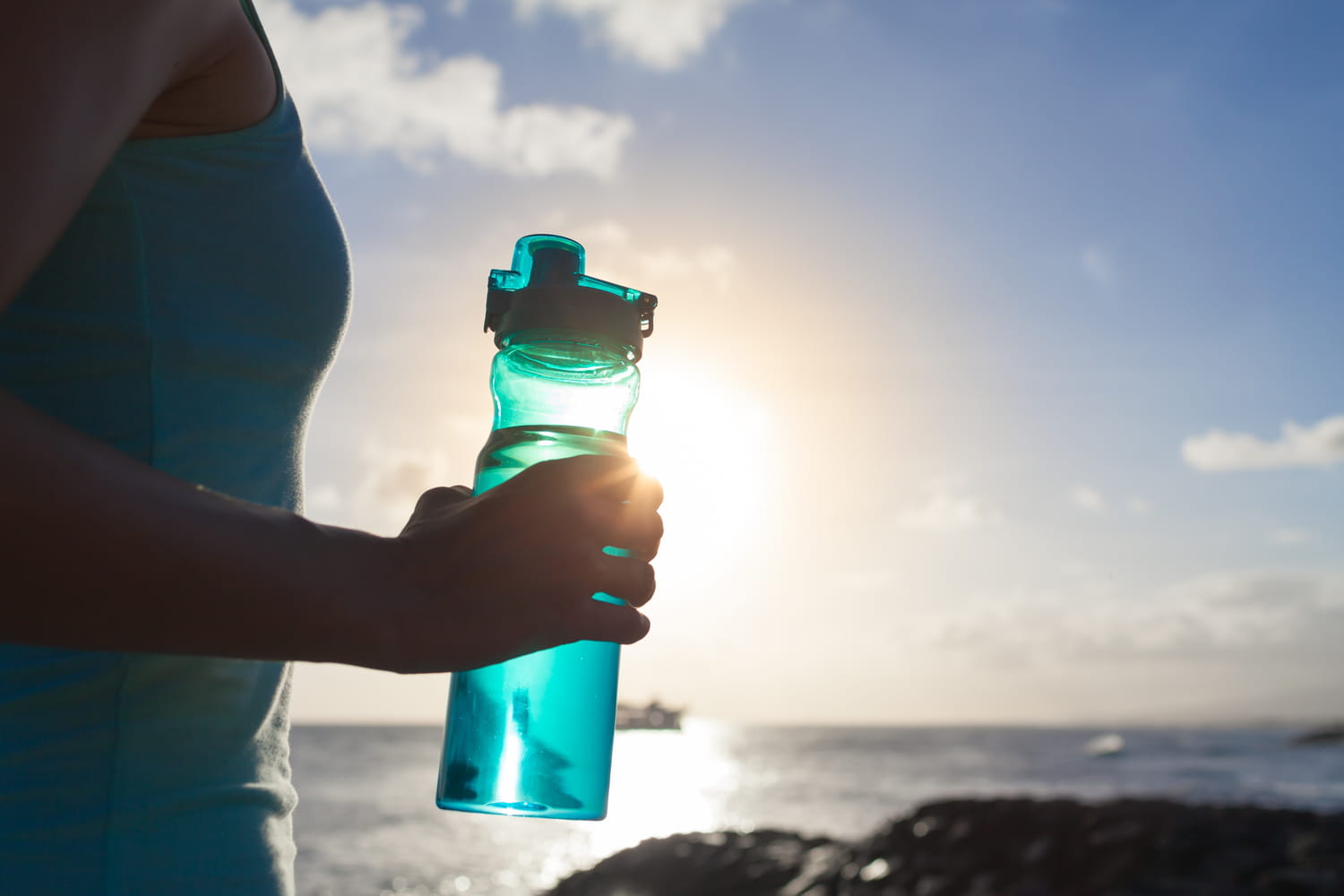
► Drink water. Rule #1: Hydration. You need to hydrate well before, during and after exercise. You don’t have to wait until you’re thirsty to drink! Be careful, avoid drinking ice cold to avoid creating thermal shock.
You don’t have to wait until you’re thirsty to drink!
► Choose loose, light and “breathable” clothingso as not to retain perspiration and help the body to cool down, and instead to light colors because the latter absorb the sun’s rays less than dark colors. If possible, shoes must allow good heat dissipation with insulation at the sole level,
► Exercising in the shade or in an air-conditioned gym (Or run in the undergrowth rather than on bitumen for example).
► Sprinkle yourself with water regularly.
► If you play sports outdoors, you must protect your skin with sunscreen with a high index (even if the sky is overcast), sunglasses, a hat or cap ideally with a return on the neck to protect it.
► Avoid making too much physical effort in full sun/when it is hot or very hot (above 28°C).
► Stay vigilant towards oneself and other athletes.
► We don’t drink alcohol before physical exertion and we avoid diuretic drinks like coffee which are dehydrating.
► We decrease the intensity and the duration physical activities.
What advice after the sports session in case of heat?
We drink lots of water to compensate for the loss. And we wait a bit for the body to cool down before taking a shower to avoid thermal shock. Above all, no very cold water (drinking or showering) : the brain would start warming up the body.
To avoid the risk of dehydration, we drink a lot of water before the sports session, 200 to 300ml (2 glasses) every 30 minutes, during And After the session every 15 to 20 minutes. And above all, you must drink before you are thirsty. ‘Drinking allows evaporation through sweat and cooling of the body” explains Dr. Krzentowski. “You have to drink more if it’s hot and you’re making an effort.” “For example, moderate walking (5km/H) and with 50% humidity and 30 degrees temperature, you should drink 1 liter of water every hour. In these same weather conditions, but in fast running (30KM/H), you should drink 3 liters per hour”. It is advisable to drink regularly in small successive quantities. Still water but rich in mineral salts is preferable since it promotes perspiration: salt allows water to pass through the skin. In the event of very prolonged efforts, it may be useful to add sugar in the water.
Contrary to popular belief, doing sport in the heat does not burn more calories: we sweat more, so we lose more water, but we do not lose more weight and therefore do not melt more fat. |
What sport can you do when it’s hot?
Sport has many health benefits (it acts against excess weight, improves endurance, reduces cardiovascular risk, prevents osteoporosis, reduces stress and anxiety, etc.) but when it is hot, certain sports are more recommended.
► Swimming, aquagym, aquabike, water polo, paddle : “Sports practiced in the water rreduce the risks linked to heat but we must not neglect the parts of the body which are outside the water” says Dr Roland Krzentowski, sports doctor.
► Fitness, zumba, body balance, yoga, pilates, bodybuilding: “Sports practiced in a air-conditioned gymsheltered from the sun are preferred” adds the doctor.
► Avoid competitive sports (tennis, football, rugby) and outdoor sports during heatwaves, since they encourage you to surpass yourself and increase the intensity of your effort. “Finally, as long as you take precautions (see above), all sports can be practiced. It’s the way you practice that counts” recalls Dr. Krzentowski.
What time to exercise during a heatwave?
We avoid the time when the sun hits the strongest, that is to say between noon and 4 p.m. We choose to plan these sessions in the morning (before 10 a.m.) or early evening (after 6 p.m.)close to sunset. Between 11 a.m. and 5 p.m., sport is not recommended in case of very high heat or heatwave.
Who should avoid sport when it’s very hot?
► Children, people over 65, and pregnant women are advised not to practice sports in the heat because they are at greater risk of dehydration.
►“Young people are not more protected, they run the same risks in the event of intense practice under the sun” warns Dr. Krzentowski.
► The populations most at risk are those called fragile : in overweight or obeseaffected by diabetes, hypertension or any condition that weakens the body and increases the risks.
► Untrained people or beginnerspeople who are recovering from an illness (colds, gastro, angina, etc.) should not do sports when it is hot
Trick : “If we want test its adaptation to heat, We weigh ourselves before then after the effort. Weight loss corresponds to the amount of water lost. If you have lost 2% of your body weight, mental and physical performance is somewhat affected (fatigue, less concentration, etc.). Between 3% and 4% loss, capacities are significantly reduced. Beyond 10% of body weight, we are in danger“ alerts Dr. Krzentowski.
Thanks to Dr Roland Krzentowski, sports doctor and Founder of Mon Stade Maison Sport Santé Mgen.
Sources:
– Heat waves, Ministry of Solidarity and Health, June 15, 2022
– Heatwave and extreme heat: launch of the seasonal watch and reminder of the actions to be adopted by everyone, Public Health France, June 10, 2022
– Recommendations for populations in the event of heat, Ministry of Solidarity and Health, June 10, 2021
– General knowledge on physical activity, sedentary lifestyle and health, HAS, “heatwave” recommendations from the Ministry of Solidarity and Health.