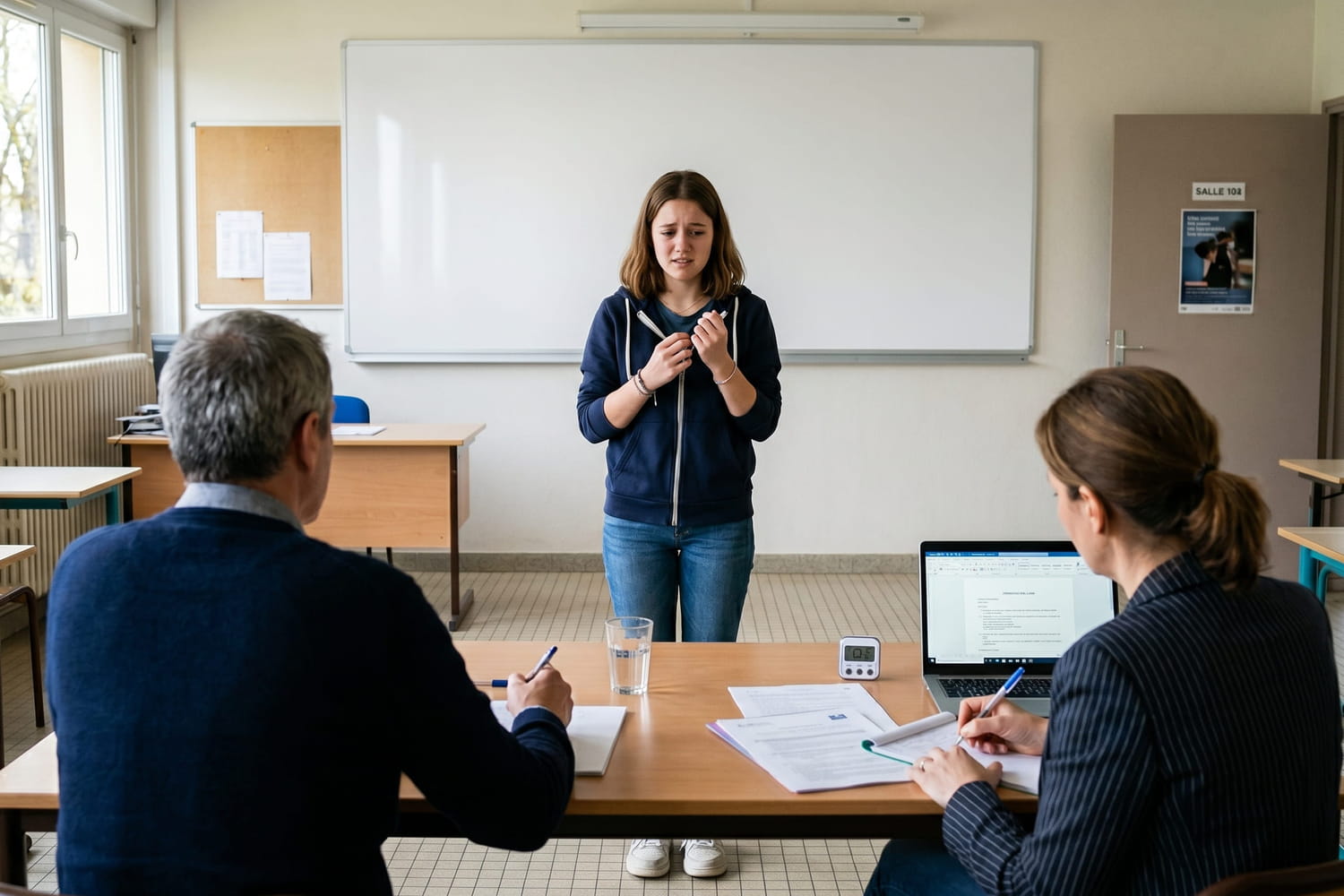
Speaking in front of a jury is a stressful exercise that can quickly make you lose your train of thought. Whether it’s the Grand oral, the French oral or the catch-ups, don’t panic: here are some practical tips to avoid a memory lapse on the big day, and channel your anxiety.
The exercise of baccalaureate oral exams is often a great source of anxiety, especially for naturally shy students. The 2026 event calendar is also imminent: the Great oral will run from June 22 to 1er July for Terminale, Première students will also take their oral French from June 22 (dates may vary depending on the academies), while catch-up oral exams will be held from July 9 to 11, for high school students who have not obtained the average in the baccalaureate.
To succeed, it is essential to know how to express yourself with clarity, seriousness and confidence. However, pressure and fear of failure can quickly make you lose track of the big day. So how do you overcome your stage fright in front of examiners ? Here are our practical tips for staying in control and tackling these deadlines with complete peace of mind.
1 – Practice speaking out loud
For the oral exams of the baccalaureate, it is not only the knowledge of the subjects that counts: it is also necessary practice speaking out loud ! To help your child prepare, you can have them review a theme, as if you were the baccalaureate examiner : in a quiet room, give him a topic, give him time to prepare, and ask him questions.
If these are themes that you do not master, that you do not have the time or that your teenager prefers not to do it with you, suggest that they do it with their classmates by organizing an afternoon dedicated to oral exams for the baccalaureate. You can also advise him to recite his revision sheets out loud, alone in his room. All that matters is thathe practices expressing himself correctly, articulating well and using simple words that he understands.
2 – Anticipate memory lapses when speaking
Stress sometimes causes memory lapseseven if your child knows his subject like the back of his hand, and this tends to increase the level of panic. To prevent this from happening on the day of the oral, use mnemonics with your child during revision.
The student can make acronyms of a theme or plan for the oral presentation. He can find associations of ideasfor example, to remember dates, find someone (a loved one or even a celebrity) who was born on the same day to remember them more easily. It can also memorize your revision sheets thanks to important words highlighted in bold with a specific color code.
3 – Do breathing exercises
THE breathing exercises are very useful at the time of baccalaureatebecause not only do they help manage stress, but they also allow to focus. Furthermore, they can be done the day before, or just before taking the oral exam!
First exercise: in a quiet corner, the student breathes in and out slowly, emptying his lungs several times until he feels a little relief.
Second exercise: To calm down, breathe in through your nose for 4 seconds, hold your breath for 4 seconds, exhale through your nose for 4 seconds, and hold your breath again before starting at the beginning.
Third exercise: to concentrate, do the same exercise by closing your eyes and clearing your mind, for example during the last few minutes of your preparation time before going in front of the examiner.
4 – Learn to put things into perspective
To avoid panicking too much on the day of the oral exam, you must also learn to put things into perspective. First, tell him that it’s just an exam and, although it is important, it is only one note among many. As for not succeeding, your child has already done it during the white bac exams… So there’s no reason why he can’t do it this time.
As a parent, do not hesitate to reassure him by reminding him thatthe examiner is not there to be harsh with him. On the contrary, many of the teachers who administer the oral exams tend to be benevolent. If it reassures him, he can imagine talking to someone he already knows to feel more confident.
5 – Have self-confidence on the day of the oral exam
This is by far the most important thing, even if it’s not the easiest to implement! Your child must have trust in him. Not only will this help him not to panic, but it will also give a better impression to the examiner.
Before taking your oral exam, remind him what makes him a good studenttell him that you will be proud of him whatever his results, provided that he gives himself the means to succeed of course. Finally, help him remember his previous successesthe things he accomplished alone, the times he surpassed himself, whether in his school career or his sports club for example. Promote your skills is indeed essential to give him all the necessary confidence on the day of the exam.
6 – Do anti-stress massages
Stress sometimes causes cramps or tremors in your hands or legs. To avoid this, teach your child to massage your hands or legs to soften your muscles and relieve stress.
Massage exercises: press the palm of your hand with your thumb and make small circles. To relax, you can also massage your face with the tips of your fingers, starting at the bottom of the face, making small circular massages then moving up towards the cheekbones, temples, forehead and scalp.
Finally, work on your breathing : place your hands on your stomach and feel it expand for 5 to 7 seconds. Exhale slowly so that it gradually deflates over 5 to 7 seconds. Generally speaking, in cases of stress, amplify your breathing to lengthen the breath in the abdomen. A stress ball to hold in the palm of the hand can also be useful.