


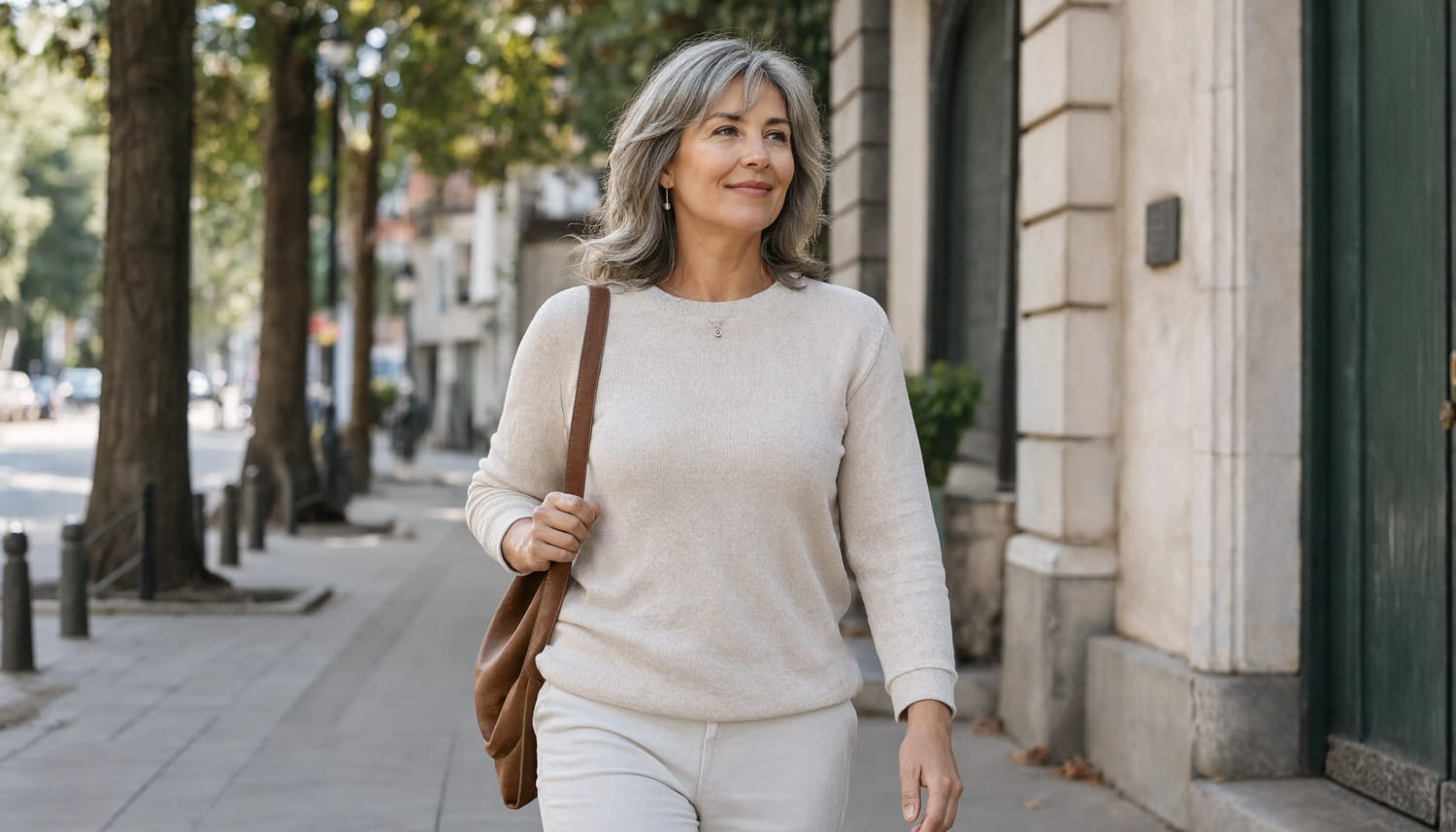
According to a new study, a certain way of walking could burn more fat, especially during menopause. Explanation.
During menopause, the body undergoes changes that make fat loss more complicated. Many then turn to crazy diets, or high-intensity workouts with lots of cardio. However, according to a new study, there is a much easier and healthier way to lose fat as the years go by. Published in the American journal Nutrients, it sheds light on a question that we have been asking ourselves for a long time: when we walk, is it better to focus on speed or slowness? Which option helps burn the most fat?
To answer this question, researchers followed 25 postmenopausal women who they asked to follow a walking program for 15 weeks. After this time, nine participants stopped the study, while sixteen continued for an additional 15 weeks. All participants walked approximately 5 km four times a week. Those in the fastest group walked at around 6.6 km/h and therefore exercised for around 45 minutes per day. Women in the slowest group walked at a pace of 5.1 km/h and exercised for 54 minutes per day.
Among the 16 women who followed the program for 30 weeks, those who walked at a slower pace lost 2.73 times more fat than the brisk walkers. Another important point: the fast walkers did not lose fat before completing the 30 weeks, unlike the others who eliminated throughout the study.
But then, how can we explain that walking slowly burns more body fat? Without having a precise answer, the researchers put forward a hypothesis: walking at a higher speed requires more breath, which pushes the body to consume the sugar present in the blood as an immediate source of energy. Conversely, when you walk more slowly, the body draws more on its fat reserves. It is important to clarify that the study was carried out on a small scale and therefore does not reflect a general truth.
However, the results correspond to what sports doctors have been saying for several years now: at menopause, hormonal changes already make the body more sensitive to stress. The body perceives high-intensity cardio sessions as an attack and then triggers a spike in cortisol. This hormone promotes fat storage, particularly in the abdominal area. This is why, during this period of life, it is preferable to focus on gentle cardio, long walks but also and above all muscle strengthening. QED.