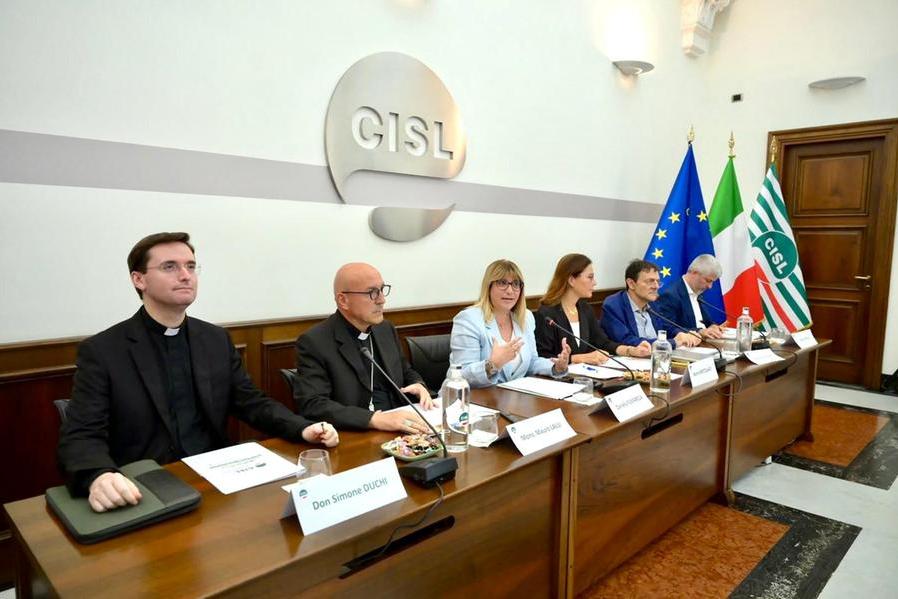
Artificial intelligence can become an extraordinary tool for progress, but only if it remains at the service of man. This is the underlying theme of the meeting promoted by the CISL, which in Rome dedicated a session of its executive committee in a study session to the encyclical Magnificent Humanitas by Pope Leo XIV, comparing representatives of the ecclesial world, scholars and economists on the relationship between technological innovation, personal dignity and the future of work.
The debate was attended by Monsignor Mauro Lalli, archbishop and Apostolic Nuncio; Don Simone Duchi, theologian and official of the Secretariat of State; Marta Bertolaso, professor of Logic and Philosophy of Science at the Campus Bio-Medico University of Rome; the economist Leonardo Becchetti and Alec Ross, among the leading international experts on technological policies.
In the conclusions, the general secretary of the CISL Daniela Fumarola recalled the value of the encyclical as a compass to guide a transformation that does not only concern technology, but the destiny of man. «Technological transformation, and in particular artificial intelligence, cannot be approached only as a technical matter. It’s not just about algorithms, machines, data, platforms. It’s about the person.”
According to Fumarola, Pope Leo XIV’s message offers an interpretation that goes beyond the boundaries of the Catholic world. «Faced with the power of technology, humanity is called to take a decisive step against the waste economy and for the full humanization of work. No innovation is truly innovation if it leaves the person behind or compresses their dignity.”
It is a call which, for the CISL, fits fully into the tradition of the social doctrine of the Church, which has always considered work as an expression of human dignity and an instrument of participation in the construction of the common good. «Ours is a Confederation born in freedom, grown in responsibility, rooted in participation», Fumarola recalled. «We recognize in the Encyclical many key elements of CISL’s thought: the centrality of the person, the social value of work, the primacy of the community over selfishness and participation as a way to make technological transformation fairer and more human».
During the meeting, the idea that the digital revolution cannot be governed solely by the logic of the market or the power of algorithms emerged forcefully. «We are not only faced with a new generation of digital tools. We are in the midst of a civilizational choice”, observed the CISL secretary, inviting us to overcome both alarmism and uncritical enthusiasm.
The risk, in fact, is that artificial intelligence ends up impoverishing personal responsibility. «It can be a great support. It can free up time, reduce repetitive tasks, improve diagnosis and services. But it becomes dangerous when it claims to replace human judgment.” For this reason, Fumarola added, “the risk is to deliver to the machine, piece by piece, not only some activities, but the very meaning of the work”.
Alongside ethical reflection, the CISL also relaunches a concrete commitment: investing in ongoing training, so that no one is excluded from the digital transition. «Mass education is the great social differentiator of the digital transition. Without widespread skills, artificial intelligence does not emancipate: it selects.”
The other pillar indicated is participation. For Fumarola, technological change cannot be passively undergone, but must involve those who work, enhancing their experience, responsibility and skills. «If there is no participation, technology becomes technocracy and workers suffer it. Participation does not slow down innovation: it makes it stronger, because it roots it in the concrete knowledge of those who work.”
The discussion promoted by the CISL thus showed how the dialogue between the social teaching of the Church and the world of work can offer an original contribution to one of the most decisive themes of our time. Artificial intelligence represents an extraordinary opportunity, but the criterion with which to evaluate it remains that indicated by the encyclical: all progress is authentic only if it safeguards the dignity of the person and strengthens the value of work as an experience of freedom, responsibility and participation.