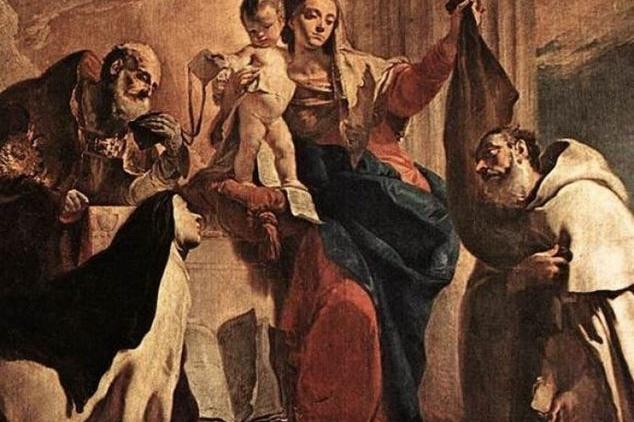
The liturgical feast of Our Lady of Mount Carmel was established to commemorate the apparition on 16 July 1251 to Saint Simon Stock, prior general of the Carmelite Order at the time, during which Our Lady gave him a scapular (from the Latin scapulashoulder) in fabric, revealing notable privileges connected to his cult.
The apparition to Elijah on Mount Carmel
In the First Book of Kings of the Old Testament it is said that the prophet Elijah, who gathered a community of men on Mount Carmel (in Aramaic “garden”), worked in defense of the purity of faith in God, winning a challenge against the priests of the god Baal. Christian monastic communities were later established here.
The crusaders, in the 11th century, found religious people in this place, probably of the Maronite rite, who defined themselves as heirs of the disciples of the prophet Elijah and followed the rule of Saint Basil. Around 1154, the French nobleman Berthold retreated to the mountain, having arrived in Palestine with his cousin Aimerio of Limoges, patriarch of Antioch, and it was decided to reunite the hermits to live a cenobitic life.
The religious built a small church in the middle of their cells, dedicating it to the Virgin and took the name of Brothers of Santa Maria del Monte Carmelo. In this way, Carmel acquired its two characterizing elements: the reference to Elijah and the link to the Most Holy Mary.
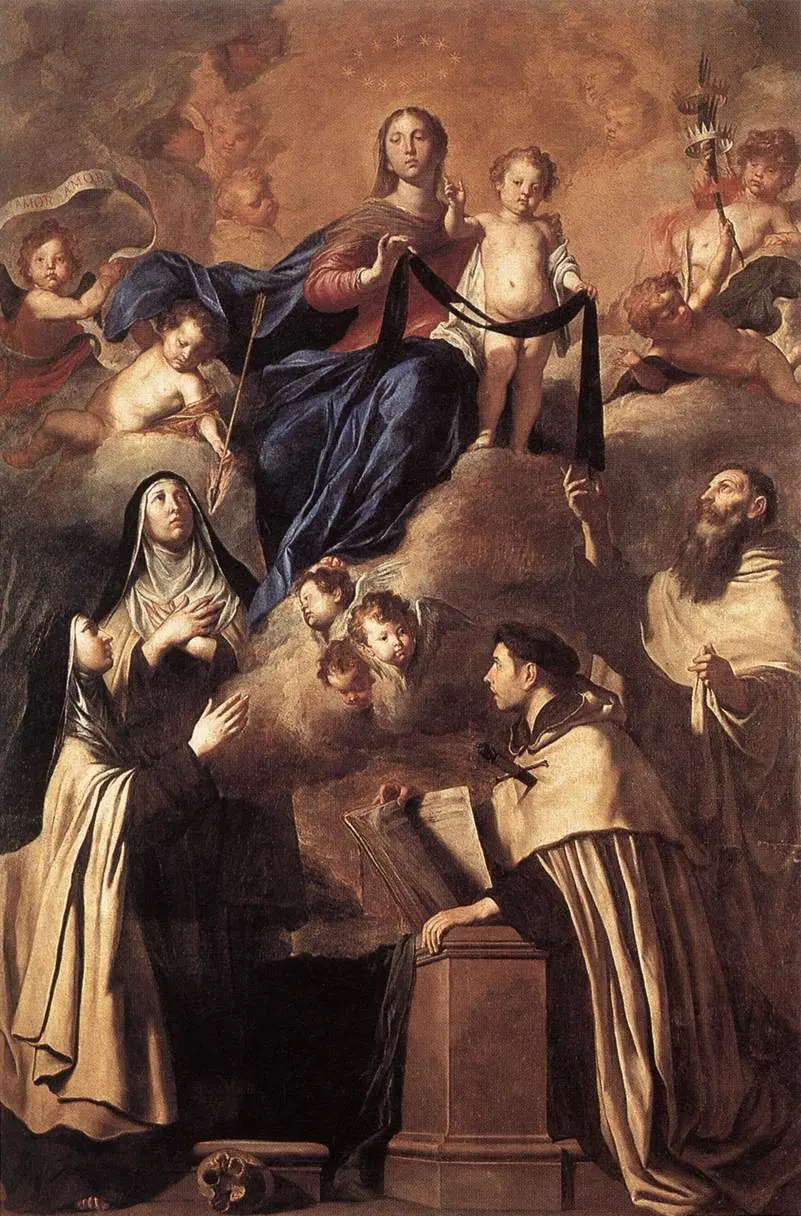
Pietro Novelli, Our Lady of Mount Carmel delivers the scapular of the order to saints Simone Stock, Angelo da Gerusalemme, Maria Maddalena de’ Pazzi and Teresa D’Avila
The rest of the Holy Family
Mount Carmel, where according to tradition the Holy Family stopped on their way back from Egypt, is one mountain range, located in the Upper Galilee, a region of the State of Israel and which develops in a northwest-southeast direction from Haifa to Jenin. Between 1207 and 1209, the Latin patriarch of Jerusalem (which was then based in San Giovanni d’Acri), Albert of Vercelli, drew up the first statutes for the hermits of Mount Carmel (the so-called Primitive Rule or Formula vitae). The Carmelites have never recognized the title of founder to anyone, remaining faithful to the model that saw the prophet Elijah as one of the fathers of monastic life.
The Rule of the Carmelites
The Rule, which prescribed night vigils, rigorous fasting, abstinence, the practice of poverty and silence, was approved on 30 January 1226 by Pope Honorius III with the bull Ut vivendi normam. Due to the incursions of the Saracens, around 1235, the friars had to abandon the East to settle in Europe and their first convent found its home in Messina, in the Ritiro area. News about the life of Saint Simon Stock (Aylesford, circa 1165 – Bordeaux, 16 May 1265) are scarce. After a pilgrimage to the Holy Land, he decided to join the Carmelites and, having completed his studies in Rome, he was ordained a priest. Around 1247, when he was already 82 years old, he was chosen as the sixth prior general of the Order. He worked to reform the rule of the Carmelites, making it a mendicant order: Pope Innocent IV, in 1251, approved the new Rule and also guaranteed the Order particular protection from the Holy See.
The scapular that frees from the pains of Purgatory
Precisely to San Simone Stock, who propagated the devotion of Our Lady of Mount Carmel and composed a beautiful hymn for her, the Flos Carmelilhe assured Madonna that those who died wearing the scapular would be freed from the pains of Purgatory, stating: «This is the privilege for you and for yours: whoever dies wearing it will be saved». The consecration to the Madonna, through the scapular, translates first of all into the effort to imitate her, at least in intent, to do everything as she would have done it.