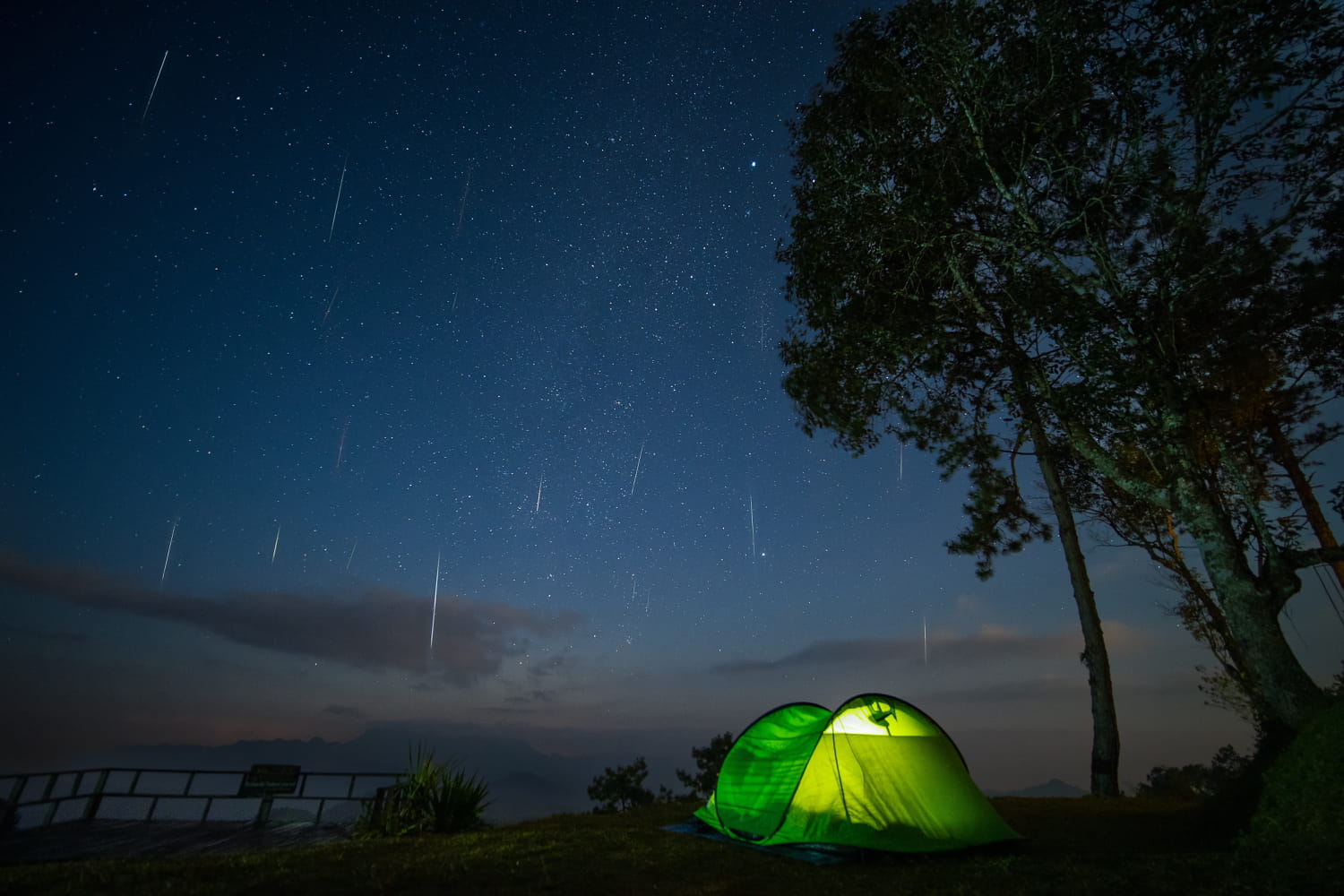
In astronomy, the Perseids are the most anticipated celestial event of the summer. This is the exact night not to be missed to admire this real natural fireworks display.
Notice to astronomy and starry night enthusiasts. After the timid meteor showers at the beginning of summer, the August sky is about to offer us its most grandiose spectacle: the night of the Perseids. The good news is that this edition promises to be one of the most beautiful of the decade. At the peak of the event, the Perseids can deliver up to 100 shooting stars per hour, or more than one meteor per minute. The show will also have its share of “bolides”, these larger fragments of rock which burn up, creating magnificent, very luminous and colorful trails for several seconds.
To fully enjoy the spectacle: neither telescope nor binoculars are necessary. Our eyes alone offer a much wider field of vision so we don’t miss anything. Make yourself comfortable and grab a deck chair or blanket to lie on the ground with your head propped up to avoid neck cramps. Stay away from city centers and public lighting. Choose the countryside, a dark park, the mountains or the seaside. Give your eyes 15 to 20 minutes to fully adapt to the darkness (and avoid looking at your phone screen).
To not miss anything of the show, remember the night of Wednesday August 12 to Thursday August 13, 2026. According to the International Meteor Organization (IMO) and Stelvision, it is at this precise moment that the meteor cloud will reach its peak of intensity. The icing on the cake this year: the peak occurs just a few hours after the great solar eclipse of August 12 and coincides with the New Moon. Without any lunar reflection to disturb the night, the sky will be pitch black. If a few shooting stars will cross the sky as soon as dusk falls, the ideal time to catch their eyes is in the second part of the night, between midnight and dawn.
The apparent starting point of these shooting stars (called the “radiant”) is in the constellation of Perseus, towards the Northeast. However, there is no need to focus only on this point: the Perseids cross and pass through practically the entire celestial vault.
Behind these ephemeral light trails are not real stars, but dust and stones left behind by comet 109P/Swift-Tuttle. Every year in August, the Earth encounters this cloud of debris. By entering our atmosphere at the dizzying speed of 60 kilometers per second (or 210,000 km/h), this debris ignites under the effect of friction, creating these magnificent trails of light.