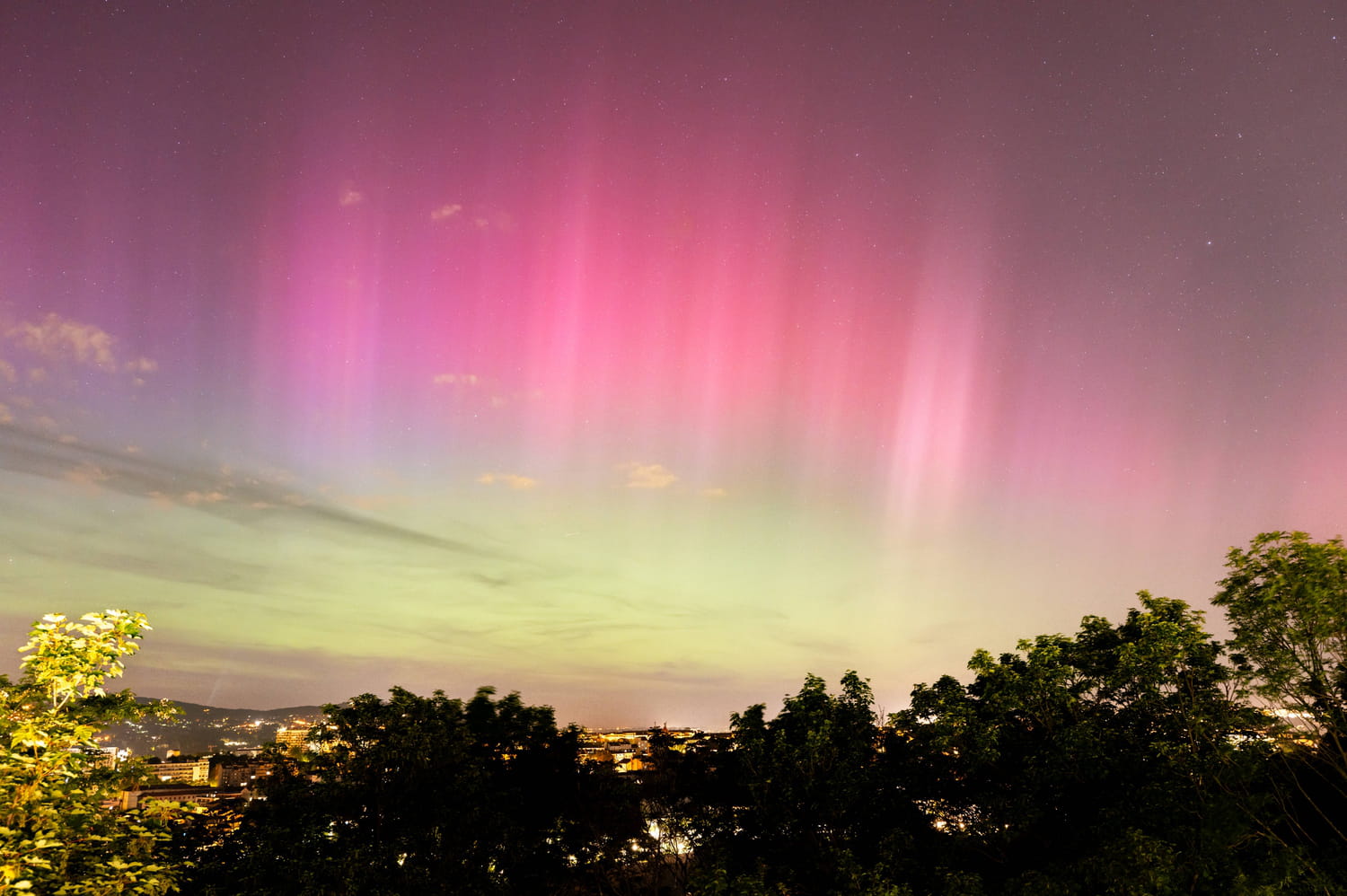
According to forecasts from the American Oceanic and Atmospheric Observation Agency, the peak of the aurora borealis storm is expected on the night of…
It is a celestial spectacle of exceptional rarity. Following a powerful solar flare projecting billions of tons of charged particles into space, the Earth’s magnetic field is about to receive a major geomagnetic shock. A rare opportunity for residents of mainland France to hope to witness sumptuous northern lights, at the heart of a particularly intense 25 solar cycle.
Concretely, what should we expect? Due to our distance from the pole, we do not observe the base of the auroras (usually green), but their top. The northern sky could thus be tinged with pink, magenta, purple or reddish veils, appearing to float very high on the horizon. If the storm gains intensity, large vertical “curtains” will appear to move slowly for a few minutes.
According to forecasts from NOAA (the American Oceanic and Atmospheric Observation Agency), the peak of the storm is expected on the night of Wednesday July 22 to Thursday July 23. The chances of observation will be particularly favorable in the northern half of France (Normandy, Hauts-de-France, Brittany, Grand Est), while the South will have to count on a burst of intensity from the storm to see lights on the horizon. In the middle of summer, the brevity of the nights imposes a strict constraint: the only ideal observation window is between 11:30 p.m. and 3:00 a.m.
To benefit from it, no heavy equipment is required. Move away from cities to escape light pollution and choose an elevated spot with a clear view of the northern horizon. The unstoppable tip: use your smartphone in Night mode (exposure of 3 to 5 seconds). Since the digital sensor is more sensitive than the human eye, your screen will instantly reveal magenta colors, even if you only see a fine pink haze with the naked eye.
When will the next wave of Northern Lights be seen? Space weather can only be predicted with 24 to 72 hours notice. However, astrophysicists confirm that the global window remains wide open until the end of 2026. With the Sun remaining on its plateau of maximum activity, other giant sunspots will turn towards Earth in the weeks and months to come. Other alerts will therefore take place between now and autumn, a season even more conducive to observation thanks to much longer and darker nights.