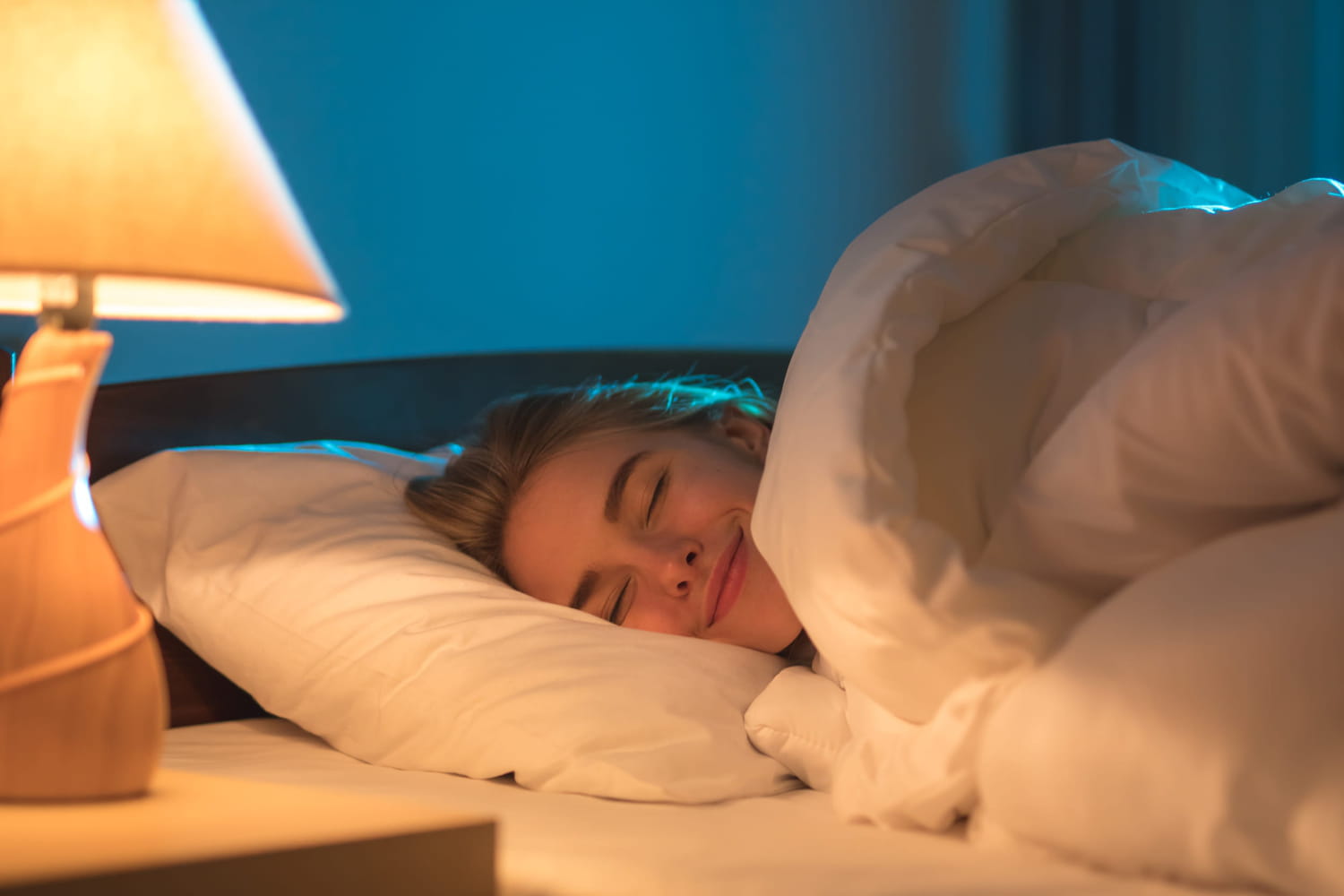
According to a large study on sleep, the way we sleep has an impact on the brain and influences our intellectual and cognitive performance such as memory or logic.
We are not equal when it comes to sleep: on the one hand the early risers, often held up as models, on the other the late risers, who are readily accused of laziness. The main reason? We don’t all have the same chronotype and therefore don’t all fall asleep at the same time. This difference could even go further: according to a British study, there is a link between our bedtime and our brain performance.
To see more clearly, scientists analyzed more than 26,000 adults aged 53 to 86. Each participant declared their duration of sleep, their quality of rest and their chronotype, that is to say their natural tendency to be more of a morning person or more of an evening person. Their mental abilities were then measured via tests covering logic and reasoning, visual memory, processing speed and prospective memory. The goal: to explore the relationship between our sleep habits and the brain.
And, surprise, it’s not the early risers who win the prize. The results clearly lean towards night owls. According to the study, “later chronotypes are correlated with better cognitive performance”while “morning people consistently had the lowest scores in both cohorts”. Concretely, night owls reason more quickly, retain better what they see and remember more of the tasks to be accomplished. How to explain it? It would all depend on age. Among younger people, being a morning person remains an asset. But over the years, the trend would reverse, undoubtedly because our internal clock evolves. However, here, all the participants were over 50 years old.
It remains to be seen at what time we can call ourselves a night owl. In sleep medicine, there are three profiles of sleepers. Early sleepers, whose internal clock runs a little faster than 24 hours, reach “the end” of their day more quickly and are reluctant to stay late at night (around 20% of the population), which does not pose a problem when we know the two hours of the night when sleep is most restorative. Next comes the most widespread profile, the “in-between” (60% of people), who likes to go to bed between 10:30 p.m. and midnight. Finally, night owls, whose internal clock is slower: rarely in bed before midnight, or even 1 a.m., they stay up without difficulty but struggle to emerge. They also represent nearly 20% of French people.
But should we force ourselves to keep watch? Certainly not, and scientists are clear: staying up late does not make you smarter. Night owls often live against their biological clock to meet social demands, which puts them at greater risk of cardiovascular disorders, type 2 diabetes and anxiety. The study above all recalls the importance of sleeping seven to nine hours per night, taking care not to sleep too much so as not to age faster. A few reflexes contribute to this: exposing yourself to natural light as soon as you wake up, dimming the lights and banishing screens two hours before sleeping, or taking a lukewarm shower in the evening, which lowers your body temperature and signals to the brain that it is time to sleep.