





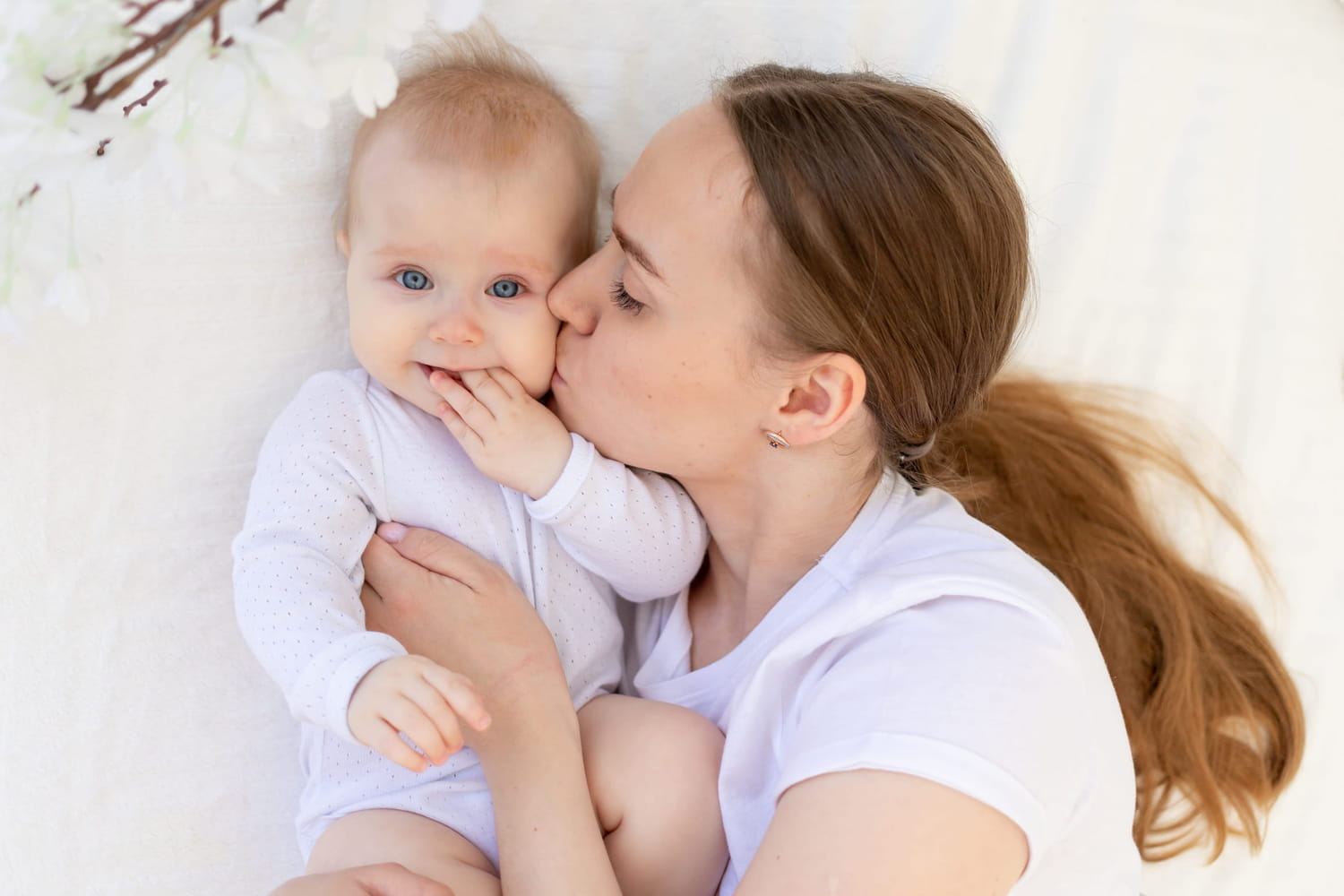
Contrary to what one might believe, the bond of attachment between a baby and his parent is not established either at birth or during the first weeks of life. A psychologist specializing in young children reveals to us the precise age at which this fundamental bond is truly built.
Of all mammals, the little human is the one born with the most immature brain. Its survival depends exclusively on the adult and it comes into the world with a vital need for social contacts and attachment. A lack of regular and warm contact with adults can also have a negative impact on their development, as we have observed in certain children raised in the dramatic contexts of post-war orphanages. The baby is thus programmed to attach to the adult who will take care of him the most during his first months, regardless of the way in which the latter meets his needs. But be careful:this process is not innate between a baby and his parents, it is constructed”explains Héloïse Junier, psychologist specializing in young children.
Furthermore, a baby can absolutely have several attachment figures, even if they will not all have the same weight in his life. We thus distinguish the primary attachment figure (the one who will have been most present during the first months) and the secondary attachment figures, that is to say the people who regularly take care of him. “Often the mother is the primary attachment figure, followed by the dad, the nanny or the nursery professional, the uncle or aunt, then the grandparents. All the people who take care of him on a regular basis thus become an attachment figure”, explains the specialist.
“We know that the child takes between 6 and 9 months to build this attachment bond with his main attachment figure”explains Héloïse Junier. To build quality attachment, the key word is emotional availability in the face of distress signals. “To properly apply attachment theory, you must first encourage the parent not to let their baby cry alone repeatedly. Indeed, the quality of the bond between a child and his parent will vary depending on the responses made to the baby’s distress signals.“, informs the psychologist. Concretely? “When a baby cries, we are not going to let him cry in his bed, nor yell at him asking him to stop, nor scare him… We are going to take him in our arms and try to soothe him against us in the minutes that follow“, she advises. The important thing: that the adult’s reaction is predictable for the child.
Contrary to popular belief, holding your baby often will not make him dependent, quite the contrary. Numerous studies have shown that the more a child is carried, which is what he is originally programmed to do, the more he will calmly explore his environment around 12-15 months. Certain everyday moments also constitute privileged opportunities to forge this bond: episodes of distress where baby needs to be reassured, but also bathing, eating and sleeping. And for parents who are worried about a lack of receptivity in their child, Héloïse Junier wants to be reassuring: “It is impossible for a child not to become attached to either his mother or his father, as long as they were present during the first months of the child’s life.
To promote a healthy attachment with your baby, keep these simple principles in mind: respond to his cries gently and consistently, increase physical contact without fear of carrying him “too much”, take advantage of everyday moments (bath, meal, bedtime) to create complicity, and do not feel guilty if you regularly entrust him to other caring adults. These secondary attachment figures contribute to his emotional balance and will not replace you as a parent. The essential thing remains the regularity and predictability of your responses: it is this stability which will allow your child to build, between 6 and 9 months, a solid and secure bond with you.
Thanks to Héloïse Junier, psychologist specializing in early childhood, doctor of psychology and author of the comic book My Baby Life (Dunod, 2021).