
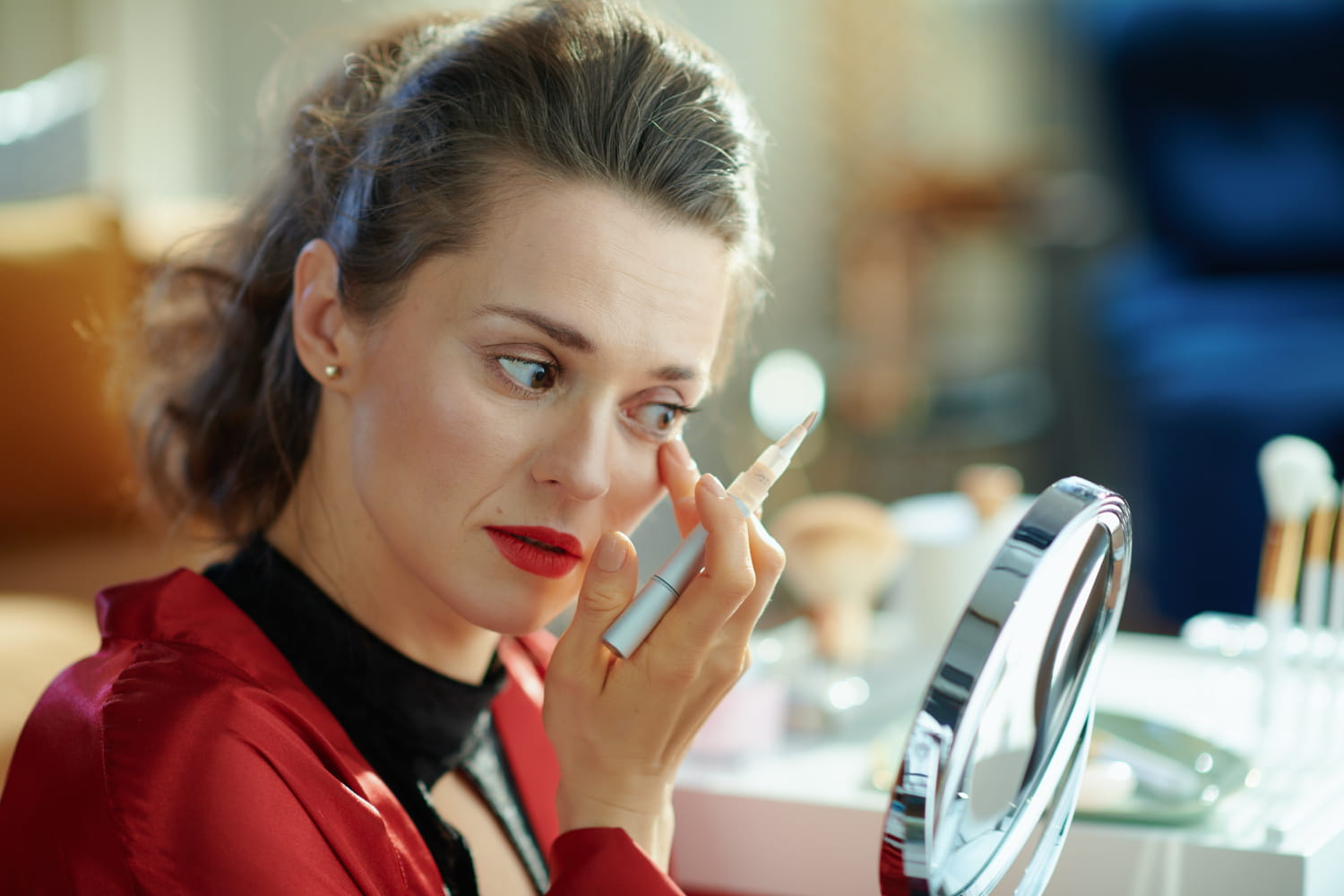




You will only have to arm yourself with small accessories, already present in your drawers. To your foundation.
After 40, complexion makeup becomes a balancing act. A foundation that covers too much marks wrinkles. Too light, it reveals redness and dark areas. But a professional makeup artist has rekindled the debate with a very easy-to-reproduce tip, presented as a real turning point for those looking for a clean, luminous result, without overload or plaster effect.
As we age, the skin loses suppleness, hydration and homogeneity, radically changing the way textures are deposited on it. Many find that the foundations and concealers they previously used end up emphasizing fine lines instead of blurring them. It is precisely this observation that pushed a makeup professional to rethink the way of applying cosmetic products.
At the origin of this method, Katie Jane Hughes became known for her very pragmatic approach to makeup, far from the ultra-coverage demonstrations often seen online. In a video posted to TikTok, she shared what she describes as “the best advice I can give you” to apply concealer. She states straight away that “this tip is for concealer or foundation”before insisting on a central point: “The secret? The brush.” Indeed, she explains how to obtain a pretty complexion, without makeup concentrating in the creases.
The principle? Use very little product, but work with it differently. The trick itself is to put a little full coverage concealer on the back of your hand, then tap the material with an eyeshadow brush. It is this barely loaded brush which is then delicately passed over the areas to be corrected, allowing the material to be deposited in a very fine veil, without visible overload or accumulation in wrinkles. For a perfect result, Katie Jane Hughes recommends well-maintained skin beforehand, in particular by gently exfoliating it the day before.
The specialist takes the opportunity to point out that if you apply a thick foundation around the nose, it will mark the folds more quickly. A warning that applies to all moving areas of the face such as the forehead and the contour of the mouth, where material tends to migrate. She insists: “Once you try the method, you won’t be able to do without it.”