








After starting her career at a thousand miles an hour in Silicon Valley, Anne-Laure Le Cunff is called to order by her body… An awareness that leads her to wonder what drives her deeply… and to follow training in neuroscience at King’s College London. She is now a researcher at the Institute of Psychiatry, Psychology and Neurosciences, hosted by the prestigious British university.
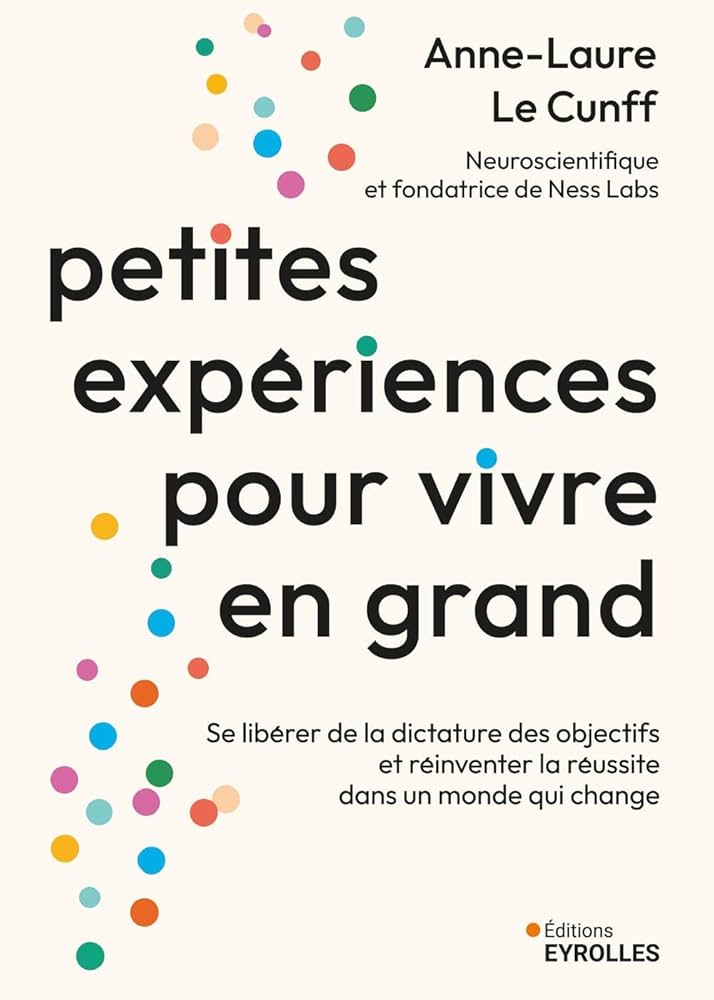
From his questions will also be born Ness Labs, a newsletter, launched at the end of 2019, dedicated to creativity and conscious productivity, today bringing together more than 130,000 subscribers. A concept that she has developed in the form of an educational platform offering courses or conferences. She looks back on her journey in a book, Small experiences to live big (Eyrolles, 2025).
In 2017, you had a daily life that, on paper, would make more than one person fantasize: you lived in San Francisco and worked for Google in the team dedicated to digital health. However, one day, you announced to your boss that you were leaving everything. Tell us about it.
Anne-Laure Le Cunff: Until this decision, I had had a fairly linear journey, based on a definition of success consisting of climbing the different levels of a ladder, of following steps prescribed by what society expects of us… or by what we imagine it expects of us.
Following my management studies at ESC Rouen, during a flight to San Francisco, I discussed the future of tech with my seatmate… thanks to whom I was able to have an interview and land an internship at Google, then a first position.
I then threw myself headlong into this new career, ignoring a certain number of weak signals. Starting with the amplitude of my hours. I lived in San Francisco and the Google offices are in Mountain View. To eliminate the problem of travel and traffic jams, the company provided its employees with a bus, equipped with wifi. So I took this bus around 6:30 in the morning, I worked there for two hours, I arrived at the office between 8:30 and 9 a.m. (depending on traffic jams)… Same in the evening, I worked again for two hours on the bus. Sometimes I even reopened my computer after having dinner. I regularly canceled commitments with my friends to devote myself to professional projects… like presentations to prepare for the next day.
I neglected my health. I didn’t really exercise anymore and I didn’t sleep well. The problem when you work so much is that you struggle to switch off your brain in the evening. Besides, when I got home, my instinct was to pour myself a glass of alcohol… It was a way to manage my stress and anxiety.
What was supposed to happen happened… You experience burnout which is manifested by the appearance of a clot in your arm. But that’s still not enough to make you ” unplug »…
Anne-Laure Le Cunff: In fact, I asked to postpone the surgery recommended by the doctor so as not to fall behind on my plans. The worst thing is that I imposed this on myself or almost alone…. Many people suffering from burnout find themselves in similar situations, between fear of not doing enough and imposter syndrome.
I would describe what I went through as “ lifequake “, a kind of ” earthquake of life »: this allowed me to realize that my priorities were not aligned, that something was not working…
Leaving this position does not free you: you explain that you then succumbed to another trend of the moment…
Anne-Laure Le Cunff: I had the chance to start my career at Google, a company that, at the time, was everyone’s dream. Consequence: as soon as I was asked “ what do you do for a living? » and I replied “ I work at Google “, the reaction was always very positive… It’s something you get used to and which creates comfort. When I left Google, I suddenly lost that identity…
So, I quickly fell back into what is sanctified in Silicon Valley: I set up my start-up, Lysa. This artificial intelligence-based offer was supposed to help patients regulate their diabetes, a pathology that affected my grandmother and today my mother.
In this way, I convinced myself that this new project fascinated me. Looking back, I was very lucky that this start-up didn’t work: for the first time in my life, I had no ladder to climb in front of me… I no longer knew what my career should look like.
A pivotal moment… What did you do?
Anne-Laure Le Cunff: I asked myself a basic question: If I take the comfort of identity and what society expects of me out of the equation, if I had to wake up every morning to spend my energy on something that makes me happy, what would it be?
However, it turns out that I have always been interested in the study of the brain, of emotions… I decided to enroll in a neuroscience program, part-time, at King’s College London. The rest of the week, I worked freelance to pay my rent.
This is how I became aware of scientists’ experimental approach to uncertainties: they test, analyze the results and move forward accordingly. No more need for a perfect plan, in short!
So I said to myself: why not integrate this way of thinking? As I had always loved writing, I embarked on an experience that took me out of my comfort zone: writing a hundred articles in a hundred days and publishing them.
In addition to this, I opted for an apprenticeship “ in public “. Instead of posting my finished articles, I tweeted “ here is the next paper I am considering » and, sometimes I put screenshots of my current draft asking, for example, if there were any blind spots…
I thus collected quite a few subscriptions to my newsletter: Internet users were both interested in the subject of neuroscience and in the writing process!
Based on your personal experience and your research in neuroscience, you consider that the linear success model is no longer suitable for today’s world. For what ?
Anne-Laure Le Cunff: I find that the classic interview question: “ how you do you see in five years? » no longer makes sense. Careers change too quickly! This is not necessarily harmful: if this new paradigm can be a source of fear and anxiety, it can also represent an opportunity. To do this, in my opinion, we must adopt an experimental mentality… and substitute curiosity for anxiety.
To achieve this, what is your advice?
Anne-Laure Le Cunff: In my opinion, it is crucial to draw inspiration from a scientific method based on two parameters: the thing to test and the time we allow to do it.
For example, take the case of public speaking. A linear, traditional approach would consist of thinking: “ my goal is to be able to speak in front of a thousand people by the end of the year. » The experimental approach, on the other hand, is based on saying “ by the end of the year, I’m going to present every month, regardless the audience… Each time, I look at what works, or not. »
Another example; that of building your professional network. We can say to ourselves “10,000 people must follow me on LinkedIn by this summer » or, by adopting the experimental strategy, “ I’m going to post three times a week and I’m going to learn as I go. measure. »
This experimental approach applies to different parameters relating to mental health, via small, time-efficient initiatives. In particular, you can schedule ten minutes of meditation every day, or impose a small rule on yourself: “ I don’t will not check my emails during the first hour of my work day for two weeks… »
In your book, you also highlight the impossibility of succeeding on all fronts at the same time… It is “ intentional imperfection »: you illustrate it through the example of a screenwriter, Shonda Rhimes…
Anne-Laure Le Cunff: What’s interesting is that Shonda Rhimes has a wonderful career. She notably created and co-produced Grey’s Anatomy… Her latest production is The Bridgertons Chronicle. From the outside, it is perfect! However, during a speech at Darmouth College, she was very transparent: “ Whenever you see me succeeding in one area of my life, it almost certainly means I’m failing in another area. »
This statement is both very honest of her, while also being extremely logical: it is impossible to be 100% invested in all parts of your life and career at the same time. Thinking that you can do it can cause a lot of tension and frustration.
On a daily basis, this can be adjusted if, for example, we have the reflex to say to our spouse: “ I won’t be able to be 100% on managing the children this week, because I have a big presentation at work. »
“ Manager » its productivity requires rethinking our relationship with time…
Anne-Laure Le Cunff: In fact, the ancient Greeks had two words for time: chronos and kairos. Chronos is based on a quantitative vision of time and dictates society: it is the time of clocks, calendars, etc.
Kairos refers to a qualitative definition of time, to the depth of each experience: reading a story to your child, watching the sunset with a friend, watching a great film… In short, being in the present moment.
In our lives, I call for making more room for kairos and creating opportunities to reconnect, to focus on the depth of our experience and not on productivity. When you feel stuck in the clock, between your emails, your to-do lists, etc., the best thing is to impose a “kairos” type ritual on yourself to be in the present. This can involve something as simple as making a cup of tea, but do it slowly, to feel the warmth, the smell…
In short, living bigger involves, in particular, small actions… as the title of your book indicates!
Anne-Laure Le Cunff: Yes. Sometimes, after reading my book, some people feel that they cannot adopt the experimental approach because they have children, they cannot afford it financially, etc. But experimenting doesn’t necessarily mean quitting your job, or starting something new. This may involve removing things. For example, it’s currently been two weeks since I slept with my cell phone in my room: I assure you that I feel much more rested!
Finally, let’s distance ourselves from the advice received. At the moment, I hear a lot: “it’s great, your newsletter, friends for “scaler”, you should be on Tik Tok, that you do this, do that… » In short, I should always do more. I even say it to myself sometimes. But, when I think, above all I want to live each day… It is not by working more that I will increase my happiness…!
Comments collected by Claire Bauchart


