




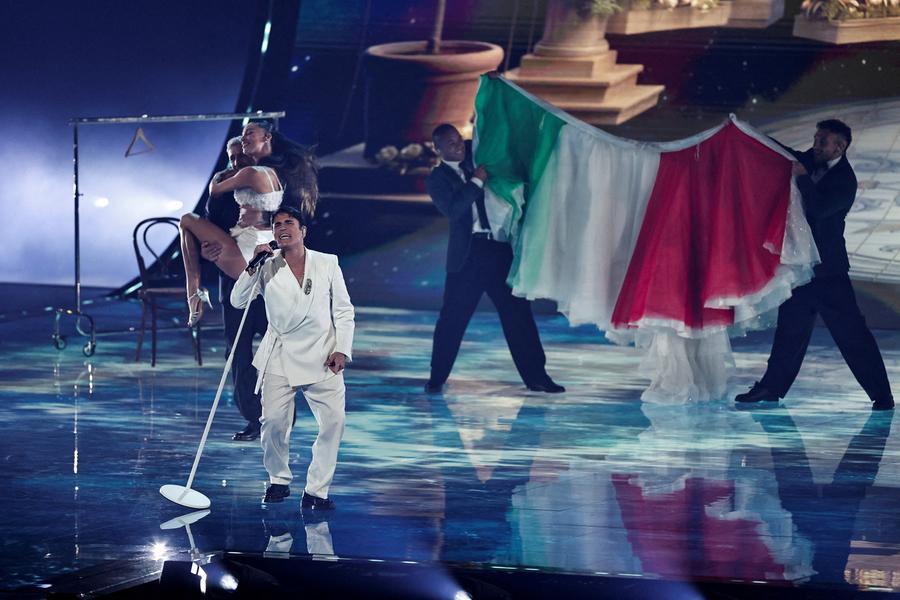
From Vienna.
Of course, a victory for Sal Da Vinci for Italy would avoid any embarrassment at Eurovision: Forever yesthe winning song of Sanremo 2026, talks about marriage and eternal love, all positive messages, and Italy continues to generate great sympathy among the audience of Eurovision fans, as seen during last Tuesday’s performance, when – along the millimetric choreography studied by Marcello Sacchetta, who grew up in Friends by Maria De Filippi – the dancer’s wedding dress revealed a gigantic tricolor on stage.
«It doesn’t happen, but what if it happens», repeats Gabriele Corsi in his commentary. It will be difficult for Sal to reach first place in Saturday’s final, even if his prices rise more every hour: within the first seven positions every result is certainly good; the podium would be a huge success. In the meantime, however, around the Stadthalle in Vienna the most discussed topics are political, or rather, geopolitical. And it’s not new at all. Because, as Jean Coucrandun, a Belgian journalist, wrote in 1979: «If Eurovision doesn’t deal with politics, politics takes care of Eurovision».
During the first semi-final, and again at the general rehearsals, the object of the dispute has always been the same for a few years, that is, from 7 October 2023 and the war that followed: the participation of Israel, which qualified for the final with Noam Bettam and his Michellea song with rhymes in Hebrew and French. At every performance protests start, recalling the deaths in Gaza and Netanyahu’s policies.

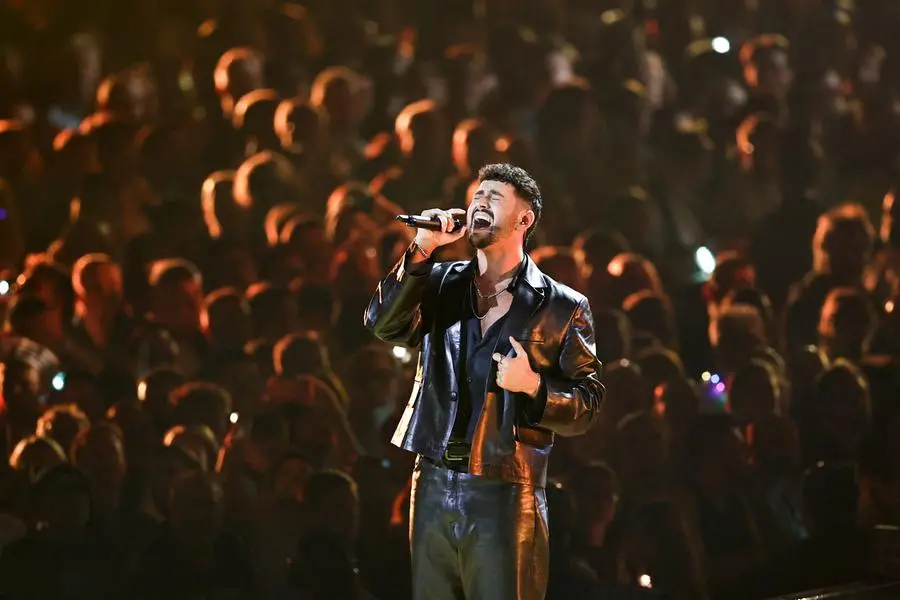
Israeli Noam Bettan during the dress rehearsal of the Eurovision final.
(REUTERS)
EBU (European Broadcasting Union), which organizes the demonstration, limited itself somewhat Pilatesquely to saying that “it will not cover the boos”: never mind that we could be considered censors. It’s like inviting someone to dinner without giving them food. The reason is that the matter has become really complex to manage, given that five countries – Spain, Iceland, the Netherlands, Ireland and Slovenia – have actually boycotted this edition precisely because of the presence of Israel, and they didn’t show up in Vienna.
Simplifications and extreme polarization reign supreme today, but things are actually complex: let’s try to explain why. Eurovision is the most visible emanation of EBU, the consortium of “public service” networks founded in 1950, well before the European Economic Community (1957) or the European Union. There is often some confusion: Dean Vuletic, author of, explains it well Eurovision Song Contest. A European story (minimum fax).
And here is the crux of the matter: representing Israel is the public service broadcaster KAN, which has a prolonged and declared history of hostility and conflict with the government of Benjamin Netanyahu. The Israeli government has tried several times to dismember and weaken the public service, which it does not control. It’s a recurring story: illiberal or authoritarian governments try to exercise direct control of public service media (as happened in the recent past in Hungary and Poland) or aim to drastically reduce their influence (for example by cutting public funding).
This is why the boycott is a real paradox: it seems to align Netanyahu’s critics precisely with his government’s positions hostile to public service. And this is why the comparison with Russia, excluded from Eurovision after the invasion of Ukraine, does not hold up: here television and the media in general are entirely propaganda tools. It is the thin but clear line that distinguishes “public service” and “state TV”. For the funniest paradoxes in history, there is the fact that, among the countries boycotting, there is Spain, which – in the midst of Franco’s regime – tried to “use” Eurovision as an instrument of soft power and international accreditation. In short, nothing new on these screens.
There has been a lot of discussion about soft power in recent days, also following an investigation by New York Times which revealed that the Israeli government itself would have financed a well-paid advertising campaign to support its singers participating in Eurovision. However, nothing really concrete has emerged, other than the fact that the televoting mechanism is easily influenced by a well-orchestrated campaign of massive and organized voting. But this effect is probably activated precisely when a diaspora is mobilized – or manages to be mobilized – which tele-votes en bloc its representative (Eurovision regulations do not allow those living in a country to vote for their representative). The EBU would probably need greater transparency on the votes cast at the end of the event.
To return to Sal Da Vinci, this last observation may, however, be favorable to Italy: even without any need for orchestration, the large “diaspora” of Italians in the world could actually mobilize: it doesn’t happen, but if it happens…