






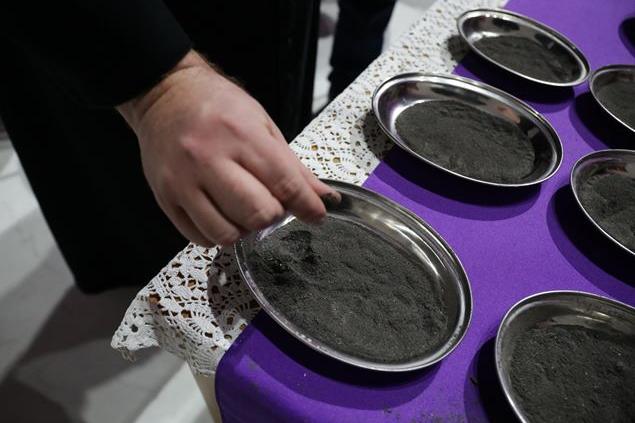
With the Ash Wednesday begins there Lentthe period preceding Easter, and is a day of fasting and abstinence from meat, an abstention that the Church requires for every Friday of the year but which in recent decades has been reduced to only the Fridays of Lent.
The other scheduled day of fasting and abstinence is Good Friday.
«Memento homo, quia pulvis es et in pulverem reverteris», or: «Remember man, what dust you are and dust you will return». These words appear in Genesis 3.19 when God, after original sin, expelling Adam from the Garden of Eden condemns him to the toil of work and death: «By the sweat of your brow you will eat bread; until you return to the earth, because from it you were taken: dust you are and to dust you will return!
This phrase was recited on Ash Wednesday when the priest imposed the ashes – obtained by burning the olive branches blessed on Palm Sunday of the previous year – on the faithful. After the liturgical reform, following the Second Vatican Council, the phrase was changed to the phrase: «Convert and believe the Gospel» (Mk 1:15) which expresses, in addition to the penitential one, the positive aspect of Lent which is a time of conversion, assiduous prayer and return to God.
The origin of this celebration
The celebration of Ashes was born because of the public celebration of penance, it was in fact the rite that began the journey of penance of the faithful who would be absolved of their sins on the morning of Holy Thursday. From a liturgical point of view, ashes can be imposed in all Wednesday Eucharistic celebrations but, the liturgists warn, it is appropriate to indicate a “privileged” community celebration in which the ecclesial dimension of the journey of conversion that is being undertaken is highlighted even more.
Fasting is important for all religions: Muslims celebrate the month of Ramadanthe Jews the kippur and the Christians there Lent.
The difference with the Ambrosian Rite
Unlike the Roman Rite, in the Ambrosian one (which is celebrated in the diocese of Millano) there is no Ash Wednesday rite. «The Ambrosian tradition has never known this day, but has always rigorously started the Lenten period with the Sunday that introduces Lent, precisely, in capite quadragesimae», explained Monsignor Claudio Magnoli, head of the Liturgical Pastoral Service of the Diocese.
What is the biblical meaning of the sign of ashes?
Biblical theology reveals a twofold meaning of the use of ashes:
1. First of all I am sign of the weak and fragile condition of man. Abraham, turning to God, says: “See how I dare to speak to my Lord, I who am dust and ashes…” (Gen 18:27). Job, recognizing the profound limits of his existence, with a sense of extreme prostration, states: “He threw me into the mud: I became dust and ashes” (Job 30.19). In many other biblical passages this precarious dimension of man symbolized by ash can be found (Wis 2.3; Sir 10.9; Sir 17.27).
2. But ash is also the external sign of the one who repents of his evil actions and decides to make a renewed journey towards the Lord. Particularly well-known is the biblical text of the conversion of the inhabitants of Nineveh due to the preaching of Jonah: “The citizens of Nineveh believed God and proclaimed a fast, and put on sackcloth, from the largest to the smallest. When the news reached the king of Nineveh, he rose from the throne, took off his cloak, covered himself with sackcloth and sat down in the ashes” (John 3.5-9). Judith also invites all the people to do penance so that God can intervene to free them: “Every Israelite man or woman and the children who lived in Jerusalem prostrated themselves before the temple and sprinkled ashes on their heads and, dressed in sackcloth, raised their hands before the Lord” (Jdt 4.11).