




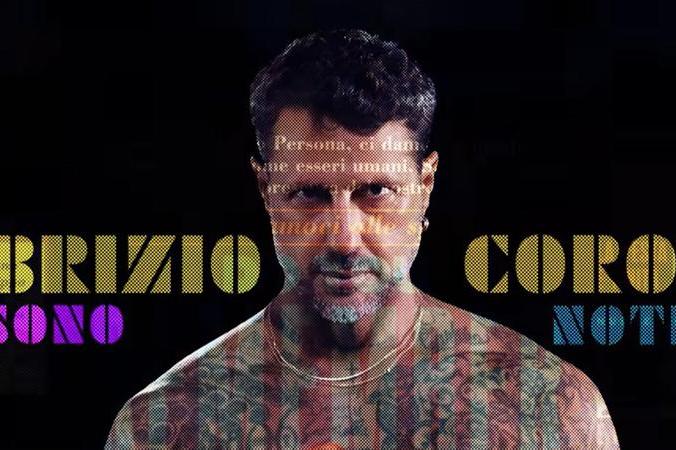
An excellent litmus test of the state of health or, perhaps, illness of our media system, of communication, and perhaps, more broadly, of the cultural humus in which we are all inevitably immersed: this is what the docu-series represents Fabrizio Corona. I am newsbut also much of the debate that, since its release on Netflix on January 9th, it has been able to generate.
Let’s start from an assumption: Fabrizio Corona, by his own, repeated and almost obsessive admission, is not a good guy. For thirty years now he has wanted, on the contrary, to appear as the embodiment of the bad boy, of someone who has no hesitation in breaking the law (for this he has been in prison several times) and, what is perhaps worse, in lying shamelessly even to those closest to him (as his ex-wife Nina Moric testifies in the series). So, let’s say it right away, the docu has nothing edifying or didactic about it.
Is this a problem? The growing mass of true crime media narratives – just think of the revival of the “Garlasco show” which shows no sign of missing a beat – demonstrates the widespread interest and fascination for evil. Therefore, on paper, telling Fabrizio Corona, in the reckless intersection with the news, not only pink, of these thirty years of Italy is certainly a good idea. On the other hand, the launch of the series coincided, in a dynamic of mutual, formidable promotion, with the point of maximum interest aroused by the episodes of Extremely falsethe YouTube channel of Corona himself which, among cross-reports, raised the so-called “Signorini case”, relating to castings to enter “Big Brother” in exchange for alleged favors of a sexual nature on the part of Alfonso Signorini.
But – this is the most important question – does the Netflix series manage to give us back the sense of what Fabrizio Corona has represented in these thirty years and, evidently, still represents? Only partly, due to a vice of proximity. Corona is a seducer who knows perfectly the mechanisms of the media machine. When he agreed – we presume for a fee – to be the protagonist of the Netflix documentary, he was already certain that he was capable of bending the narrative to his own personal “mythology”: which is, in fact, that of the bad boy who doesn’t care about the rules and who is guided solely by an obsessive passion for money. He succeeded, also thanks to the closeness with many of the interviewees who act as a common thread, from the lawyer-friend who remembers his “gypsies” to the “coronologist” who, episode after episode, turns out to be more of a friend of Fabrizio than an analyst of the phenomenon.
On the other hand, the “Corona phenomenon” could also be explained in less time and fewer episodesbecause the plot is recurring and can be summarized as follows: Fabrizio Corona, smart even more than endowed with a certain intelligence, has no moral problem with going beyond the shared rules (and the law) if this gets him a gossip “news story”, a sellable photo and, essentially, a lot of money. Corona is a vampire who quickly learns how to move (his figure empties and replaces that of his former mentor Lele Mora), and knows how to grasp all the weaknesses of the media system.
From this last point of view, perhaps even unintentionally, the docu and the debate that arose from it become more interesting. Because in the almost five hours of story some important considerations can be drawn precisely on the communication machine of our Italy.
Meanwhile, the Italian media system has never let Fabrizio Corona lack what he is looking for: the light of a camera. Even just from the archive footage that the series offers, we see him pass through countless cathode salons, from Daria Bignardi to Corrado Formigli up to, the other evening, Massimo Giletti. Corona is therefore perhaps the one in Italy that has successfully been able to make the most of the new media ecosystem, suspended today between TV (still central), gossip weeklies (less and less), YouTube (its channel generates millions of views) and social media.
Even the latest controversy raised by some newspapers about the public financing (just under 800 thousand euros) that the Netflix docu-series received from the Ministry of Culture in the form of tax credit seems like a blunt weaponthe result of little knowledge of the topic. Without going into technicalities, public funding for films, series and documentaries has two rather distinct purposes: there are those given for the merits of the work (and this is not the case) and the “automatic” ones which aim to support national audiovisual production to try to make it more solid and industrial. And there is no doubt that – at least on a strictly commercial level – I am news functions: just think of the hype it is causing and the views it is producing. Therefore, even the “critical” debate generated by the series is not free from carelessness and a certain populism.
In conclusion, beyond the sometimes clumsy “mythologizing” of the Corona character, which more than anything else generates a feeling of repetitiveness and boredom especially from the third episode onwards, what evaluation can we give of this product? Perhaps the element of greatest “truth” in the story about Fabrizio Corona is the one that connects him with his father, Vittorio Corona, a piece of history of national journalismin the words of the mother, Gabriella Privitera, or in those of the director of Il Fatto Marco Travaglio. Fabrizio appears almost dazzled by his father’s successes in the 1980s and 1990s and, as happens in this type of paternal relationship – without needing to bother Freud – he decides to want to reach and surpass him by systematically embodying his opposite, his nemesis.