





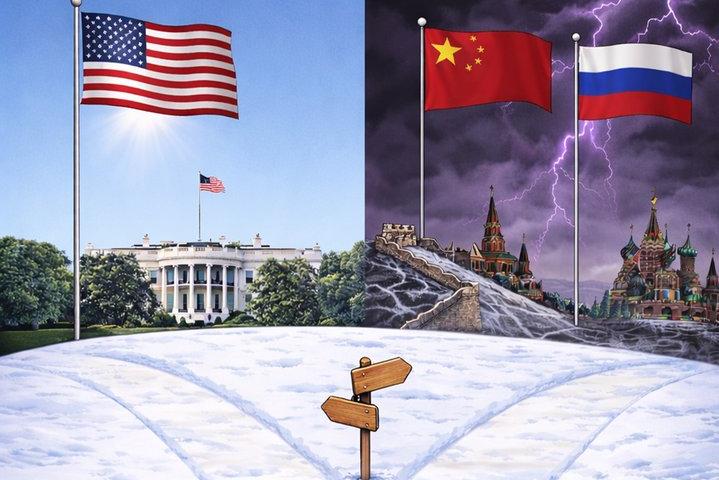
It must be said that the future of the land of ice called Greenland, between the United States and Denmark, remains frosty. Even after the meeting on Wednesday 14 January at the White House between Danish Foreign Minister Lars Lokke Rasmussen, US Vice President JD Vance and Secretary of State Marco Rubio. A “fundamental disagreement” remains, Rasmussen declared, while the official White House profile on
It’s difficult to understand how it will end, but Donald Trump remains above all a businessman, with the soul of a real estate developer (“I was really good at the real estate sector, maybe I was better at the real estate sector than at politics”, he confided in the recent interview with New York Times), so the purchase hypothesis appears plausible.
Buying Greenland is always better than invading it. It may certainly seem like a sign of arrogance and neocolonial behavior, but the purchase of a territory would not be new in the history of the United States.
Buying lands without sending “boots on the ground” (military in the field) has allowed the United States, in its history, to acquire as much as 40 percent of its territory. This expansion began in 1803 with the acquisition of Louisiana from France and ended with that of Alaska from Russia in 1867. But there is an appendix in 1917 which concerns Denmark.
Louisiana was purchased for $15 million. Less expensive was the purchase of Florida, bought from Spain in 1819 for 5 million dollars. Alaska was purchased from Russia in 1867, in a treaty signed at 4 a.m. on March 30, for $7.2 million, oxygen for the indebted Russian Empire. For the United States, however, it was an opportunity to expand into the Pacific area.
In the twentieth century there was also the purchase of territories under Danish sovereignty, as is the case today in part for Greenland. The United States, which had been seeking expansion in the Caribbean region for decades, set its sights on the islands of the Danish West Indies. The aims became insistent during the years of the First World War. U.S. President Woodrow Wilson and Secretary of State Robert Lansing feared that the German government might annex Denmark, in which case the Germans might also secure the Danish West Indies as a naval or submarine base from which to launch attacks against merchant shipping in the Caribbean and Atlantic. In the reconstruction of the negotiation on the US State Department website we read that Secretary of State Lansing had been very clear: “he implied that if Denmark was not willing to sell, the United States could occupy the islands to prevent them from being conquered by Germany”. The formal transfer of the islands occurred on March 31, 1917, along with the United States paying Denmark $25 million in gold coins. The islands were not incorporated into the United States of America. The Virgin Islands are politically autonomous but linked to the USA for defense, foreign affairs and citizenship; the inhabitants are US citizens and can enter the United States without restrictions, but do not vote in presidential elections.