




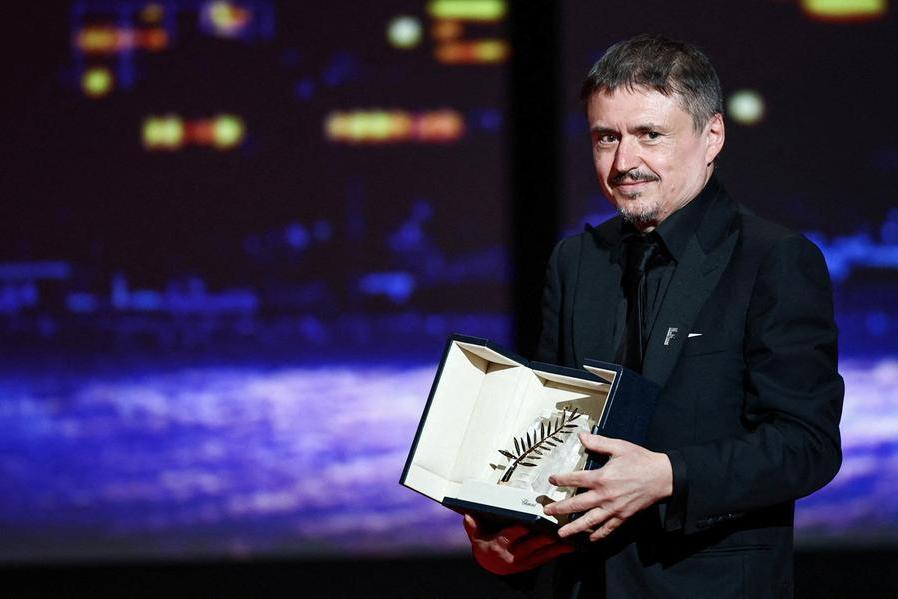
It closed 79th edition of the Cannes Film Festival with the awarding of the Palme d’Or to Fjordthe new film by Romanian director and screenwriter Cristian Mungiu, already winner of the highest award on the Croisette in 2007 with 4 months, 3 weeks, 2 days.
With Fjord, Mungiu returns to investigate the moral and family tensions that run through contemporary society, but shifting its gaze to a Nordic context. The film tells the story of a Pentecostal couple, made up of a Romanian man and a Norwegian woman, who, after the death of his parents, move with their five children from Bucharest to an isolated village in Norway, on a fjord. The family balance is shattered when the eldest daughter shows up at school with some bruises: an episode that brings to light suspicions linked to the rigid religious education imparted in the family. The cast also includes Renate Reinsve, already nominated for an Oscar for Sentimental Value.
The film, as often happens in Mungiu’s cinema, focuses on the conflict between individual conscience, parental responsibility and society’s gaze, in a crescendo of ethical questions rather than definitive answers.
The Grand Prix of the Jury to “Minotaur”
The Jury Grand Prix was awarded to Minotaur by Russian director Andrey Zvyagintsev. The film, set in 2022 Russia during the invasion of Ukraine, tells the parable of Gleb, a business executive who sees his network of professional and personal relationships collapse with the start of the war. Added to this external disintegration is the domestic crisis, with the discovery of his wife’s betrayal. A political thriller that intertwines public and private dimensions, marked by a strong criticism of the contemporary context.
Jury Prize to “The Dreamed Adventure”
The Jury Prize went to Das geträumte Abenteuer (The Dreamed Adventure) by German director Valeska Grisebach. Set on the border between Bulgaria and Türkiye, the film follows a young archaeologist who, in an attempt to help an old acquaintance, finds herself involved in illegal trafficking. A narrative suspended between social realism and moral drift, which explores the theme of individual choices in frontier, geographical and ethical contexts.
Caméra d’Or at “Ben’Imana”
The Caméra d’Or award, dedicated to first works, was awarded to Ben’Imana by the Rwandan director Marie Clémentine Dusabejambo. The film stands out for its sensitive and attentive look at the social dynamics of contemporary Rwanda, confirming the festival’s attention towards new voices in international cinema.
Best director: double recognition
The award for best director was awarded ex aequo to two very different works. On the one hand The black bola by Spanish directors Javier Ambrossi and Javier Calvo, a film inspired by the unfinished project of the same name linked to Federico García Lorca and the play The dark stone by Alberto Conejero. The film crosses three historical eras – 1932, 1937 and 2017 – telling the intertwined lives of three homosexual men, between repression, memory and freedom.
On the other Fatherland by Polish director Paweł Pawlikowski, a black and white film set during the Cold War. At the center of the story is the return to Germany from exile in the United States of the writer Thomas Mann together with his daughter Erika, in a context marked by political memories and ideological tensions.
Best performances: shared awards
The award for best actor was awarded ex aequo to Emmanuel Macchia and Valentin Campagne For Coward, film set during the First World War which tells the story of the relationship between two young comrades, between fear, war and the discovery of feelings. The award for best female performance was also shared: Virginie Efira and Tao Okamoto received it for All of a Suddenfilm by director Ryūsuke Hamaguchi. The work, inspired by a correspondence between a terminally ill philosopher and a medical anthropologist, reflects on the meaning of time, care and the shared word.
Screenplay and short films
The award for best screenplay went to Emmanuel Marre for Our regards, historical drama set in France during the Second World War, between the Resistance and the Vichy regime. The Palme d’Or for best short film was awarded to For the contradictory ones, by the Argentine director Federico Luis.
Park Chan-wook’s jury
The South Korean director led the jury for this edition Park Chan-wook, author of films such as Old Boy. Next to him, an international group made up of artists and cinema professionals: the actress Demi Moore, the actor Stellan Skarsgård, the Chilean director Diego Céspedes, the Ivorian actor Isaach de Bankole, the screenwriter Paul Laverty, the actress Ruth Neggathe director Laura Wandel and the director Chloe Zhao.
A festival between ethics and politics
This edition of Cannes has confirmed, once again, the festival’s vocation to talk about the fractures of the present: wars, family crises, transforming identities and moral conflicts run through most of the awarded works.