

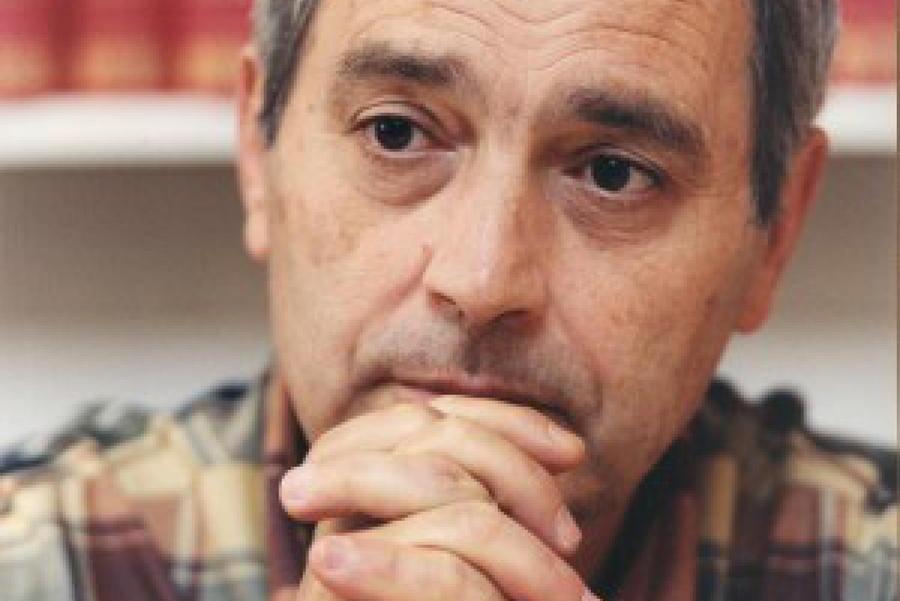



Every morning when he entered the office, Messori greeted his colleagues with this word, in Turin dialect, friendly and charming which can mean both hello and goodbye.
Vittorio lived in Turin for several years in his youth, but was not born there. He was born in Sassuolo and therefore, like all Emilians, he was a hard worker, a “testa quèdra”, square.
When he was working he isolated himself, he was able not to even hear the ringing of the telephone or the chatter of the neighbors passing through the corridors. He was deep in thought and worked hard. He was also very punctual in submitting requested items.
I met Vittorio at the end of the seventies. We became friends while working together for at least 30 years.
In that period I had been asked by Don Zilli, the legendary director of Famiglia Cristiana, the religious weekly which then boasted 1,500,000 copies a week, to found an ecumenical magazine, of a medium-high calibre, which could speak to all those who were curious and interested in the faith of Abraham. So Christians, Jews, Muslims, Orthodox and Romans. I then made a small group of scholars and friends to begin building an editorial team. I had taken Paolo De Benedetti, Silvio Barridon, Gabriele Mandel as management advisors.
Vittorio, who was in Turin at the time, had been lucky enough to put a book in the bookstore, almost a kind of catechism, Ipotesi su Gesù, which within a few years had already reached a million copies. I also asked him if he wanted to come and take part in our adventure, which was as new as it was perhaps dangerous. He came to see, stayed with us for a month on trial and then never returned to Turin. For about twenty years he lived in Milan with us, in our editorial office.
He was a character, Vittorio, with a somewhat prickly character and his friendships were rare but good. Faithful to his friends when he had chosen them as such.
He wasn’t great company, he lived rather isolated, but he worked a lot and his research was always very careful, profound and original.
He thus wrote about twenty volumes on the history of the Church, the Popes, Christ, the Madonna, miracles, on the history of Christians and on the reality and relevance of Christianity. He had also asked himself the same question that Jesus asked in the Gospel: “When I return, will there still be faith on earth?”. He was a very introverted and introspective man, who aimed to get to the point and what he had to do, he did at the cost of great sacrifices.
I remember that when he was writing a book, and therefore almost always, he retreated into solitude. When he did the last reading he got some swelling on his hands, as if there was some kind of friction, but it was the fact of holding the pencil or pen for so long to make the corrections. Vittorio was perhaps a difficult character to deal with, but loved by everyone.
He had invented a whole series of columns for Jesus magazine which was widely followed by readers. And at the same time, while he was writing the newspaper, he was writing books. He wrote books about the Madonna and miracles. He wrote books about Christ, he had his hypotheses to resolve, he had his doubts to clarify.
Vittorio left at the beginning of the Easter triduum of 2026, when the bells of the towns were already silenced for that liturgical silence that takes Christians around the tombs that have been set up in the churches in memory of the tomb of Christ. With these strange flowers, with these strange herbs. He left there, in these days of silence, which precede Easter. The air of Easter, spring and the beginning of the Jewish liturgical year is so close that you can feel it in the air.
I have always thought that Vittorio was a bit like the disciples of Emmaus: full of doubts, full of research, also full of fears, of disappointment for the things that happened. And they are there walking, with this burden on their hearts, along the certainly not asphalted streets of the time. And they return home, disappointed when any pilgrim, an unknown pilgrim approaches them, looks for them. And he wants to enter into their internal conversations. And therefore it provokes them, it influences them.
And explain the Scriptures to them. It is the Master who approaches us. And they walk with Him. And He explains those things that they couldn’t understand. Meanwhile it’s evening, the fear of the night, of loneliness comes and the disciples say: stay with us Lord. It is the first great prayer. Jesus stops and breaks the bread. Jesus celebrates the second mass, after that of the Last Supper, where he had instituted the Eucharist, where he, even before the request, had said: “I remain with you” and had become the Eucharist. Here we are with Vittorio, I see him together with the disciples of Emmaus. I remember a strange event many years ago. We were in Paris at Jean Guitton’s, for an interview. Guitton was a great poet and writer and a great Christian, in short a pillar of religious culture beyond the Alps. And he asked him: “Master, but if you had to choose just one page to represent the whole Gospel, perhaps leaving it like this, with a spaceship that goes to a different world and has to leave this testimony, which page of the Gospel would you choose?”. And he immediately replied: «That of the disciples of Emmos. Because it is the first page of the Gospel that I have known and before which I have prayed. It was in my grandparents’ room, this painting. I saw it since I was a child, I always saw these disciples of Jesus with the others and him breaking the bread. And here, in my opinion, is the whole Gospel. Because with the disciples who did not understand, who suffered, who were saddened, disappointed by the atrocious and serious events that had happened – the Son of God, who was supposed to be the liberator of the world, ended up on the cross, tortured, crucified, killed – who had their hearts swollen by these things and were unable to understand and accept, well, with them this traveler becomes a Master. He becomes a traveling companion and explains to them the mysteries of faith. Explain to them what the mystery of God means. And above all explain to them the love of God. And then the prayer of the soul comes out: “Stay with us, O Lord”». When I think about this I also think that now Vittorio no longer has problems because he too has gone to the Lord. And therefore with him he celebrates his Mass in Heaven, where Christ becomes bread. Bread for our soul and he gives us a sign and teaches us, because he also becomes our Master on our everyday journey.