





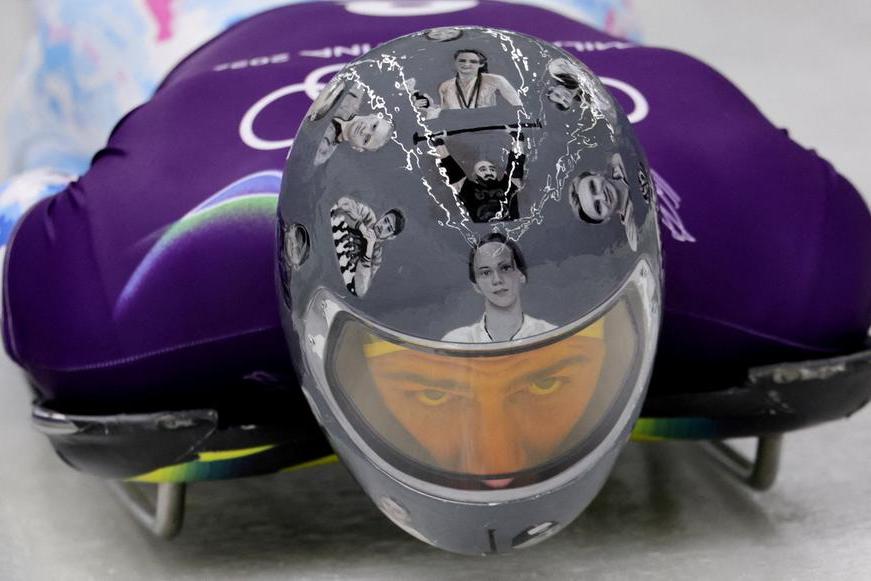
A dilemma reminiscent of a Greek tragedy is taking place on the Olympic track in Cortina and the Olympians are watching.
Vladyslav HeraskevychUkrainian, goes fast with his skeleton, the strange sled with which you go down on your stomach and head down, which is why the helmet is the only element by which during the descent you can recognize the athlete whose face cannot be seen lying prone.
RULE 50 OF THE OLYMPIC CHARTER
In recent days during the official trials Heraskevych came to the official training sessions wearing a gray helmet with photos of 21 Ukrainian athletes who died in the conflict glued to it. He made it known that he intended to take it to the race too, but the IOC, the international Olympic committee, has counter-proposed a more sober mourning on his arm, Heraskevych doesn’t agreethe helmet in theory is free expression, but according to the IOC it violates the controversial rule 50 of the Olympic Charter (the Constitution of the Olympic movement, also explains the Ghali case), which prohibits “any type of political, religious or racial demonstration or propaganda”.
Considered implicit before, the rule was formally introduced in 1974following the protest in support of Black Power against racial discrimination in the United States staged by the Americans Tommy “Jet” Smith and Juan Carlos on the podium of the 100 meters in Mexico 1968 and above all following the very serious attack by a commando of Palestinian Feddayn on the Israeli building in the Olympic village of Munich 1972 which cost the lives of 11 guest athletes, a policeman who intervened and 5 terrorists. Initially extended to all Olympic sites and all forms of expression, the rule has recently been limited to competition fields and protocol ceremonies only, i.e.: opening, closing of the podium and competition field during the competition. For the rest, freedom of expression, from social media to interviews.
ANTIGONE AND CREON IN A MODERN KEY
The point is that the Ukrainian athlete does not intend to give in by claiming that his message is not political. The IOC supports its ban: the contrast is a classic from Greek tragedy, reflects Antigone’s drama perfectly lex And ius, between written law and natural law, but also the contrast between the claim of the individual and the law of the polis (the Greek city state which by extension today is synonymous with institutional perimeter, between the right of the individual citizen and the common good.
In this case the polis it is the neutral international “city” of Olympism, not without contradictions, but which the IOC represents evidently feeling the concern that opening up to this type of exposure could mean opening a Pandora’s box to the most varied individual causes, including those that could jeopardize security, on the part of those who could be encouraged to exploit a world showcase, or even just undermine the precarious balance of an event which in its declared internationalism, in its vocation to peace, can lend itself to nationalistic claims every time a flag goes up on the flagpole and it happens on every podium.
PREVIOUSLY, EXCESSIVE STIFFNESS
The wounds of the past led in previous editions to interpret the rule with great rigidity, to the point of bordering on obtuseness in Sochi 2014, when the women’s relay team of the Norwegian cross country was sanctioned for mourning the arm suffered following the sudden death just before the Games of the brother of one of the team’s athleteswith a written warning that did not prevent the Norwegians from winning the race but which contributed to drawing attention to a draconian application that seemed unjustified for a private mourning, devoid of any public connotation.
The explanation, a patch worse than the hole, sparked indignationand: «With 2,800 athletes, unfortunately many have lost friends and loved ones. We understand your pain, but we do not want to allow the competition to become a place of mourning”, replied the IOC, and after the explanation of the IOC spokeswoman Emanuelle Moreau to the Norwegian newspaper VG made the situation worse: «We understand their desire to honor the memory of their friend», he stated, «but we believe that a competitive arena, where the atmosphere is festive, is not the right place to do so», also because it sounded mocking, after just four years earlier in Vancouver 2010 the Georgian luger Nodar Kumaritashvili had died at the age of 21 during an official training session by crashing into a pylon of the Olympic track during an official training session six hours before the opening ceremony. The Norway case brought out the problem from Rio onwards mourning would have been admitted.
POLITICAL GESTURE OR NOT?
It is more complex to argue that Vladyslav Heraskevych’s helmet is apolitical, if only because his cause had the public support of Ukrainian President Zelensky, which loaded the issue with formal politics. However, this is not enough to resolve the contradiction surrounding the case, net of the broad human solidarity around the athlete and his gesture, the human empathy for the Ukrainian people, think of the roar that greeted the Ukrainian delegation at San Siro during the opening ceremony, there is also the fact that on the casus belli the Olympic polis did not remain neutral, but sanctioned Russia and Belarus for violation of the Truce and therefore of the Olympic chartertheir athletes can participate, if they are not military, as independents without national anthem or flag, finding only the five-circle flag and the Olympic anthem on the podium. To complicate matters, Vladyslav Heraskevych also declared that he did not like them.
HOW IT WILL END
In Antigone no god descends from Olympus to resolve the conflict, as happens in other Greek tragedies: «The contrast between Antigone and Creon», writes Luciano Violante in the beautiful little essay Justice and myth signed for Laterza with Marta Cartabia, «incurable like all conflicts it can be deadly for both. Creon cannot negotiate with Antigone because she refuses any form of mediation and he has no way out beyond imposition or surrender”, in the absence of a tribunal to decide, he concludes: “One of the two protagonists is too many and the tragedy takes place”.
In the Olympic international one of the ways in which modern systems have already been tried, without success.
If the Ukrainian athlete does not relegate, we will go down the path that modern systems call conscientious objection/civil disobedience: Heraskeviych will violate the IOC rule knowing that he is violating it and will have to accept the sanction, but he has already partially obtained the visibility he was looking for on his cause. «I cannot tell my boys that the only way to love the law is to obey it», wrote Don Lorenzo Milani in 1965 in the Letter to the judges, «I can only tell them that they will have to hold the laws of men in such honor as to observe them when they are right (i.e. when they are the strength of the weak). However, when they see that they are not right (i.e. when they sanction the abuse of power by the strong) they will have to fight to have them changed.”
However it ends, the case of the “memory helmet” raised the question about the relevance of rule 50: it will be inevitable to think about the opportunity to update it, after having exposed to the world the contradiction of a demonstration that proclaims peace but then hides the effects of war under the carpet. But that will be a matter for the next four years. But it will be a job to be done with a chisel, not an axe.