





On the table, in the room of the Carabinieri investigative unit in via della Moscova in Milan, the major Antonio Coppola arranges a row of colored pens. Dark green, red, fuchsia, lilac, red, and he says «one is Cosa Nostra from Catania, the Mazzei. This is the club of Legnano-Lonate Pozzolo, the ‘Ndrangheta. Then the Neapolitans of Moccia and Senese. Here Palermo, here Trapani, here Melito Porto Salvo.”
Pens are not for writing, but for explaining. They serve to tell how the three great Italian mafias, historically enemies, have learned to sit at the same table. Not a super-mafia, he insists, “but a consortium of purpose: an alliance to make money.”
The major speaks slowly, with a dry but guarded tone, like someone who knows that behind every word there are months of investigations, interceptions, men stationed for hours. In the background, the buzz of the provincial command and the traffic coming up Corso Garibaldi. Milan flows out there, busy and unaware. Inside, the story of a metamorphosis.
“We are together because we have to make money”, intercept the Carabinieri among the leaders of the cartel, after a confidential meeting. It is the key phrase of Hydra, the investigation that revealed how Cosa Nostra, the ‘Ndrangheta and the Camorra have stopped shooting at each other to share the profits.
It all starts from a void. The disappearance of Gaetano Cantarella, a Mazzei man, is the spark. «A classic white lupara», recalls Coppola. “That crime opened our eyes to an unprecedented system: a fluid alliance, capable of bringing different criminal worlds together.” From that moment, the work of the investigative unit intertwines with that of the Milan Prosecutor’s Office, in a mosaic of stakeouts, tracking, corporate reconstructions, to the point of drawing the map of a power that cannot be seen but conditions everything.
«At the beginning it seemed like the usual area investigation», he explains. «But the more we dug, the more a new logic emerged. Nobody was looking for control of the territory: they were looking for control of the economy.”
Today’s mafias no longer impose protection money: they propose partnerships. They don’t shoot to conquer neighborhoods: they enter the boards of directors. «The weapons have become invoices, VAT numbers, inflated tax collections. It is a system that produces money out of thin air and drugs the legal market. It’s as if the State were paying involuntary protection money.”
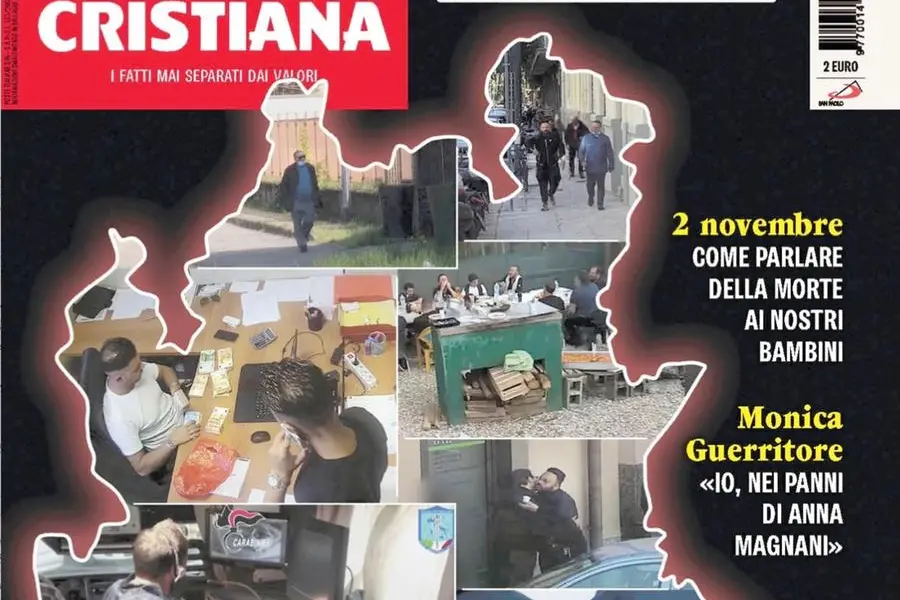
The investigation Hydra has documented dozens of fictitious companies created to generate fake tax credits, then passed on to struggling entrepreneurs. «Do you need one hundred thousand euros to settle a tax debt? I’ll give you one hundred and fifty thousand credit, at half price. And you accept. Because you save your company, your family, your employees”, says the major. «But this way you enter the system. You become part of the machine.”
In his story, Lombardy appears as a land of half lights: industrious, cultured, productive, but crossed by an infiltration that does not need threats. There are no guns here, but bank transfers; there are no corpses in the street, but societies that are born and die in two years. «They call them “laundries”, but in reality they are money factories. They don’t wash: they multiply.”
Environment, the gray area moves: notaries, accountants, consultants, public officials. «It is the social capital of the mafia», explains Coppola. «People who don’t shoot, but open doors, facilitate practices, turn a blind eye. It is the network that holds the whole system together.”
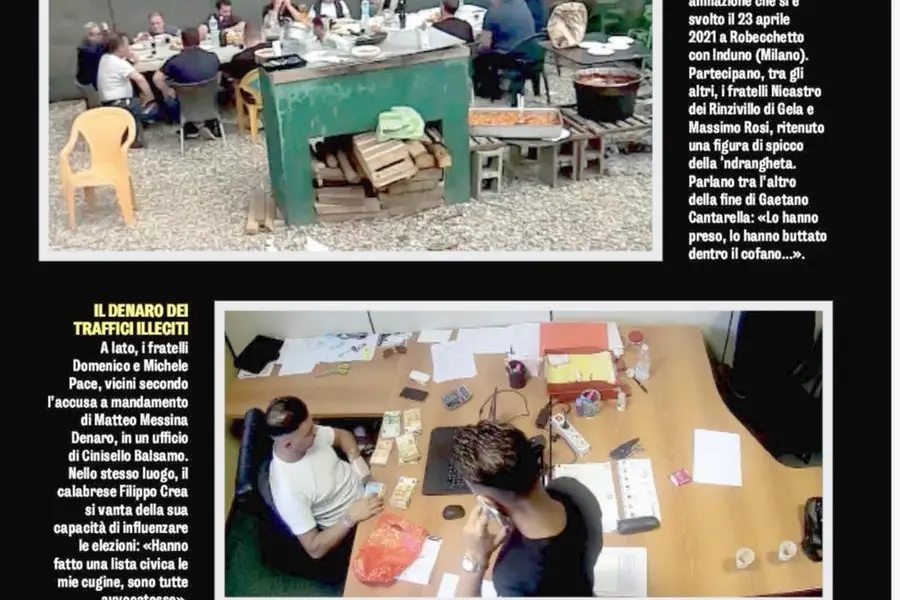
Among the names that appear in the file there are the usual ones: the Mazzei of Catania, the Fidanzati of Palermo, the Pace of Trapani, the Senese of Rome, the local of Legnano-Lonate Pozzolo. And above all, Paolo Parrino, from Trapani, related to the Messina Denaro family, “connection point” – the magistrates write – between the Lombard system and the Castelvetrano boss. But it’s not a pyramid. «The word “super-mafia” is conceptually wrong», says Coppola. «There is no dome that commands. It is a federation of interests. Everyone answers to their bosses in their territories of origin, but here we work together.” They also support each other with the “bacinella”, the common fund that finances the families of prisoners. «A Calabrian paid the lawyers of a Neapolitan. Why? Because tomorrow it will be his turn, and the others will do the same.” The strength of this pact is liquidity. «They bring real money, accumulated through drug dealing, extortion and fuel trafficking. Here they make them profit. And when you put dirty money into the market, you tamper with the economy, you alter competition, you destroy those who respect the rules.”
Milan, in this context, is a perfect laboratory: cosmopolitan, rich, apparently immune. «You can’t think of territorial control like in Reggio Calabria or Partinico», he explains. «Here the control is invisible. It is economic, financial, relational.”
The agents of the Unit see it in the logistics hubs, in contracts, in the subcontracts of cooperatives that change their names every year. «A gangmaster 2.0», the major calls it. «The same logic as the agricultural fields of the South, but inside the warehouses of the Po Valley».
And it’s not an isolated case. «We saw similar models in Rome, in the Siege operation, and we will see others in Turin, Bologna, Genoa. It is a form of mafia that adapts to metropolises: silent, liquid, transversal.” Listening to him speak, one understands that his battle is not only judicial, but also cultural. «The absence of blood does not mean the absence of violence. It’s just another way of killing: you kill trust, justice, competition, hope. Every euro taken from the community is an open wound.”
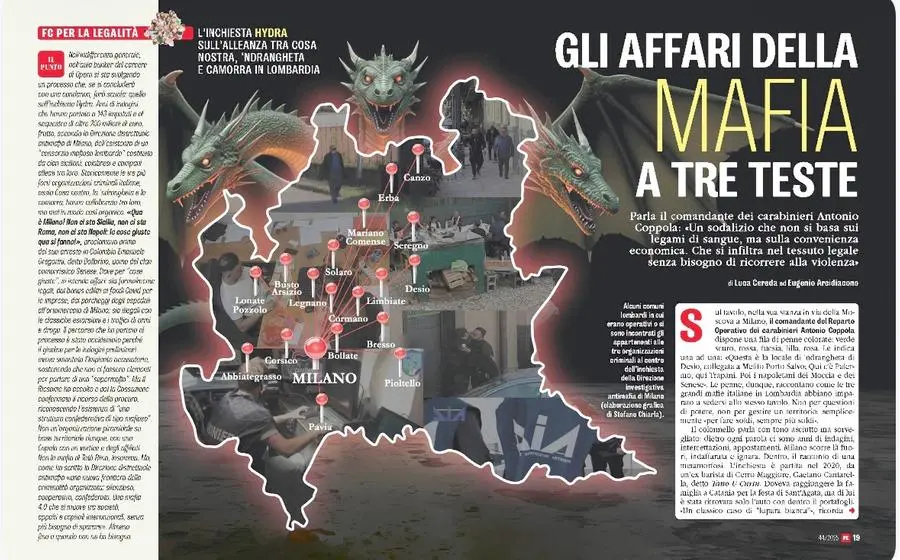
His gaze stops on the feathers. «This is the Milan we see from our observatory. A city where control is not imposed with terror, but with appearance. Where criminal peace is not a good, but a business strategy».
Outside, the Moscova traffic doesn’t stop. Inside, the carabinieri continue their painstaking work: reading wiretaps, rebuilding companies, chasing threads of money that get lost in tax labyrinths. «Mafias evolve, we must do it faster», concludes Coppola, before getting up and rearranging the pens on the desk. Green, red, lilac, fuchsia. Each color a story, a clan, a monster head. Yet, the more time passes, the more that monster seems to multiply in silence, like a virus that makes no noise but corrodes everything. “It’s not over,” says the major. «The names will change, the leaders will change. But the system will remain, until we understand that the mafia does not only live where it shoots. She lives where it suits her.”
Then he stops for a moment. «And where you don’t want to see it». One for each head of the mythological Hydra.