






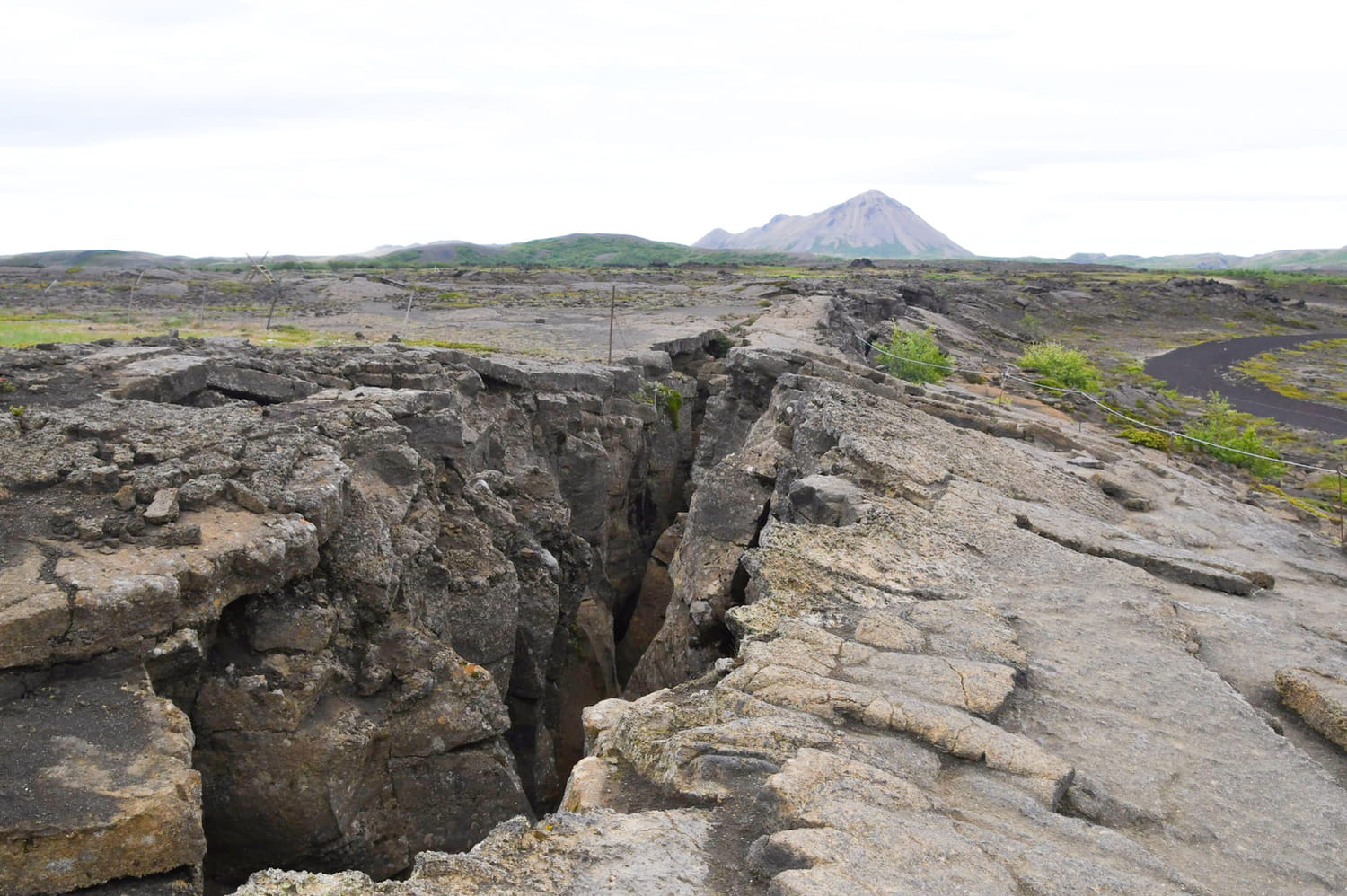
Geologists have detected rare signs of a deep fracture in the Earth’s crust, a possible prelude to the birth of a new ocean. They share their discovery in the scientific journal Frontiers in Earth Science.
Geological experts have just identified rare signs of a deep fracture in the earth’s crust, a “rift” phenomenon which could, in the very long term, give rise to a new ocean. Their study, published in the scientific journal Frontiers in Earth Science, intrigues geologists around the world because it touches on plate tectonics. On Earth, the continents have been moving slowly for hundreds of millions of years. They come together, separate, crack and sometimes form oceans again. But witnessing the very beginnings of a continental rupture is exceptional. In this specific case, researchers believe they have detected the first signs of a new tectonic boundary.
The area studied is located in southern Africa, more precisely in Zambia, in the Kafue rift. This immense geological fracture belongs to a 2,500 kilometer system which crosses part of the continent, from Tanzania to Namibia. For several years, geologists suspected that this region was hiding unusual deep activity: high temperatures below the surface, small seismic tremors and gravitational anomalies suggested that the Earth’s crust was beginning to stretch. To test this hypothesis, the team led by Rūta Karolytė analyzed gases escaping from five thermal springs and several geothermal wells located in central Zambia. The researchers were interested in two elements that are very precious to geologists: helium and carbon.
The result surprised scientists. The isotopes present in these gases correspond to those found in the Earth’s mantle, the layer beneath the crust. This means that fluids are currently rising from nearly 190 kilometers deep through faults already open in the rock. For the authors of the study, this is a strong sign: the earth’s crust is being torn apart in this region. “Our data confirms that this system is currently active and geologically active”explains Rūta Karolytė. The researcher nevertheless remains cautious. An active rift does not guarantee that an ocean will ever appear. But the scenario becomes credible.
The phenomenon takes place over immense periods of time. When a tectonic plate begins to break, the crust gradually thins over millions of years. Then the magma can rise more easily and eventually create a complete separation between two land masses. Eventually, water can invade this space and form a new ocean. This has happened several times in Earth’s history. The Atlantic Ocean, for example, was born when Africa and South America separated about 180 million years ago. It is also reminiscent of the East African Rift System, this giant fault, which extends thousands of kilometers from the Gulf of Aden to Mozambique.
For Patrice Rey, professor of geodynamics at the University of Sydney, Australia, believes that these new data clearly reinforce the idea of a continental rift at an early stage. Even without large active volcanoes or major earthquakes, several clues show that this region is geologically in flux. The researchers point out, however: no one will see this new ocean born. If the process continues, it will likely take tens of millions of years before the fracture actually transforms the world map.