






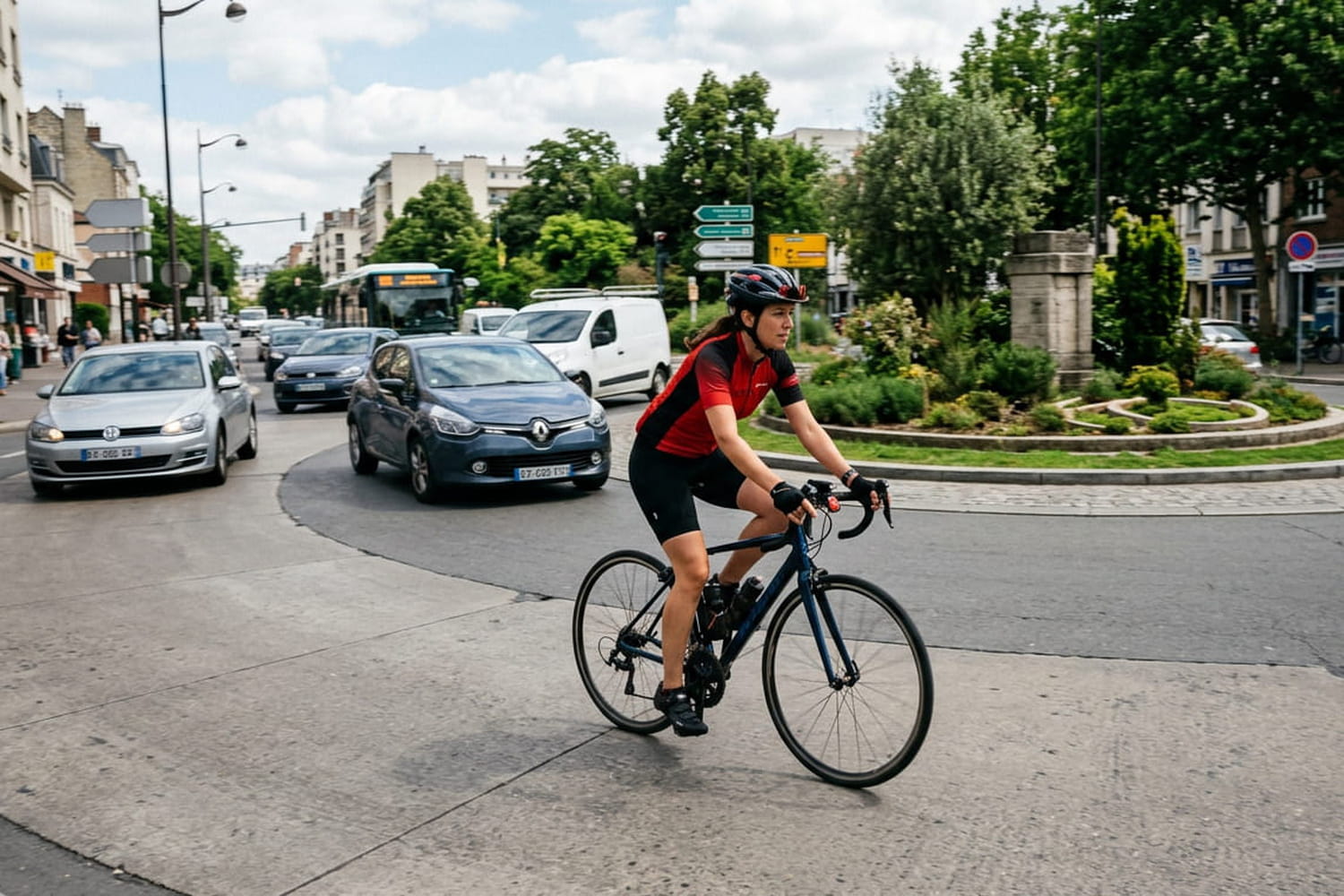
Approaching a roundabout or a roundabout is never easy, especially when you are a cyclist. Here are the rules to know, some of which are sometimes forgotten…
Entering a roundabout is often a little stressful for motorists or two-wheelers. Trajectories intersect, blind spots multiply and the feeling of insecurity can quickly increase. However, the Highway Code very precisely regulates these transition zones. It is also essential to recall a major technical distinction: in a traditional “roundabout” (which has become very rare), the priority is on the right, which means that vehicles entering have priority over those already circulating in the ring. Conversely, in a “roundabout” (the most common case), engaged users have priority, indicated by a “Give way” sign at the entrances. Whether it is one or the other, a bicycle and a car have the same priority rights once inserted.
In fact, a car wishing to exit a roundabout must give way to the cyclist who continues on the ring and is on their right. To integrate safely, the Highway Code requires cyclists to clearly signal their intentions. In the absence of electric indicators, it is the arm extended horizontally which acts as a light signal: to the left if you continue to turn in the ring, then to the right just after passing the exit preceding the one you want to take. But beyond this gestural communication, a specific rule still completely ignored by an immense majority of motorists authorizes bicycles to radically modify their placement on the road. A legal behavior which tends to surprise, or even wrongly annoy, drivers in a hurry.
The Highway Code confirms that a bicycle has every right to circulate within the ring in the same way as a car. Although some large intersections offer peripheral cycle paths or lanes designed to isolate them from traffic, these are not always obligatory (unless there is specific signage with a square or round blue sign). In the absence of any development or if the cyclist decides to stay on the road, he has the right to leave the right side of the road and “take his place”. To avoid the phenomenon of “shearing” (when a car overtakes a bicycle in the ring then cuts off the road to exit), official Road Safety guides and specialized associations strongly recommend that cyclists deliberately place themselves in the middle of the traffic lane.
Thus, by taking their full place in the center, they prevent cars from attempting dangerous overtaking and ensure that they remain perfectly visible in the direct field of vision of the driver following them. In addition to this central positioning, we must not forget other vital safety rules defined by the Highway Code. When overtaking, a motorist must respect a lateral safety distance of at least 1 meter in built-up areas (and 1.50 meters outside built-up areas) with the cyclist. Attempting to overtake a bicycle inside a small single-lane roundabout is therefore almost always an offense, because the space available does not allow this legal distance to be respected.
Finally, the Code recalls that cyclists are strictly prohibited from riding on sidewalks to go around a roundabout (except for children under 8 years old). If the situation seems too dangerous, the only legal option is to dismount: a cyclist who pushes his bike by hand becomes a pedestrian again in the eyes of the law and can then cross safely on protected crossings.