





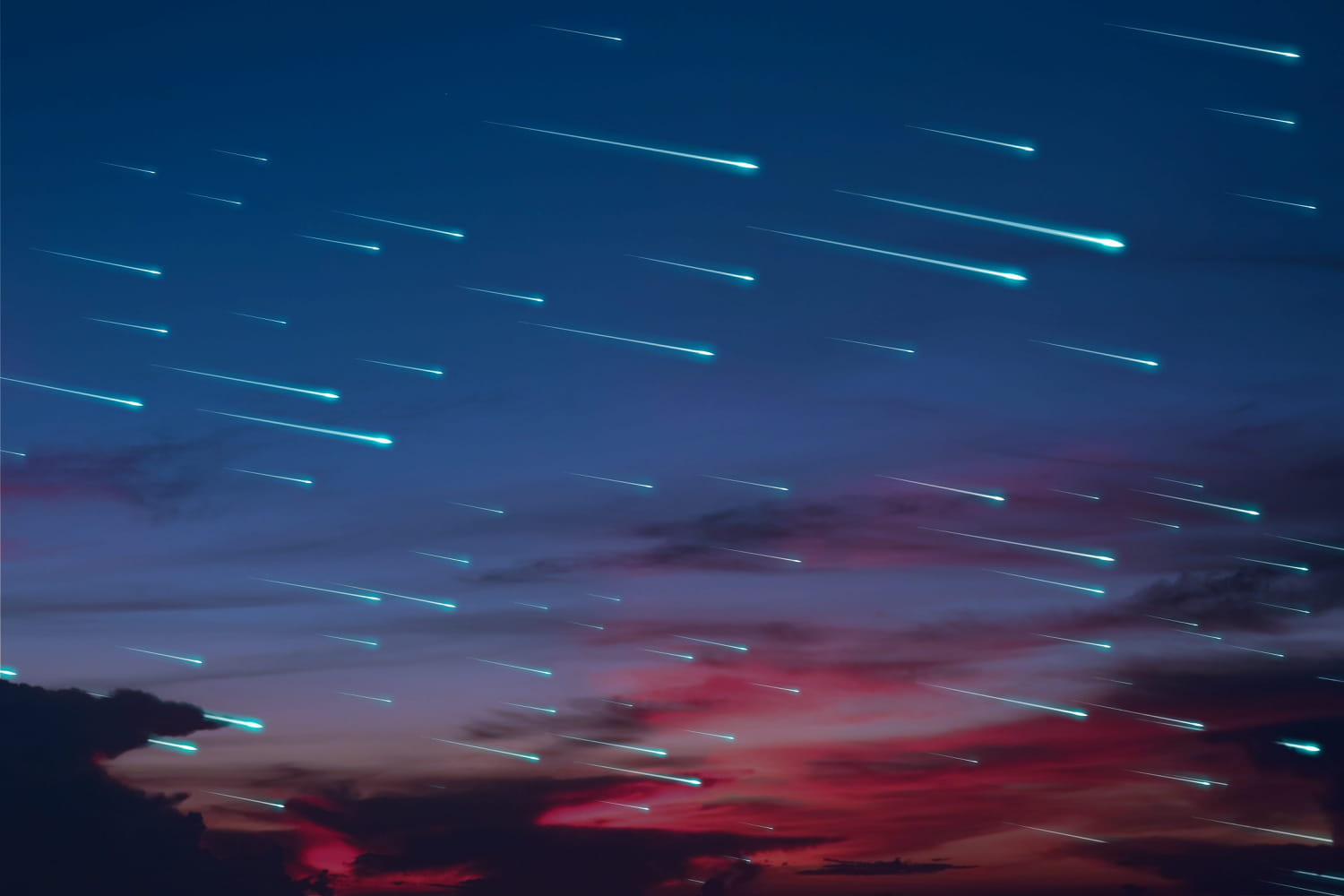
This phenomenon, well known to astronomers, returns every year in spring. It is visible to everyone but we don’t always know it…
Looking up into the sky and seeing a shooting star is always magical. Even if the phenomenon lasts less than a second, it immediately captures attention. Many even associate it with a wish. When these apparitions multiply, they give the sky an impression of majestic movements. After the cloud of 1000 stars and the star shower of the Lyrids, a new celestial spectacle not to be missed is planned during this first week of May and it will be visible in France.
A shooting star is actually not really a “star” but a small piece of rock or dust, often no bigger than a grain of sand, that travels through space. When it enters the Earth’s atmosphere at very high speed – sometimes more than 50,000 km/h – it heats up suddenly due to friction with the air. It burns and produces a very brief luminous trail in the sky, hence the term “shooting” star.
Every spring, a shower of shooting stars well known to astronomers returns on a fixed date: these are the Eta Aquarids. This debris has a very specific origin. They come from Halley’s famous comet, which leaves behind a veritable cloud of particles in its orbit. This comet only approaches Earth every 76 years – the last time was in 1986, and the next time is expected in 2061 – but its wake remains present. Every year, at the same time, the Earth passes through this dust-laden zone, creating a shower of shooting stars. In France, the peak of activity of the Eta Aquarides is expected on the night of May 5 to 6.
It is just before dawn that visibility will be maximum. In good conditions, up to 30 shooting stars per hour can cross the sky, although this figure is often a little more modest in our latitudes. To benefit from it, you should aim for the darkest hours, between 3 a.m. and around 6:15 a.m., and move away from artificial lights. No equipment is necessary, but patience makes all the difference: you have to let your eyes get used to the darkness for around twenty minutes.
One downside, however: the peak of the Eta Aquarids this year falls very close to a phase where the Moon is still very bright. Concretely, at the beginning of May 2026, the Moon is gibbous (almost full). She goes to bed late at night, even early in the morning. It brightly illuminates the sky at the very time when the shooting stars are most visible, just before dawn. This strong lunar luminosity acts as “parasitic lighting”. Only the brightest streaks will remain clearly visible to those who take the time to look up.