Climate change is now forcing us to rise in temperatures irreversibly. Heat waves are no longer an exceptional phenomenon confined to the summer months, but they now permanently affect May, June and September, when millions of students are still in class – during the hottest hours of the day – and lessons, tests, assessments and exams take place. This new structural condition affects the learning levels and well-being of those who study and work in schools. The vast majority of school buildings lack adequate refrigeration systems. And the Italian school system will have to deal with this.
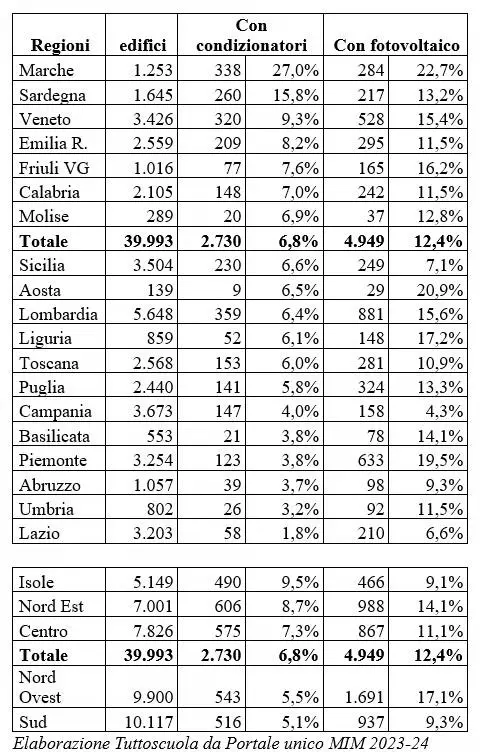
The alarm was raised by Tuttoscuola, which analyzed the latest data available from the School Building Registry of the Ministry of Education and Merit. The analysis – referring to the latest available data relating to the school year 2023-24 – highlights that, out of almost 40 thousand state school buildings, only 2,730 are equipped with air conditioning systems, equal to just 6.8% of the total, i.e. one building in every fifteen. Considering that there are around 368 thousand school classrooms, and even assuming that all buildings equipped with air conditioning have all air-conditioned classrooms, there would still be around 350 thousand classrooms without air conditioners. Without considering corridors, services, gyms and canteens.
In those classrooms without air conditioning systems approximately 6 and a half million students study and almost 700 thousand teachers take turns.
«The heat emergency is no longer just about comfort» observes Tuttoscuola «but directly affects the health of students and staff, the quality of learning and the continuity of the school service. Italian school buildings, with an average age of over 50 years, were not designed to deal with the climate that characterizes our country today.”
The survey also highlights strong territorial differences. The Marche is the region with the greatest diffusion of air-conditioned school buildings (27%), followed by Sardinia (15.8%), Veneto (9.3%), Emilia-Romagna (8.2%) and Friuli Venezia Giulia (7.6%). In absolute terms, Lombardy has the highest number of buildings equipped with air conditioners (359), but this is still just 6.4% of the regional school assets.
The analysis also highlights a positive element: 4,949 school buildings, equal to 12.4% of the total, already have photovoltaic systems or solar panels. According to Tuttoscuola, the integration between air conditioning and energy production from renewable sources could represent the most effective solution for containing system management costs.
For Tuttoscuola it is no longer sufficient to face the emergency of “furnace” schools every summer with temporary measures. Instead, we need to launch a multi-year national climate adaptation plan for school buildings, which includes air conditioning of buildings, energy efficiency, installation of photovoltaic systems and structural interventions to guarantee adequate environmental conditions throughout the school year.
«Extreme heat» concludes Tuttoscuola «is destined to become the new normality. Continuing to consider it an episodic emergency would mean leaving millions of students and school workers in buildings that are increasingly less suitable for promoting learning. Adequately air conditioning school buildings would avoid the direct and indirect costs linked to the climate emergency in schools and would make it possible to make the immense spaces of the Italian school building heritage usable for scholastic and extracurricular activities for 12 months of the year, with a significant impact”.
Here is the data by Region taken from the MIM Portal, processed by Tuttoscuola.