





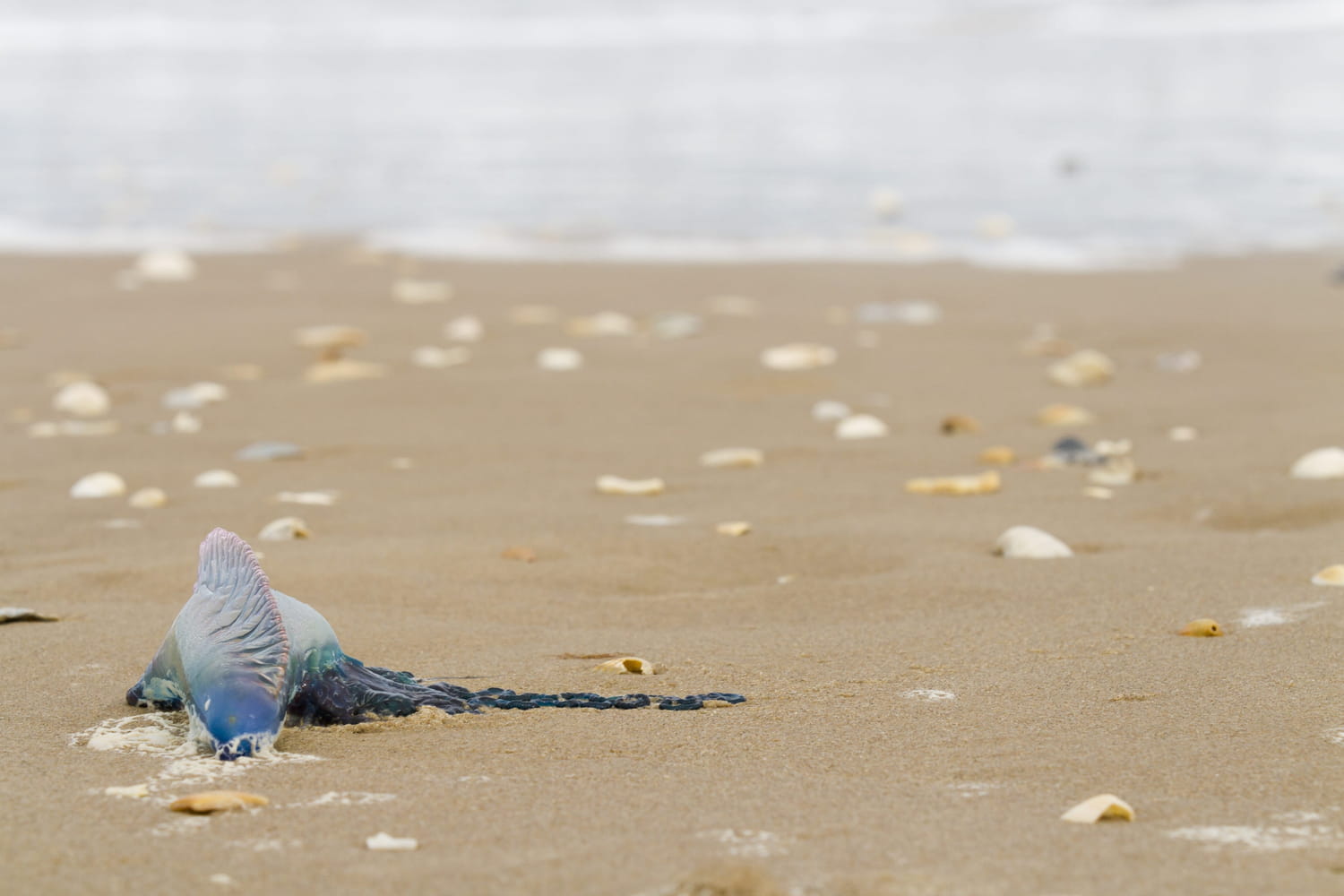
Be careful on Atlantic beaches: the physalia (or sea bladder), a marine animal very close to the jellyfish, sometimes washes up on the coasts of Brittany, Vendée or Landes. It is essential to never touch it.
The physalia (Physalia physalis), also nicknamed “Portuguese galley”, “Spanish galley” or “sea bladder”, is a marine animal that closely resembles a jellyfish. Its extremely stinging filaments can cause serious burns at the slightest contact. It is regularly observed on the French Atlantic coast, particularly in Aquitaine, Vendée, Loire-Atlantique and, more rarely, in Brittany. If you come across them on the beach, do not touch them under any circumstances: even dead or stranded, they remain particularly dangerous. For this summer of 2026, the authorities remain on alert, but the situation is currently different from that of last summer. There is, for the moment, no warning of a massive invasion like the one that paralyzed the Basque-Landes coast in July and August 2025.
The physalia is close to the jellyfish, even if it is not the same marine animal. It presents a characteristic form of air-filled bagmeasuring 15 to 20 cm. She is colored pinkish or bluish and equipped with filaments of great length (they can reach 15 to 40 meters), which are extremely stinging and can break easily and drift with the waves. It floats out of the water and can easily be confused with a plastic bag or a beach ball.
What are the dangers of a snail bite?
Contact with the filaments of a physalia can cause very painful skin lesions with a burning sensation or electric shock, orhives that can last for several hours. Small blisters may form on the skin, which turns purplish, and last for a few weeks. More general symptoms are possible: feeling unwell, loss of consciousnessincreased heart rate and blood pressure, dizziness, abdominal painvomiting… In 10% of cases, these symptoms are serious and require hospitalization.
What to do to relieve a physalia sting?
In the event of contact with a physalia, the Pays de la Loire Regional Health Agency recommends:
- Rinse with sea water without rubbing
- Do not apply heat (heat exaggerates the burn) even if the venom is sometimes thermolabile
- Remove, without crushing them, the visible filaments with pliers or a double glove,
- Apply shaving foam or, failing that, dry sand (especially not wet), scrape with a credit card or rigid cardboard
- Consult a doctor or call SAMU Center 15 when the general symptoms listed above appear
If you notice the presence of these animals on the beach, it is recommended not to swim or practice water sports involving frequent contact with water (such as windsurfing, kite surfing, etc.). It is also recommended not to touch the animal, even if it is stranded or dead. because The stinging cells of jellyfish can remain active for several days.