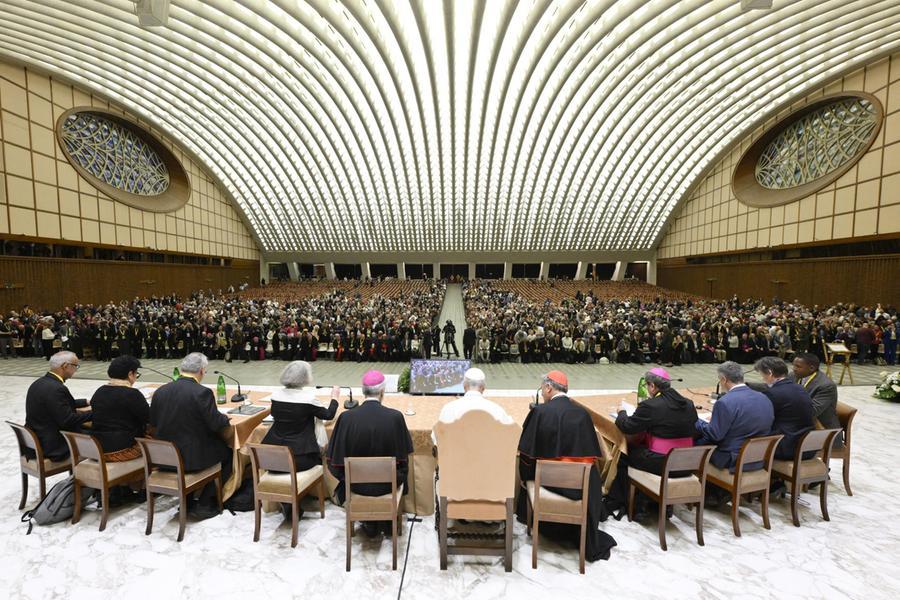






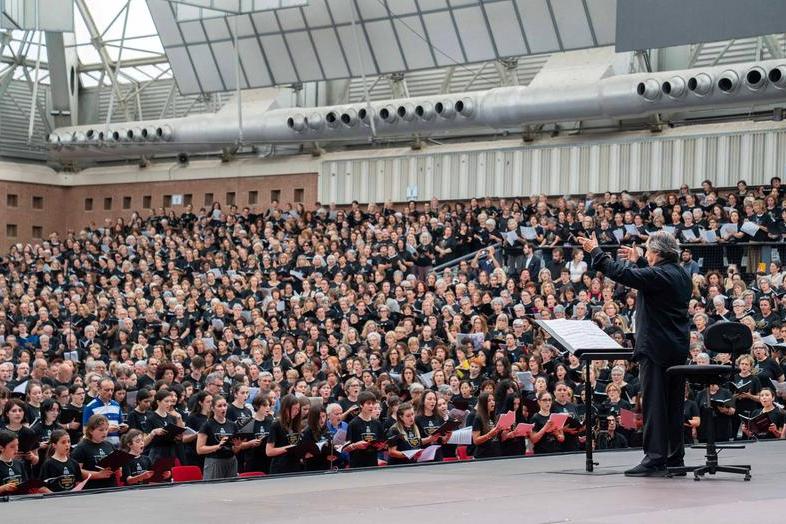
After the extraordinary success of last year, the Ravenna Festival proposes again the event “Cantare amortis est”, which inspired by the words of Santo’Agostino (“singing belongs to those who love”) involves 3,500 choristers arriving from all over Italy in a “journey into chorality” led by Riccardo Muti. The project, curated by Anna Leonardi, brings together professional and amateur choristers, expert and beginner singers, of all ages and levels, on 1 and 2 June at the Pala de Andrè in Ravenna.
In this dedicated edition of the Ravenna Festival dedicated to Saint Francis, on the eighth centenary of his death, the theme of Cantare amortis est will be that of common prayer, understood in the sense of a spirituality that knows no distinctions of religion or culture: to send to the world, today more than ever, a message of peace through the universal language of music. And for the occasion, the event at the beginning of June has a special dedication.
“After choosing to focus the new program of Cantare amoris est on some pages of sacred themes”, explains Maestro Muti, “it seemed natural and right to me to pay homage, through them, to Don Giovanni Minzoni, central figure and martyr in the history of our country”.
“A priest”, explains Muti, “who was an extraordinary man of faith and at the same time a free, modern, revolutionary spirit for his times; for his commitment to young people, workers, the poor, capable of looking ahead and carrying out fundamental works”. Muti also underlines: “since my arrival in Ravenna I have always heard about him, the time has come to pay him a tribute”.
Don Minzoni, born in Ravenna in 1885, became chaplain in Argenta, a land of socialists and landowners, the scene of serious unrest and conflicts between trade unions and workers. It is there that, after earning a silver medal for military valor as a chaplain in the Great War, he strengthens the parish organization in support of the weakest: young people, women, labourers. And it was there that the fascist squadristi struck him to death in August 1923. He said he had always responded to their violence “with a weapon that for us is sacred and divine, that of the first Christians: prayer and goodness”.
At the center of this sort of “masterclass” led by Riccardo Muti, free and gratuitous, there will be four famous choral pages. THE’ Hail Verum Corpus by Wolfgang Amadeus Mozart is a celestial motet written by the Salzburg genius in the summer of 1791. It is a piece much loved by Muti. We remember him in July 2022, in front of the Sanctuary of Our Lady of Lourdes, when he had a choir made up of children from the schools of Lourdes and Tarbes sing it on the occasion of the Le Vie dell’Amicizia event. At a certain point, during the rehearsals, the teacher, an eighty-year-old in great shape, climbed onto a chair to make himself seen better by the children and to encourage them in a joking tone (“this is a prayer, it’s not Hail Caesar!)”.
Prayer to the Moon “Casta Diva”from Vincenzo Bellini’s Norma, is the most famous piece by the Catanian composer and engages the choir in a melody that forms the backdrop to the soprano’s vocalizations. Also scheduled is an excerpt from Requiem Mass by Giuseppe Verdi (composition conducted and recorded by Muti several times, with large orchestras, choirs and prestigious soloists) and the Prologue from Mephistopheles by Arrigo Boito. These choral pages will be explored in depth during two intense days of study and rehearsals, Monday 1 June (from 3pm to 8pm) and Tuesday 2 June (from 10.30am to 1pm and from 3.30pm to 6.30pm).
A unique experience in which music becomes an instrument of cohesion and peace, because as Muti himself never tires of underlining, “singing and making music together is the most vivid example of a society that through harmony and beauty tends towards the common good”.